

352
P.I. Lechler
probably becomes strongly associated with organic matter as well). This
transformation appears to be restricted, as would be expected, to areas where
the sulfur content of soils or sediments is enriched (requiring, it appears, a
minimum of 0.05 to 0.1% by weight of labile total sulfur).
These systematics are predictable and substantiated with Eh-pH diagrams
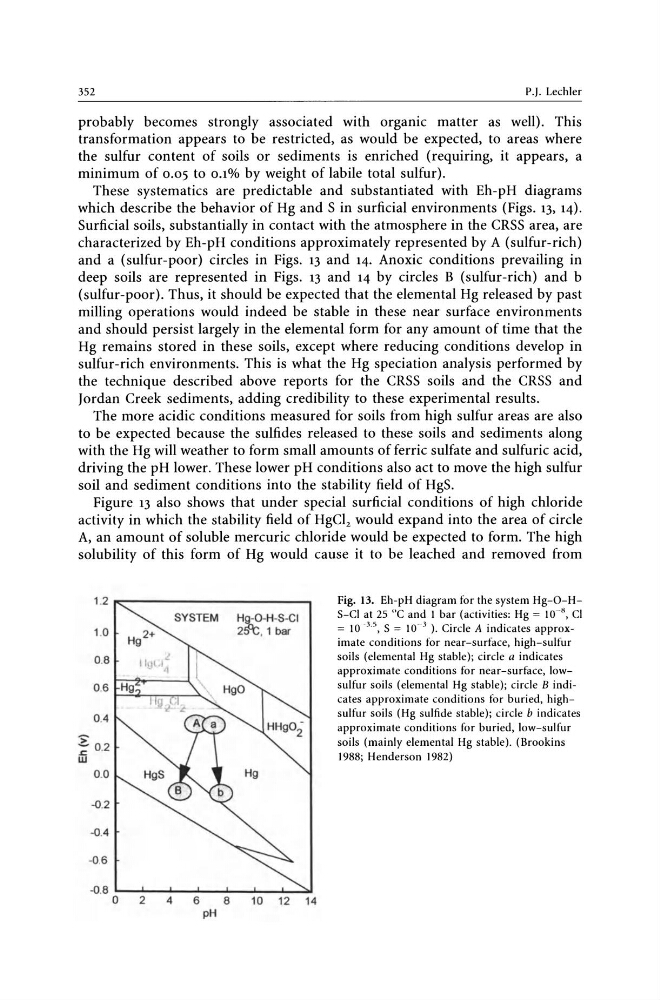
which describe the behavior of Hg and S in surficial environments (Figs. 13, 14).
Surficial soils, substantially in contact with the atmosphere in the CRSS area, are
characterized by Eh-pH conditions approximately represented by A (sulfur-rich)
and a (sulfur-poor) circles in Figs. 13 and 14. Anoxic conditions prevailing in
deep soils are represented in Figs. 13 and 14 by circles B (sulfur-rich) and b
(sulfur-poor). Thus, it should be expected that the elemental Hg released by past
milling operations would indeed be stable in these near surface environments
and should persist largely in the elemental form for any amount of time that the
Hg remains stored in these soils, except where reducing conditions develop in
sulfur-rich environments. This is what the Hg speciation analysis performed by
the technique described above reports for the CRSS soils and the CRSS and
Jordan Creek sediments, adding credibility to these experimental results.
The more acidic conditions measured for soils from high sulfur areas are also
to be expected because the sulfides released to these soils and sediments along
with the Hg will weather to form small amounts of ferric sulfate and sulfuric acid,
driving the pH lower. These lower pH conditions also act to move the high sulfur
soil and sediment conditions into the stability field of HgS.
Figure 13 also shows that under special surficial conditions of high chloride
activity in which the stability field of HgCl2 would expand into the area of circle
A, an amount of soluble mercuric chloride would be expected to form. The high
solubility of this form of Hg would cause it to be leached and removed from
1.2 ~-------------,
1.0
0.8
0.4
>- ~ 0.2
w
0.0
-n.2
-0.4
-0.6
-0.8
0
2
Hg-O-H-S-CI
251:: , 1 bar
4
6
8
10
12 14
pH
Fig. 13. Eh-pH diagram for the system Hg-O-HS-CI at 25 .. c and I bar (activities: Hg = 10- ", CI
= 10 3 .5 , S = 10. 3 ). Circle A indicates approximate conditions for near-surface, high-sulfur
soils (elemental Hg stable); circle a indicates
approximate conditions for near-surface, lowsulfur soils (elemental Hg stable); circle B indicates approximate conditions for buried, highsulfur soils (Hg sulfide stable); circle b indicates
approximate conditions for buried, low-sulfur
soils (mainly elemental Hg stable). (Brookins
1988; Henderson 1982)
P.I. Lechler
probably becomes strongly associated with organic matter as well). This
transformation appears to be restricted, as would be expected, to areas where
the sulfur content of soils or sediments is enriched (requiring, it appears, a
minimum of 0.05 to 0.1% by weight of labile total sulfur).
These systematics are predictable and substantiated with Eh-pH diagrams
which describe the behavior of Hg and S in surficial environments (Figs. 13, 14).
Surficial soils, substantially in contact with the atmosphere in the CRSS area, are
characterized by Eh-pH conditions approximately represented by A (sulfur-rich)
and a (sulfur-poor) circles in Figs. 13 and 14. Anoxic conditions prevailing in
deep soils are represented in Figs. 13 and 14 by circles B (sulfur-rich) and b
(sulfur-poor). Thus, it should be expected that the elemental Hg released by past
milling operations would indeed be stable in these near surface environments
and should persist largely in the elemental form for any amount of time that the
Hg remains stored in these soils, except where reducing conditions develop in
sulfur-rich environments. This is what the Hg speciation analysis performed by
the technique described above reports for the CRSS soils and the CRSS and
Jordan Creek sediments, adding credibility to these experimental results.
The more acidic conditions measured for soils from high sulfur areas are also
to be expected because the sulfides released to these soils and sediments along
with the Hg will weather to form small amounts of ferric sulfate and sulfuric acid,
driving the pH lower. These lower pH conditions also act to move the high sulfur
soil and sediment conditions into the stability field of HgS.
Figure 13 also shows that under special surficial conditions of high chloride
activity in which the stability field of HgCl2 would expand into the area of circle
A, an amount of soluble mercuric chloride would be expected to form. The high
solubility of this form of Hg would cause it to be leached and removed from
1.2 ~-------------,
1.0
0.8
0.4
>- ~ 0.2
w
0.0
-n.2
-0.4
-0.6
-0.8
0
2
Hg-O-H-S-CI
251:: , 1 bar
4
6
8
10
12 14
pH
Fig. 13. Eh-pH diagram for the system Hg-O-HS-CI at 25 .. c and I bar (activities: Hg = 10- ", CI
= 10 3 .5 , S = 10. 3 ). Circle A indicates approximate conditions for near-surface, high-sulfur
soils (elemental Hg stable); circle a indicates
approximate conditions for near-surface, lowsulfur soils (elemental Hg stable); circle B indicates approximate conditions for buried, highsulfur soils (Hg sulfide stable); circle b indicates
approximate conditions for buried, low-sulfur
soils (mainly elemental Hg stable). (Brookins
1988; Henderson 1982)