

Modern Mercury Contamination from Historic Amalgamation Milling
351
mineralization in the Jordan Creek watershed (Williams 1974). Mineralization in
a tributary which enters Jordan Creek between the Dewey and Delamar Mines
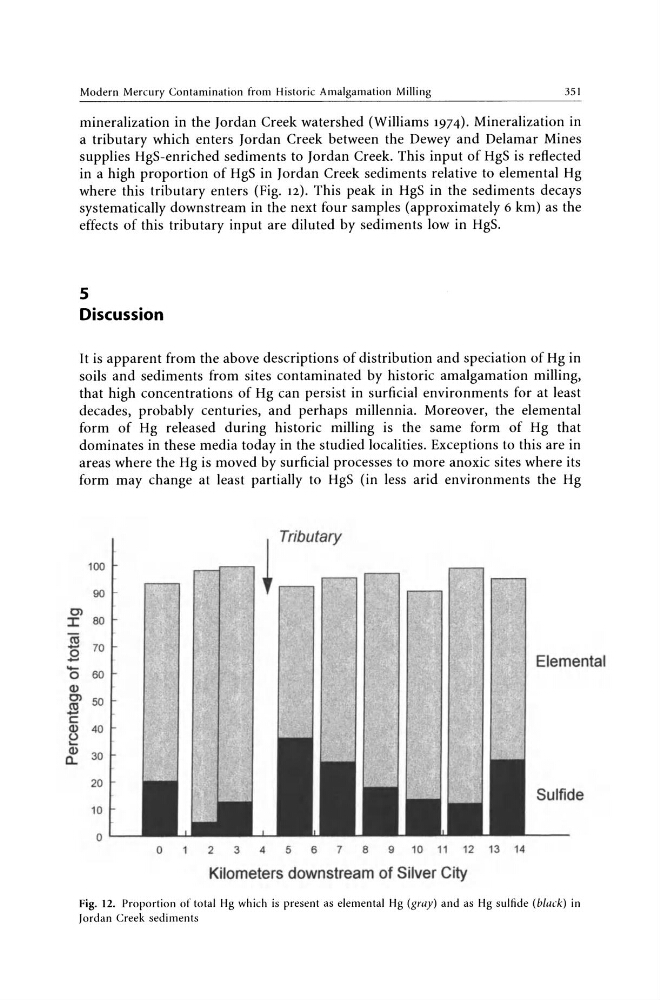
supplies HgS-enriched sediments to Jordan Creek. This input of HgS is reflected
in a high proportion of HgS in Jordan Creek sediments relative to elemental Hg
where this tributary enters (Fig. 12). This peak in HgS in the sediments decays
systematically downstream in the next four samples (approximately 6 km) as the
effects of this tributary input are diluted by sediments low in HgS.
5
Discussion
It is apparent from the above descriptions of distribution and speciation of Hg in
soils and sediments from sites contaminated by historic amalgamation milling,
that high concentrations of Hg can persist in surficial environments for at least
decades, probably centuries, and perhaps millennia. Moreover, the elemental
form of Hg released during historic milling is the same form of Hg that
dominates in these media today in the studied localities. Exceptions to this are in
areas where the Hg is moved by surficial processes to more anoxic sites where its
form may change at least partially to HgS (in less arid environments the Hg
100
~ Tributary
90
Cl
::I: 80
ro
(5 70
.....
- 60
0
Elemental
Q)
0> 50
m
+-'
c
Q)
40
U
~
Q)
30
a..
20
10
0
o
2
3
4
5
6
7
8
9
10 11 12 13 14
Kilometers downstream of Silver City
Fig. 12. Proportion of total Hg which is present as elemental Hg (gray) and as Hg sulfide (black) in
Jordan Creek sediments
351
mineralization in the Jordan Creek watershed (Williams 1974). Mineralization in
a tributary which enters Jordan Creek between the Dewey and Delamar Mines
supplies HgS-enriched sediments to Jordan Creek. This input of HgS is reflected
in a high proportion of HgS in Jordan Creek sediments relative to elemental Hg
where this tributary enters (Fig. 12). This peak in HgS in the sediments decays
systematically downstream in the next four samples (approximately 6 km) as the
effects of this tributary input are diluted by sediments low in HgS.
5
Discussion
It is apparent from the above descriptions of distribution and speciation of Hg in
soils and sediments from sites contaminated by historic amalgamation milling,
that high concentrations of Hg can persist in surficial environments for at least
decades, probably centuries, and perhaps millennia. Moreover, the elemental
form of Hg released during historic milling is the same form of Hg that
dominates in these media today in the studied localities. Exceptions to this are in
areas where the Hg is moved by surficial processes to more anoxic sites where its
form may change at least partially to HgS (in less arid environments the Hg
100
~ Tributary
90
Cl
::I: 80
ro
(5 70
.....
- 60
0
Elemental
Q)
0> 50
m
+-'
c
Q)
40
U
~
Q)
30
a..
20
10
0
o
2
3
4
5
6
7
8
9
10 11 12 13 14
Kilometers downstream of Silver City
Fig. 12. Proportion of total Hg which is present as elemental Hg (gray) and as Hg sulfide (black) in
Jordan Creek sediments