

Modern Mercury Contamination from Historic Amalgamation Milling
347
not determined at this site, but this pattern is compatible with the bulk of the
remaining Hg being present as HgS as it was at the other high-sulfur, SMF site,
and as is common in other mining-contaminated areas like this (P.J. Lechler,
unpub!. data).
3.2.2
Low-Sulfur Area
In the Jumbo Grade area (area 2), total Hg and total sulfur are both much lower
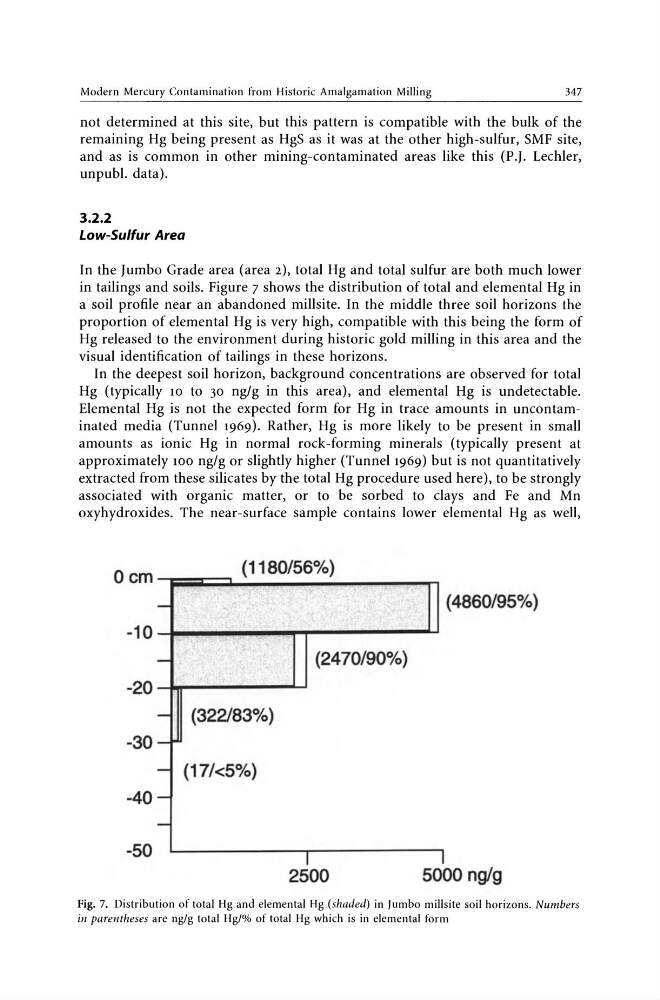
in tailings and soils. Figure 7 shows the distribution of total and elemental Hg in
a soil profile near an abandoned millsite. In the middle three soil horizons the
proportion of elemental Hg is very high, compatible with this being the form of
Hg released to the environment during historic gold milling in this area and the
visual identification of tailings in these horizons.
In the deepest soil horizon, background concentrations are observed for total
Hg (typically 10 to 30 ng/g in this area), and elemental Hg is undetectable.
Elemental Hg is not the expected form for Hg in trace amounts in uncontaminated media (Tunnel 1969). Rather, Hg is more likely to be present in small
amounts as ionic Hg in normal rock-forming minerals (typically present at
approximately 100 ng/g or slightly higher (Tunnel 1969} but is not quantitatively
extracted from these silicates by the total Hg procedure used here), to be strongly
associated with organic matter, or to be sorbed to clays and Fe and Mn
oxyhydroxides. The near-surface sample contains lower elemental Hg as well,
Oem
(1180/56%)
;,
,"
'T'
-
(4860/95%)
-10
-.
.,'
-'~
-
(2470/90%)
-20
,
- (322183%)
-30 -
- (171<5%)
-40 -
-
-50
I
I
2500
5000 ng/g
Fig. 7. Distribution of total Hg and elemental Hg (shaded) in Jumbo millsite soil horizons. Numbers
ill paren theses are ng/g total Hg/% of total Hg which is in elemental form
347
not determined at this site, but this pattern is compatible with the bulk of the
remaining Hg being present as HgS as it was at the other high-sulfur, SMF site,
and as is common in other mining-contaminated areas like this (P.J. Lechler,
unpub!. data).
3.2.2
Low-Sulfur Area
In the Jumbo Grade area (area 2), total Hg and total sulfur are both much lower
in tailings and soils. Figure 7 shows the distribution of total and elemental Hg in
a soil profile near an abandoned millsite. In the middle three soil horizons the
proportion of elemental Hg is very high, compatible with this being the form of
Hg released to the environment during historic gold milling in this area and the
visual identification of tailings in these horizons.
In the deepest soil horizon, background concentrations are observed for total
Hg (typically 10 to 30 ng/g in this area), and elemental Hg is undetectable.
Elemental Hg is not the expected form for Hg in trace amounts in uncontaminated media (Tunnel 1969). Rather, Hg is more likely to be present in small
amounts as ionic Hg in normal rock-forming minerals (typically present at
approximately 100 ng/g or slightly higher (Tunnel 1969} but is not quantitatively
extracted from these silicates by the total Hg procedure used here), to be strongly
associated with organic matter, or to be sorbed to clays and Fe and Mn
oxyhydroxides. The near-surface sample contains lower elemental Hg as well,
Oem
(1180/56%)
;,
,"
'T'
-
(4860/95%)
-10
-.
.,'
-'~
-
(2470/90%)
-20
,
- (322183%)
-30 -
- (171<5%)
-40 -
-
-50
I
I
2500
5000 ng/g
Fig. 7. Distribution of total Hg and elemental Hg (shaded) in Jumbo millsite soil horizons. Numbers
ill paren theses are ng/g total Hg/% of total Hg which is in elemental form