

346
P.). Lechler
significantly lower total Hg (approximately 0.02 to S ~lg/g) and total sulfur (0 . 02
to 0.03%) levels.
Results of Hg speciation analysis of soil profile samples from one site in area 1,
referred to here as Six Mile Fan, are depicted in Fig. SA-D. Figure SA shows that
the horizon containing relatively pure mill tailings from 28 to 42 cm deep has
both the highest total Hg and the highest percentage of elemental Hg in the
profile. This is compatible with elemental Hg being the form released to the
environment during the historic Comstock mining period. Both total and
elemental Hg decrease in the lower two samples as the proportion of sulfide Hg
increases (Fig. SA,D). In this environment this trend is interpreted as reflecting
the transformation and fixation of Hg as HgS in the lower, more reducing soil
horizons. This interpretation is further supported by additional observations
from area 2, a low sulfur environment, where such high sulfide Hg proportions in
deep soil horizons are not observed (discussed below). Exchangeable Hg is
similar in distribution to organic Hg in that it is a small proportion in all
horizons but is highest in the shallowest samples (Fig. SB,C).
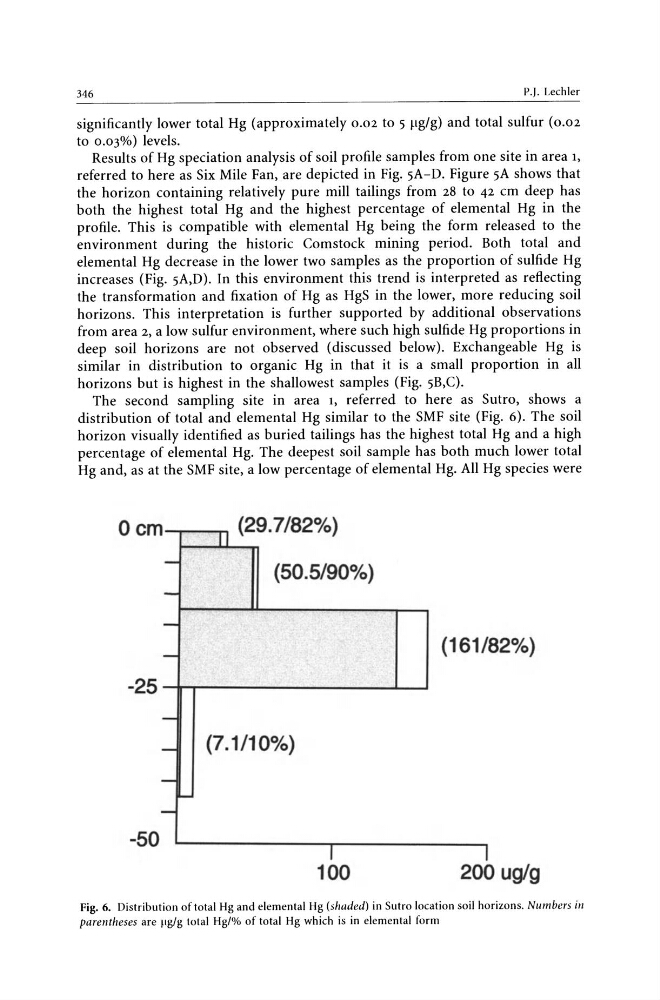
The second sampling site in area 1, referred to here as Sutro, shows a
distribution of total and elemental Hg similar to the SMF site (Fig. 6). The soil
horizon visually identified as buried tailings has the highest total Hg and a high
percentage of elemental Hg. The deepest soil sample has both much lower total
Hg and, as at the SMF site, a low percentage of elemental Hg. All Hg species were
II
.
°
(29 7/82O/C )
Oem
-
(50.5/90%)
-
-
-
(1611 820/0)
-25
-
-
(7.1/100/0)
- ....
-
-50
I
I
100
200 ug/g
Fig. 6. Distribution of total Hg and elemental Hg (shaded) in Sutro location soil horizons. Numbers in
parentheses are pg/g total Hg/O/O of total Hg which is in elemental form
P.). Lechler
significantly lower total Hg (approximately 0.02 to S ~lg/g) and total sulfur (0 . 02
to 0.03%) levels.
Results of Hg speciation analysis of soil profile samples from one site in area 1,
referred to here as Six Mile Fan, are depicted in Fig. SA-D. Figure SA shows that
the horizon containing relatively pure mill tailings from 28 to 42 cm deep has
both the highest total Hg and the highest percentage of elemental Hg in the
profile. This is compatible with elemental Hg being the form released to the
environment during the historic Comstock mining period. Both total and
elemental Hg decrease in the lower two samples as the proportion of sulfide Hg
increases (Fig. SA,D). In this environment this trend is interpreted as reflecting
the transformation and fixation of Hg as HgS in the lower, more reducing soil
horizons. This interpretation is further supported by additional observations
from area 2, a low sulfur environment, where such high sulfide Hg proportions in
deep soil horizons are not observed (discussed below). Exchangeable Hg is
similar in distribution to organic Hg in that it is a small proportion in all
horizons but is highest in the shallowest samples (Fig. SB,C).
The second sampling site in area 1, referred to here as Sutro, shows a
distribution of total and elemental Hg similar to the SMF site (Fig. 6). The soil
horizon visually identified as buried tailings has the highest total Hg and a high
percentage of elemental Hg. The deepest soil sample has both much lower total
Hg and, as at the SMF site, a low percentage of elemental Hg. All Hg species were
II
.
°
(29 7/82O/C )
Oem
-
(50.5/90%)
-
-
-
(1611 820/0)
-25
-
-
(7.1/100/0)
- ....
-
-50
I
I
100
200 ug/g
Fig. 6. Distribution of total Hg and elemental Hg (shaded) in Sutro location soil horizons. Numbers in
parentheses are pg/g total Hg/O/O of total Hg which is in elemental form