

Modern Mercury Contamination from Historic Amalgamation Milling
343
Sample Numben
Sample Numben
UlC-2
2 3 6
9
16 UlC-2
2 3 6
9
16
IS A
C
,40
1 10
J
~
,
r
o
j S
Total
~
OrgaDic
It.
0
0
SO
100
SO
100
kin doWlllttcam from US39S
kin doWlllttcam from US39S
2 3
Sample Numbers
6
9
16 UlC-2
Sample Numben
2 3 6
9
16 UlC-2
,1
'40 0
Elemental
J
J
~
~
'SO
r
It.
0
SO
SO
100
kin doWIIIttcam from US39S
kin downsRam from US39S
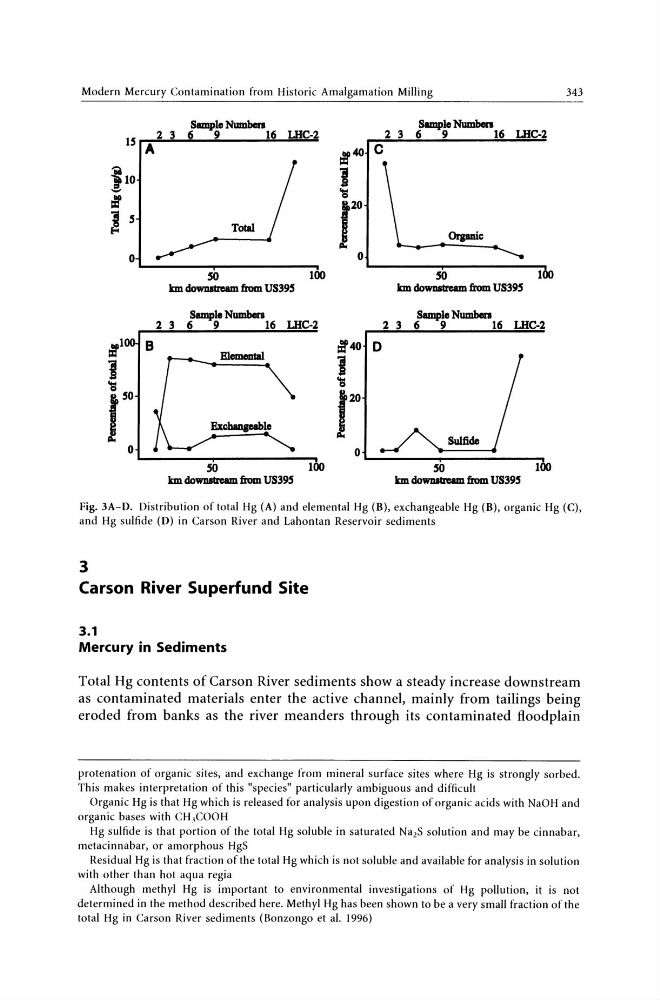
Fig.3A-D. Distribution of total Hg (A) and elemental Hg (B), exchangeable Hg (B), organic Hg (C),
and Hg sulfide (D) in Carson River and Lahontan Reservoir sediments
3
Carson River Superfund Site
3_'
Mercury in Sediments
Total Hg contents of Carson River sediments show a steady increase downstream
as contaminated materials enter the active channel, mainly from tailings being
eroded from banks as the river meanders through its contaminated floodplain
protenation of organic sites, and exchange from mineral surface sites where Ilg is strongly sorbed.
This makes interpretation of this "species" particularly ambiguous and difficult
Organic Hg is that Hg which is released for analysis upon digestion of organic acids with NaOH and
organic bases with CH,COOH
Hg sulfide is that portion of the total Hg soluble in saturated Na2S solution and may be cinnabar,
meta cinnabar, or amorphous HgS
Residual Hg is that fraction of the total Hg which is not soluble and available for analysis in solution
with other than hot aqua regia
Although methyl Hg is important to environmental investigations of Hg pollution, it is not
determined in the method described here. Methyl Hg has been shown to be a very small fraction of the
total Hg in Carson River sediments (Bonzongo et al. 1996)
343
Sample Numben
Sample Numben
UlC-2
2 3 6
9
16 UlC-2
2 3 6
9
16
IS A
C
,40
1 10
J
~
,
r
o
j S
Total
~
OrgaDic
It.
0
0
SO
100
SO
100
kin doWlllttcam from US39S
kin doWlllttcam from US39S
2 3
Sample Numbers
6
9
16 UlC-2
Sample Numben
2 3 6
9
16 UlC-2
,1
'40 0
Elemental
J
J
~
~
'SO
r
It.
0
SO
SO
100
kin doWIIIttcam from US39S
kin downsRam from US39S
Fig.3A-D. Distribution of total Hg (A) and elemental Hg (B), exchangeable Hg (B), organic Hg (C),
and Hg sulfide (D) in Carson River and Lahontan Reservoir sediments
3
Carson River Superfund Site
3_'
Mercury in Sediments
Total Hg contents of Carson River sediments show a steady increase downstream
as contaminated materials enter the active channel, mainly from tailings being
eroded from banks as the river meanders through its contaminated floodplain
protenation of organic sites, and exchange from mineral surface sites where Ilg is strongly sorbed.
This makes interpretation of this "species" particularly ambiguous and difficult
Organic Hg is that Hg which is released for analysis upon digestion of organic acids with NaOH and
organic bases with CH,COOH
Hg sulfide is that portion of the total Hg soluble in saturated Na2S solution and may be cinnabar,
meta cinnabar, or amorphous HgS
Residual Hg is that fraction of the total Hg which is not soluble and available for analysis in solution
with other than hot aqua regia
Although methyl Hg is important to environmental investigations of Hg pollution, it is not
determined in the method described here. Methyl Hg has been shown to be a very small fraction of the
total Hg in Carson River sediments (Bonzongo et al. 1996)