

342
P.J. Lechler
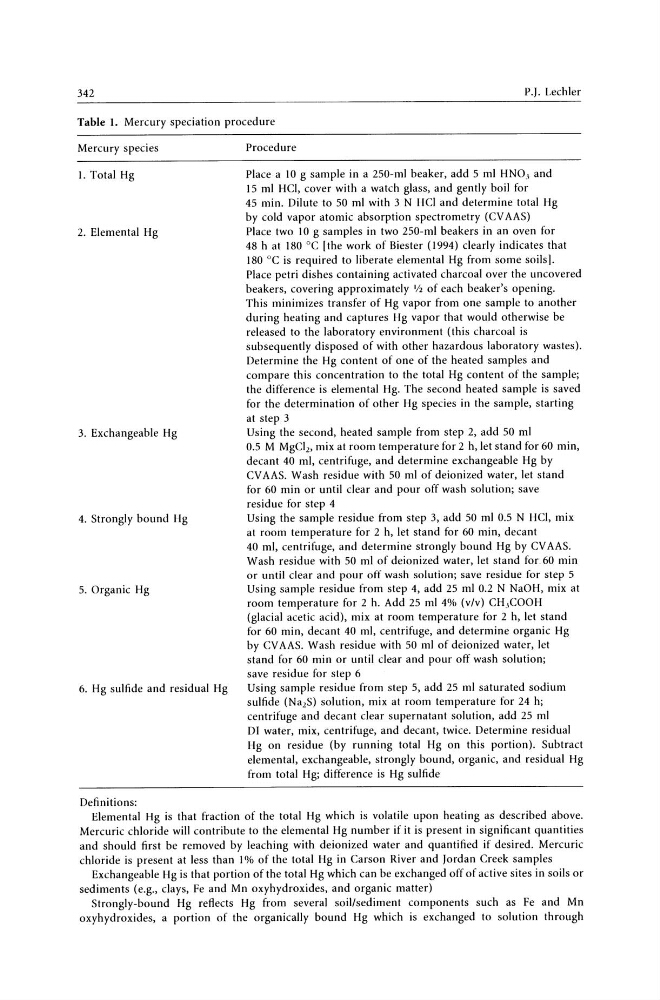
Table 1. Mercury speciation procedure
Mercury species
I. Total Hg
2. Elemental Hg
3. Exchangeable Hg
4. Strongly bound Hg
5. Organic Hg
6. Hg sulfide and residual Hg
Definitions:
Procedure
Place a 10 g sample in a 250-ml beaker, add 5 ml HNOj and
15 ml HCI, cover with a watch glass, and gently boil for
45 min. Dilute to 50 ml with 3 N HCI and determine total Hg
by cold vapor atomic absorption spectrometry (CV AAS)
place two 10 g samples in two 2S0-ml beakers in an oven for
48 h at 180°C [the work of Biester (l994) clearly indicates that
180°C is required to liberate elemental Hg from some soils 1.
Place petri dishes containing activated charcoal over the uncovered
beakers, covering approximately '/2 of each beaker's opening.
This minimizes transfer of Hg vapor from one sample to another
during heating and captures Hg vapor that would otherwise be
released to the laboratory environment (this charcoal is
subsequently disposed of with other hazardous laboratory wastes).
Determine the Hg content of one of the heated samples and
compare this concentration to the total Hg content of the sample;
the difference is elemental Hg. The second heated sample is saved
for the determination of other Hg species in the sample, starting
at step 3
Using the second, heated sample from step 2, add 50 ml
0.5 M MgCI2' mix at room temperature for 2 h, let stand for 60 min,
decant 40 ml, centrifuge, and determine exchangeable Hg by
CVAAS. Wash residue with 50 ml of deionized water, let stand
for 60 min or until clear and pour off wash solution; save
residue for step 4
Using the sample residue from step 3, add 50 ml 0.5 N HCI, mix
at room temperature for 2 h, let stand for 60 min, decant
40 ml, centrifuge, and determine strongly bound Hg by CV AAS.
Wash residue with 50 ml of deionized water, let stand for 60 min
or until clear and pour off wash solution; save residue for step 5
Using sample residue from step 4, add 25 ml 0.2 N NaOH, mix at
room temperature for 2 h. Add 25 ml 4% (v/v) CHjCOOH
(glacial acetic acid), mix at room temperature for 2 h, let stand
for 60 min, decant 40 ml, centrifuge, and determine organic Hg
by CVAAS. Wash residue with 50 ml of deionized water, let
stand for 60 min or until clear and pour off wash solution;
save residue for step 6
Using sample residue from step 5, add 25 ml saturated sodium
sulfide (Na2S) solution, mix at room temperature for 24 h;
centrifuge and decant clear supernatant solution, add 25 ml
DI water, mix, centrifuge, and decant, twice. Determine residual
Hg on residue (by running total Hg on this portion). Subtract
elemental, exchangeable, strongly bound, organic, and residual Hg
from total Hg; difference is Hg sulfide
Elemental Hg is that fraction of the total Hg which is volatile upon heating as described above.
Mercuric chloride will contribute to the elemental Hg number if it is present in significant quantities
and should first be removed by leaching with deionized water and quantified if desired. Mercuric
chloride is present at less than I % of the total Hg in Carson River and Jordan Creek samples
Exchangeable Hg is that portion of the total Hg which can be exchanged off of active sites in soils or
sediments (e.g., clays, Fe and Mn oxyhydroxides, and organic matter)
Strongly-bound Hg reflects Hg from several soil/sediment components such as Fe and Mn
oxyhydroxides, a portion of the organically bound Hg which is exchanged to solution through
P.J. Lechler
Table 1. Mercury speciation procedure
Mercury species
I. Total Hg
2. Elemental Hg
3. Exchangeable Hg
4. Strongly bound Hg
5. Organic Hg
6. Hg sulfide and residual Hg
Definitions:
Procedure
Place a 10 g sample in a 250-ml beaker, add 5 ml HNOj and
15 ml HCI, cover with a watch glass, and gently boil for
45 min. Dilute to 50 ml with 3 N HCI and determine total Hg
by cold vapor atomic absorption spectrometry (CV AAS)
place two 10 g samples in two 2S0-ml beakers in an oven for
48 h at 180°C [the work of Biester (l994) clearly indicates that
180°C is required to liberate elemental Hg from some soils 1.
Place petri dishes containing activated charcoal over the uncovered
beakers, covering approximately '/2 of each beaker's opening.
This minimizes transfer of Hg vapor from one sample to another
during heating and captures Hg vapor that would otherwise be
released to the laboratory environment (this charcoal is
subsequently disposed of with other hazardous laboratory wastes).
Determine the Hg content of one of the heated samples and
compare this concentration to the total Hg content of the sample;
the difference is elemental Hg. The second heated sample is saved
for the determination of other Hg species in the sample, starting
at step 3
Using the second, heated sample from step 2, add 50 ml
0.5 M MgCI2' mix at room temperature for 2 h, let stand for 60 min,
decant 40 ml, centrifuge, and determine exchangeable Hg by
CVAAS. Wash residue with 50 ml of deionized water, let stand
for 60 min or until clear and pour off wash solution; save
residue for step 4
Using the sample residue from step 3, add 50 ml 0.5 N HCI, mix
at room temperature for 2 h, let stand for 60 min, decant
40 ml, centrifuge, and determine strongly bound Hg by CV AAS.
Wash residue with 50 ml of deionized water, let stand for 60 min
or until clear and pour off wash solution; save residue for step 5
Using sample residue from step 4, add 25 ml 0.2 N NaOH, mix at
room temperature for 2 h. Add 25 ml 4% (v/v) CHjCOOH
(glacial acetic acid), mix at room temperature for 2 h, let stand
for 60 min, decant 40 ml, centrifuge, and determine organic Hg
by CVAAS. Wash residue with 50 ml of deionized water, let
stand for 60 min or until clear and pour off wash solution;
save residue for step 6
Using sample residue from step 5, add 25 ml saturated sodium
sulfide (Na2S) solution, mix at room temperature for 24 h;
centrifuge and decant clear supernatant solution, add 25 ml
DI water, mix, centrifuge, and decant, twice. Determine residual
Hg on residue (by running total Hg on this portion). Subtract
elemental, exchangeable, strongly bound, organic, and residual Hg
from total Hg; difference is Hg sulfide
Elemental Hg is that fraction of the total Hg which is volatile upon heating as described above.
Mercuric chloride will contribute to the elemental Hg number if it is present in significant quantities
and should first be removed by leaching with deionized water and quantified if desired. Mercuric
chloride is present at less than I % of the total Hg in Carson River and Jordan Creek samples
Exchangeable Hg is that portion of the total Hg which can be exchanged off of active sites in soils or
sediments (e.g., clays, Fe and Mn oxyhydroxides, and organic matter)
Strongly-bound Hg reflects Hg from several soil/sediment components such as Fe and Mn
oxyhydroxides, a portion of the organically bound Hg which is exchanged to solution through