

344
P.J. Lechler
(Fig. 3A). The proportion of elemental Hg in these samples starts near zero in the
upstream sample at 22 km, and increases to greater than 90% at 29 km where the
influence of mercuriferous mill tailings is manifested (subaerial tailings at
millsites generally contain >95% elemental Hg (P.J. Lechler, unpubl. data».
Thereafter, the proportion of elemental Hg decreases slightly downriver, before
decreasing sharply in the reservoir sample (Fig. 3B). In the Carson River samples
the proportion of exchangeable Hg varies inversely with respect to elemental Hg
and then both species decrease sharply in the sample from Lahontan Reservoir
(Fig. 3B). This relationship is thought to reflect the slow dissolution of elemental
Hg with readsorption of the released Hg onto clays, organic matter, and Fe and Mn
oxyhydroxides which are then deposited in downstream, lower-energy environments (Lechler and Miller 1993). This interpretation is supported by the
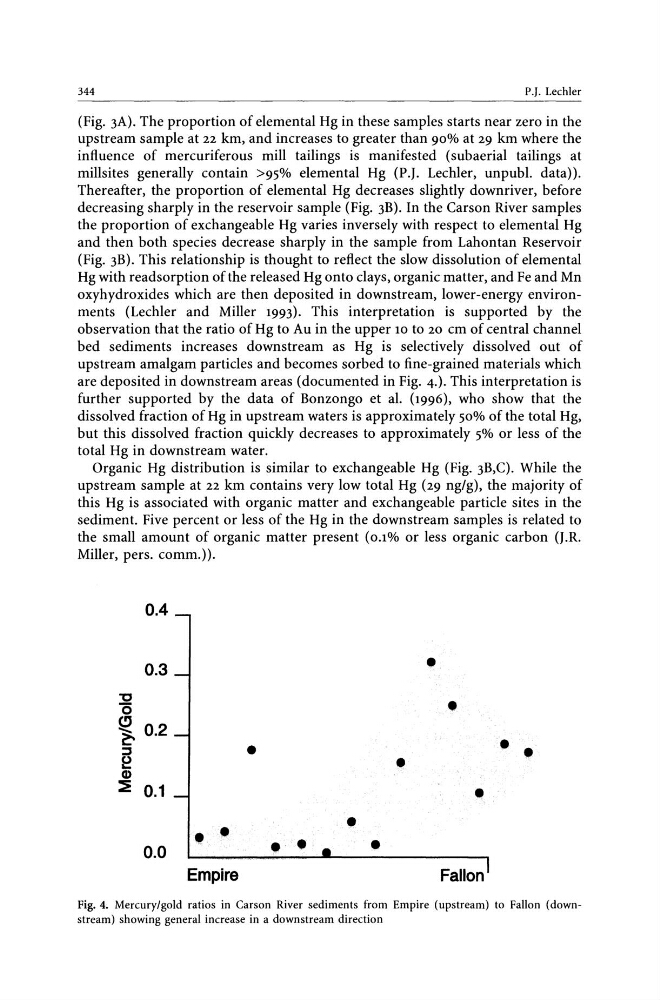
observation that the ratio of Hg to Au in the upper 10 to 20 cm of central channel
bed sediments increases downstream as Hg is selectively dissolved out of
upstream amalgam particles and becomes sorbed to fine-grained materials which
are deposited in downstream areas (documented in Fig. 4.). This interpretation is
further supported by the data of Bonzongo et al. (1996), who show that the
dissolved fraction of Hg in upstream waters is approximately 50% of the total Hg,
but this dissolved fraction quickly decreases to approximately 5% or less of the
total Hg in downstream water.
Organic Hg distribution is similar to exchangeable Hg (Fig. 3B,C). While the
upstream sample at 22 km contains very low total Hg (29 ng/g), the majority of
this Hg is associated with organic matter and exchangeable particle sites in the
sediment. Five percent or less of the Hg in the downstream samples is related to
the small amount of organic matter present (0.1% or less organic carbon (J.R.
Miller, pers. comm.».
'0
15
0.4
0.3
~ 0.2
~
::E 0.1
0.0
••
Empire
•
•
•
•
•
•
Fallon
Fig. 4. Mercury/gold ratios in Carson River sediments from Empire (upstream) to Fallon (downstream) showing general increase in a downstream direction
P.J. Lechler
(Fig. 3A). The proportion of elemental Hg in these samples starts near zero in the
upstream sample at 22 km, and increases to greater than 90% at 29 km where the
influence of mercuriferous mill tailings is manifested (subaerial tailings at
millsites generally contain >95% elemental Hg (P.J. Lechler, unpubl. data».
Thereafter, the proportion of elemental Hg decreases slightly downriver, before
decreasing sharply in the reservoir sample (Fig. 3B). In the Carson River samples
the proportion of exchangeable Hg varies inversely with respect to elemental Hg
and then both species decrease sharply in the sample from Lahontan Reservoir
(Fig. 3B). This relationship is thought to reflect the slow dissolution of elemental
Hg with readsorption of the released Hg onto clays, organic matter, and Fe and Mn
oxyhydroxides which are then deposited in downstream, lower-energy environments (Lechler and Miller 1993). This interpretation is supported by the
observation that the ratio of Hg to Au in the upper 10 to 20 cm of central channel
bed sediments increases downstream as Hg is selectively dissolved out of
upstream amalgam particles and becomes sorbed to fine-grained materials which
are deposited in downstream areas (documented in Fig. 4.). This interpretation is
further supported by the data of Bonzongo et al. (1996), who show that the
dissolved fraction of Hg in upstream waters is approximately 50% of the total Hg,
but this dissolved fraction quickly decreases to approximately 5% or less of the
total Hg in downstream water.
Organic Hg distribution is similar to exchangeable Hg (Fig. 3B,C). While the
upstream sample at 22 km contains very low total Hg (29 ng/g), the majority of
this Hg is associated with organic matter and exchangeable particle sites in the
sediment. Five percent or less of the Hg in the downstream samples is related to
the small amount of organic matter present (0.1% or less organic carbon (J.R.
Miller, pers. comm.».
'0
15
0.4
0.3
~ 0.2
~
::E 0.1
0.0
••
Empire
•
•
•
•
•
•
Fallon
Fig. 4. Mercury/gold ratios in Carson River sediments from Empire (upstream) to Fallon (downstream) showing general increase in a downstream direction