

332
V. Banasova
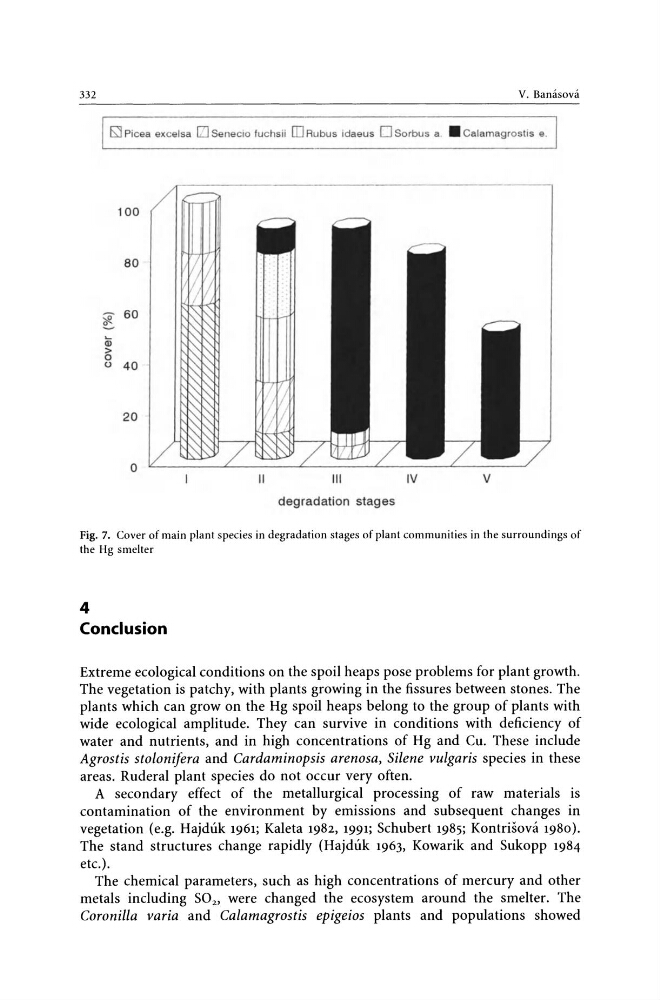
Picea excelsa 0 Senecio fuchsii OJ Rubus idaeus 0 Sorbu s a. • Calamagrostis e.
Fig. 7. Cover of main plant species in degradation stages of plant communities in the surroundings of
the Hg smelter
4
Conclusion
Extreme ecological conditions on the spoil heaps pose problems for plant growth.
The vegetation is patchy, with plants growing in the fissures between stones. The
plants which can grow on the Hg spoil heaps belong to the group of plants with
wide ecological amplitude. They can survive in conditions with deficiency of
water and nutrients, and in high concentrations of Hg and Cu. These include
Agrostis stolonifera and Cardaminopsis arenosa, Silene vulgaris species in these
areas. Ruderal plant species do not occur very often.
A secondary effect of the metallurgical processing of raw materials is
contamination of the environment by emissions and subsequent changes in
vegetation (e.g. Hajduk 1961; Kaleta 1982, 1991; Schubert 1985; Kontrisova 1980).
The stand structures change rapidly (Hajduk 1963, Kowarik and Sukopp 1984
etc.).
The chemical parameters, such as high concentrations of mercury and other
metals including S02' were changed the ecosystem around the smelter. The
Caron ilia varia and Calamagrostis epigeios plants and populations showed
V. Banasova
Picea excelsa 0 Senecio fuchsii OJ Rubus idaeus 0 Sorbu s a. • Calamagrostis e.
Fig. 7. Cover of main plant species in degradation stages of plant communities in the surroundings of
the Hg smelter
4
Conclusion
Extreme ecological conditions on the spoil heaps pose problems for plant growth.
The vegetation is patchy, with plants growing in the fissures between stones. The
plants which can grow on the Hg spoil heaps belong to the group of plants with
wide ecological amplitude. They can survive in conditions with deficiency of
water and nutrients, and in high concentrations of Hg and Cu. These include
Agrostis stolonifera and Cardaminopsis arenosa, Silene vulgaris species in these
areas. Ruderal plant species do not occur very often.
A secondary effect of the metallurgical processing of raw materials is
contamination of the environment by emissions and subsequent changes in
vegetation (e.g. Hajduk 1961; Kaleta 1982, 1991; Schubert 1985; Kontrisova 1980).
The stand structures change rapidly (Hajduk 1963, Kowarik and Sukopp 1984
etc.).
The chemical parameters, such as high concentrations of mercury and other
metals including S02' were changed the ecosystem around the smelter. The
Caron ilia varia and Calamagrostis epigeios plants and populations showed