

Vegetation on Contaminated Sites near an Hg Mine and Smelter
40
",3D -
OJ
·0
OJ
Q.
'"
C
Cd
Ci.20
o f - - - - - - , -
o
50
100
150
333
200
Hg in soil (mg/kg)
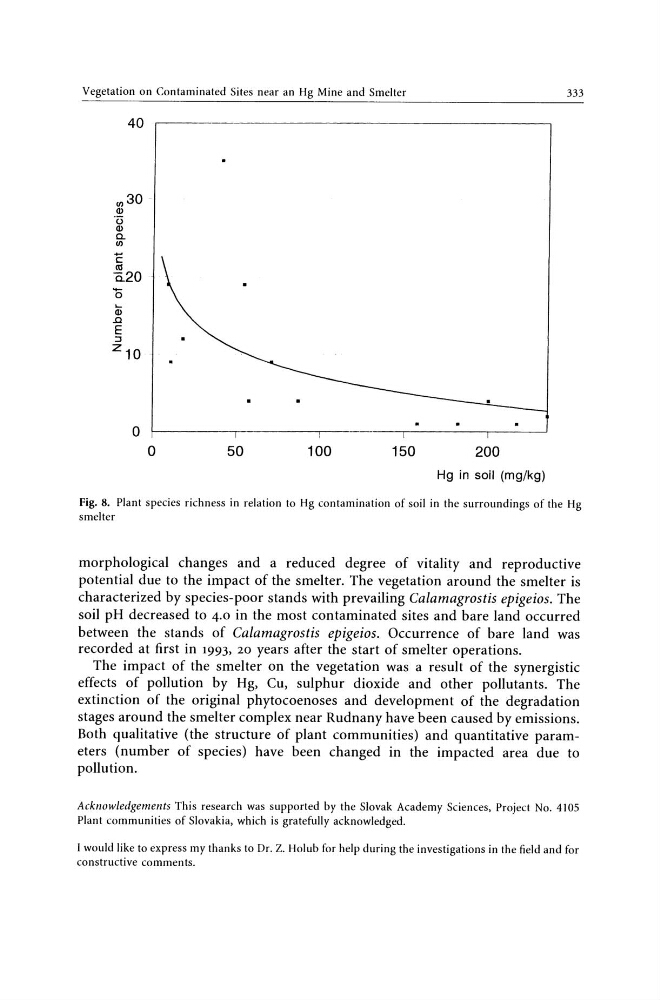
Fig. 8. Plant species richness in relation to Hg contamination of soil in the surroundings of the Hg
smelter
morphological changes and a reduced degree of vitality and reproductive
potential due to the impact of the smelter. The vegetation around the smelter is
characterized by species-poor stands with prevailing Calamagrostis epigeios. The
soil pH decreased to 4.0 in the most contaminated sites and bare land occurred
between the stands of Calamagrostis epigeios. Occurrence of bare land was
recorded at first in 1993, 20 years after the start of smelter operations.
The impact of the smelter on the vegetation was a result of the synergistic
effects of pollution by Hg, Cu, sulphur dioxide and other pollutants. The
extinction of the original phytocoenoses and development of the degradation
stages around the smelter complex near Rudnany have been caused by emissions.
Both qualitative (the structure of plant communities) and quantitative parameters (number of species) have been changed in the impacted area due to
pollution.
Acknowledgements This research was supported by the Slovak Academy Sciences, Project No. 4105
Plant communities of Slovakia, which is gratefully acknowledged.
I would like to express my thanks to Dr. Z. Holub for help during the investigations in the field and for
constructive comments.
40
",3D -
OJ
·0
OJ
Q.
'"
C
Cd
Ci.20
o f - - - - - - , -
o
50
100
150
333
200
Hg in soil (mg/kg)
Fig. 8. Plant species richness in relation to Hg contamination of soil in the surroundings of the Hg
smelter
morphological changes and a reduced degree of vitality and reproductive
potential due to the impact of the smelter. The vegetation around the smelter is
characterized by species-poor stands with prevailing Calamagrostis epigeios. The
soil pH decreased to 4.0 in the most contaminated sites and bare land occurred
between the stands of Calamagrostis epigeios. Occurrence of bare land was
recorded at first in 1993, 20 years after the start of smelter operations.
The impact of the smelter on the vegetation was a result of the synergistic
effects of pollution by Hg, Cu, sulphur dioxide and other pollutants. The
extinction of the original phytocoenoses and development of the degradation
stages around the smelter complex near Rudnany have been caused by emissions.
Both qualitative (the structure of plant communities) and quantitative parameters (number of species) have been changed in the impacted area due to
pollution.
Acknowledgements This research was supported by the Slovak Academy Sciences, Project No. 4105
Plant communities of Slovakia, which is gratefully acknowledged.
I would like to express my thanks to Dr. Z. Holub for help during the investigations in the field and for
constructive comments.