

Mercury in Gas and Oil Deposits
243
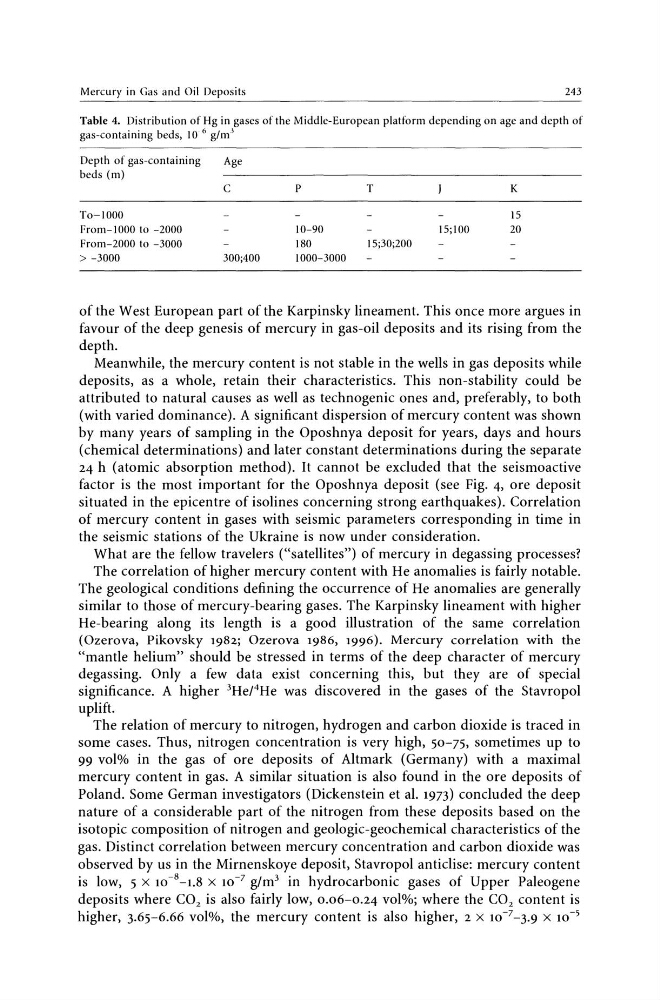
Table 4. Distribution of Hg in gases of the Middle- European platform depending on age and depth of
gas-containing beds, 10- 6 g/m'
Depth of gas-containing
Age
beds (m)
C
p
T
K
To-1000
15
From-1000 to -2000
10-90
15;100
20
From-2000 to -3000
180
15;30;200
> -3000
300;400
1000-3000
of the West European part of the Karpinsky lineament. This once more argues in
favour of the deep genesis of mercury in gas-oil deposits and its rising from the
depth.
Meanwhile, the mercury content is not stable in the wells in gas deposits while
deposits, as a whole, retain their characteristics. This non-stability could be
attributed to natural causes as well as technogenic ones and, preferably, to both
(with varied dominance). A significant dispersion of mercury content was shown
by many years of sampling in the Oposhnya deposit for years, days and hours
(chemical determinations) and later constant determinations during the separate
24 h (atomic absorption method). It cannot be excluded that the seismoactive
factor is the most important for the Oposhnya deposit (see Fig. 4, ore deposit
situated in the epic entre of isolines concerning strong earthquakes). Correlation
of mercury content in gases with seismic parameters corresponding in time in
the seismic stations of the Ukraine is now under consideration.
What are the fellow travelers ("satellites") of mercury in degassing processes?
The correlation of higher mercury content with He anomalies is fairly notable.
The geological conditions defining the occurrence of He anomalies are generally
similar to those of mercury-bearing gases. The Karpinsky lineament with higher
He-bearing along its length is a good illustration of the same correlation
(Ozerova, Pikovsky 1982; Ozerova 1986, 1996). Mercury correlation with the
"mantle helium" should be stressed in terms of the deep character of mercury
degassing. Only a few data exist concerning this, but they are of special
significance. A higher 3He/ 4 He was discovered in the gases of the Stavropol
uplift.
The relation of mercury to nitrogen, hydrogen and carbon dioxide is traced in
some cases. Thus, nitrogen concentration is very high, 50-75, sometimes up to
99 vol% in the gas of ore deposits of Altmark (Germany) with a maximal
mercury content in gas. A similar situation is also found in the ore deposits of
Poland. Some German investigators (Dickenstein et al. 1973) concluded the deep
nature of a considerable part of the nitrogen from these deposits based on the
isotopic composition of nitrogen and geologic-geochemical characteristics of the
gas. Distinct correlation between mercury concentration and carbon dioxide was
observed by us in the Mirnenskoye deposit, Stavropol anticlise: mercury content
is low, 5 X 10- 8 -1.8 X 10- 7 g/m 3 in hydrocarbonic gases of Upper Paleogene
deposits where CO2 is also fairly low, 0.06-0.24 vol%; where the CO2 content is
higher, 3.65-6.66 vol%, the mercury content is also higher, 2 X 10- 7 -3.9 x 10- 5
243
Table 4. Distribution of Hg in gases of the Middle- European platform depending on age and depth of
gas-containing beds, 10- 6 g/m'
Depth of gas-containing
Age
beds (m)
C
p
T
K
To-1000
15
From-1000 to -2000
10-90
15;100
20
From-2000 to -3000
180
15;30;200
> -3000
300;400
1000-3000
of the West European part of the Karpinsky lineament. This once more argues in
favour of the deep genesis of mercury in gas-oil deposits and its rising from the
depth.
Meanwhile, the mercury content is not stable in the wells in gas deposits while
deposits, as a whole, retain their characteristics. This non-stability could be
attributed to natural causes as well as technogenic ones and, preferably, to both
(with varied dominance). A significant dispersion of mercury content was shown
by many years of sampling in the Oposhnya deposit for years, days and hours
(chemical determinations) and later constant determinations during the separate
24 h (atomic absorption method). It cannot be excluded that the seismoactive
factor is the most important for the Oposhnya deposit (see Fig. 4, ore deposit
situated in the epic entre of isolines concerning strong earthquakes). Correlation
of mercury content in gases with seismic parameters corresponding in time in
the seismic stations of the Ukraine is now under consideration.
What are the fellow travelers ("satellites") of mercury in degassing processes?
The correlation of higher mercury content with He anomalies is fairly notable.
The geological conditions defining the occurrence of He anomalies are generally
similar to those of mercury-bearing gases. The Karpinsky lineament with higher
He-bearing along its length is a good illustration of the same correlation
(Ozerova, Pikovsky 1982; Ozerova 1986, 1996). Mercury correlation with the
"mantle helium" should be stressed in terms of the deep character of mercury
degassing. Only a few data exist concerning this, but they are of special
significance. A higher 3He/ 4 He was discovered in the gases of the Stavropol
uplift.
The relation of mercury to nitrogen, hydrogen and carbon dioxide is traced in
some cases. Thus, nitrogen concentration is very high, 50-75, sometimes up to
99 vol% in the gas of ore deposits of Altmark (Germany) with a maximal
mercury content in gas. A similar situation is also found in the ore deposits of
Poland. Some German investigators (Dickenstein et al. 1973) concluded the deep
nature of a considerable part of the nitrogen from these deposits based on the
isotopic composition of nitrogen and geologic-geochemical characteristics of the
gas. Distinct correlation between mercury concentration and carbon dioxide was
observed by us in the Mirnenskoye deposit, Stavropol anticlise: mercury content
is low, 5 X 10- 8 -1.8 X 10- 7 g/m 3 in hydrocarbonic gases of Upper Paleogene
deposits where CO2 is also fairly low, 0.06-0.24 vol%; where the CO2 content is
higher, 3.65-6.66 vol%, the mercury content is also higher, 2 X 10- 7 -3.9 x 10- 5