

242
N.A. Ozerova et al.
Table 3. Distribution of Hg in gases of Mirninskoye deposits (Northern Caucasus)
Age
Pg mkp,
K,
Hg,g/m'
5 X 10" -3 x 10 7
2 x 10 7 -4 x 10 5
Manich dislocations and submeridional ones of the Trans-Caucasian lineament.
Increase in mercury content with depth was revealed by gas sampling in the
boreholes: the mercury content is lower in the Upper Paleogene deposits than in
the Cretaceous ones, which are 2000 m lower (Table 3).
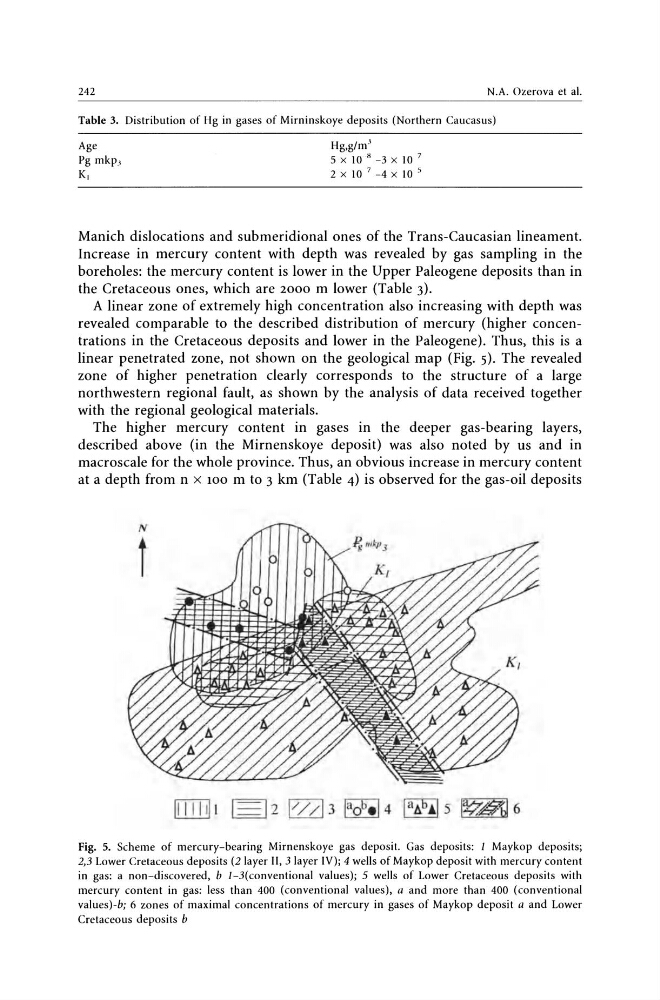
A linear zone of extremely high concentration also increasing with depth was
revealed comparable to the described distribution of mercury (higher concentrations in the Cretaceous deposits and lower in the Paleogene). Thus, this is a
linear penetrated zone, not shown on the geological map (Fig. 5). The revealed
zone of higher penetration clearly corresponds to the structure of a large
northwestern regional fault, as shown by the analysis of data received together
with the regional geological materials.
The higher mercury content in gases in the deeper gas-bearing layers,
described above (in the Mirnenskoye deposit) was also noted by us and in
macroscale for the whole province. Thus, an obvious increase in mercury content
at a depth from n x 100 m to 3 km (Table 4) is observed for the gas-oil deposits
N
t
if: mkp 3
[OJ] I 1 12 1///1 3 laob. 14 laflb.15 WM 6
Fig. 5. Scheme of mercury-bearing Mirnenskoye gas deposit. Gas deposits: 1 Maykop deposits;
2,3 Lower Cretaceous deposits (2 layer II, 3 layer IV); 4 wells of Maykop deposit with mercury content
in gas: a non-discovered, b 1-3(conventional values); 5 wells of Lower Cretaceous deposits with
mercury content in gas: less than 400 (conventional values), a and more than 400 (conventional
values)-b; 6 zones of maximal concentrations of mercury in gases of Maykop deposit a and Lower
Cretaceous deposits b
N.A. Ozerova et al.
Table 3. Distribution of Hg in gases of Mirninskoye deposits (Northern Caucasus)
Age
Pg mkp,
K,
Hg,g/m'
5 X 10" -3 x 10 7
2 x 10 7 -4 x 10 5
Manich dislocations and submeridional ones of the Trans-Caucasian lineament.
Increase in mercury content with depth was revealed by gas sampling in the
boreholes: the mercury content is lower in the Upper Paleogene deposits than in
the Cretaceous ones, which are 2000 m lower (Table 3).
A linear zone of extremely high concentration also increasing with depth was
revealed comparable to the described distribution of mercury (higher concentrations in the Cretaceous deposits and lower in the Paleogene). Thus, this is a
linear penetrated zone, not shown on the geological map (Fig. 5). The revealed
zone of higher penetration clearly corresponds to the structure of a large
northwestern regional fault, as shown by the analysis of data received together
with the regional geological materials.
The higher mercury content in gases in the deeper gas-bearing layers,
described above (in the Mirnenskoye deposit) was also noted by us and in
macroscale for the whole province. Thus, an obvious increase in mercury content
at a depth from n x 100 m to 3 km (Table 4) is observed for the gas-oil deposits
N
t
if: mkp 3
[OJ] I 1 12 1///1 3 laob. 14 laflb.15 WM 6
Fig. 5. Scheme of mercury-bearing Mirnenskoye gas deposit. Gas deposits: 1 Maykop deposits;
2,3 Lower Cretaceous deposits (2 layer II, 3 layer IV); 4 wells of Maykop deposit with mercury content
in gas: a non-discovered, b 1-3(conventional values); 5 wells of Lower Cretaceous deposits with
mercury content in gas: less than 400 (conventional values), a and more than 400 (conventional
values)-b; 6 zones of maximal concentrations of mercury in gases of Maykop deposit a and Lower
Cretaceous deposits b