

Monitoring and Assessment of Mercury Pollution
231
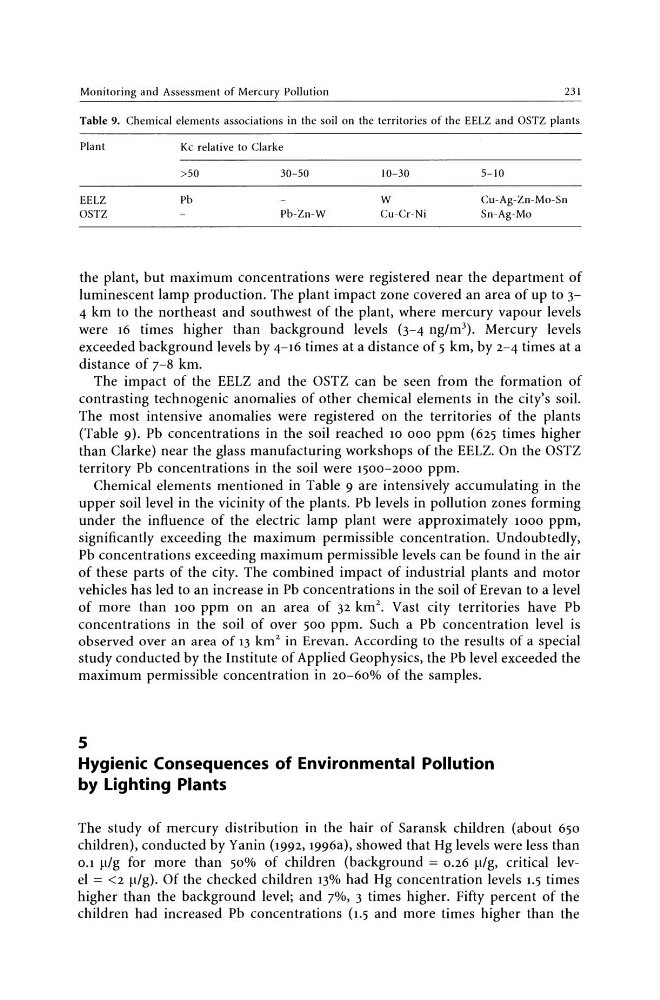
Table 9. Chemical elements associations in the soil on the territories of the EELZ and OSTZ plants
Plant
EELZ
OSTZ
Kc relative to Clarke
>50
30-50
pb
Pb-Zn-W
10-30
W
Cu-Cr-Ni
5-10
Cu-Ag-Zn-Mo-Sn
Sn-Ag-Mo
the plant, but maximum concentrations were registered near the department of
luminescent lamp production. The plant impact zone covered an area of up to 34 km to the northeast and southwest of the plant, where mercury vapour levels
were 16 times higher than background levels (3-4 ng/m3). Mercury levels
exceeded background levels by 4-16 times at a distance of 5 km, by 2-4 times at a
distance of 7-8 km.
The impact of the EELZ and the OSTZ can be seen from the formation of
contrasting technogenic anomalies of other chemical elements in the city's soil.
The most intensive anomalies were registered on the territories of the plants
(Table 9). Pb concentrations in the soil reached 10 000 ppm (625 times higher
than Clarke) near the glass manufacturing workshops of the EELZ. On the OSTZ
territory Pb concentrations in the soil were 1500-2000 ppm.
Chemical elements mentioned in Table 9 are intensively accumulating in the
upper soil level in the vicinity of the plants. Pb levels in pollution zones forming
under the influence of the electric lamp plant were approximately 1000 ppm,
significantly exceeding the maximum permissible concentration. Undoubtedly,
Pb concentrations exceeding maximum permissible levels can be found in the air
of these parts of the city. The combined impact of industrial plants and motor
vehicles has led to an increase in Pb concentrations in the soil of Erevan to a level
of more than 100 ppm on an area of 32 km
2 • Vast city territories have Pb
concentrations in the soil of over 500 ppm. Such a Pb concentration level is
observed over an area of 13 km 2 in Erevan. According to the results of a special
study conducted by the Institute of Applied Geophysics, the Pb level exceeded the
maximum permissible concentration in 20-60% of the samples.
5
Hygienic Consequences of Environmental Pollution
by Lighting Plants
The study of mercury distribution in the hair of Saransk children (about 650
children), conducted by Yanin (1992, 1996a), showed that Hg levels were less than
0.1 ~l/g for more than 50% of children (background = 0.26 ~l/g, critical level = <2 ~l/g). Of the checked children 13% had Hg concentration levels 1.5 times
higher than the background level; and 7%, 3 times higher. Fifty percent of the
children had increased Pb concentrations (1.5 and more times higher than the
231
Table 9. Chemical elements associations in the soil on the territories of the EELZ and OSTZ plants
Plant
EELZ
OSTZ
Kc relative to Clarke
>50
30-50
pb
Pb-Zn-W
10-30
W
Cu-Cr-Ni
5-10
Cu-Ag-Zn-Mo-Sn
Sn-Ag-Mo
the plant, but maximum concentrations were registered near the department of
luminescent lamp production. The plant impact zone covered an area of up to 34 km to the northeast and southwest of the plant, where mercury vapour levels
were 16 times higher than background levels (3-4 ng/m3). Mercury levels
exceeded background levels by 4-16 times at a distance of 5 km, by 2-4 times at a
distance of 7-8 km.
The impact of the EELZ and the OSTZ can be seen from the formation of
contrasting technogenic anomalies of other chemical elements in the city's soil.
The most intensive anomalies were registered on the territories of the plants
(Table 9). Pb concentrations in the soil reached 10 000 ppm (625 times higher
than Clarke) near the glass manufacturing workshops of the EELZ. On the OSTZ
territory Pb concentrations in the soil were 1500-2000 ppm.
Chemical elements mentioned in Table 9 are intensively accumulating in the
upper soil level in the vicinity of the plants. Pb levels in pollution zones forming
under the influence of the electric lamp plant were approximately 1000 ppm,
significantly exceeding the maximum permissible concentration. Undoubtedly,
Pb concentrations exceeding maximum permissible levels can be found in the air
of these parts of the city. The combined impact of industrial plants and motor
vehicles has led to an increase in Pb concentrations in the soil of Erevan to a level
of more than 100 ppm on an area of 32 km
2 • Vast city territories have Pb
concentrations in the soil of over 500 ppm. Such a Pb concentration level is
observed over an area of 13 km 2 in Erevan. According to the results of a special
study conducted by the Institute of Applied Geophysics, the Pb level exceeded the
maximum permissible concentration in 20-60% of the samples.
5
Hygienic Consequences of Environmental Pollution
by Lighting Plants
The study of mercury distribution in the hair of Saransk children (about 650
children), conducted by Yanin (1992, 1996a), showed that Hg levels were less than
0.1 ~l/g for more than 50% of children (background = 0.26 ~l/g, critical level = <2 ~l/g). Of the checked children 13% had Hg concentration levels 1.5 times
higher than the background level; and 7%, 3 times higher. Fifty percent of the
children had increased Pb concentrations (1.5 and more times higher than the