

230
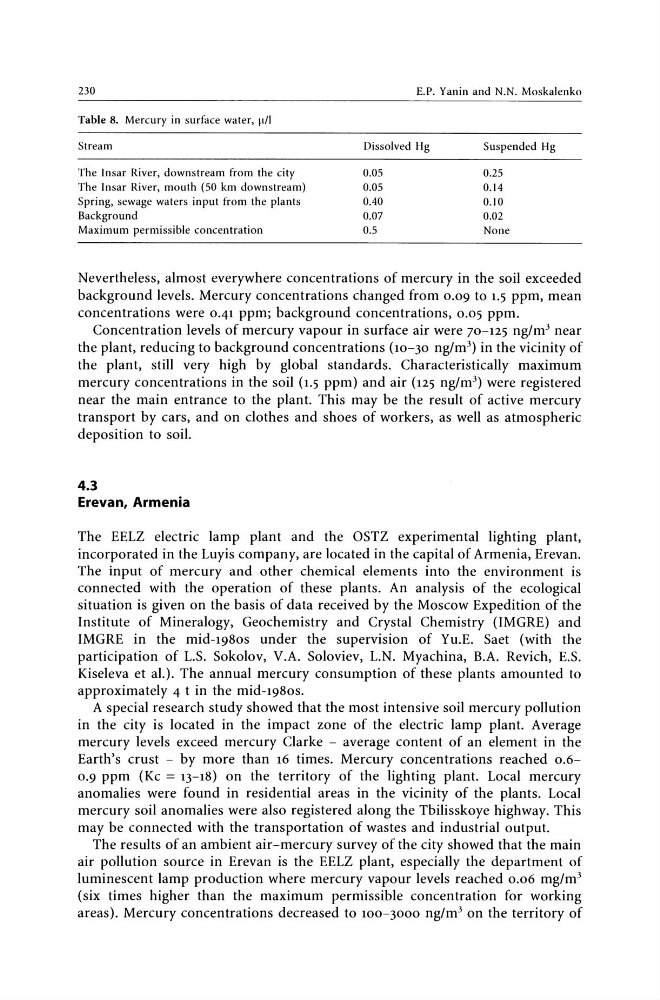
Table 8. Mercury in surface water, fill
Stream
The Insar River, downstream from the city
The Insar River, mouth (50 km downstream)
Spring, sewage waters input from the plants
Background
Maximum permissible concentration
E.P. Yanin and N.N. Moskalenko
Dissolved Hg
Suspended Hg
0.05
0.25
0.05
0.14
0.40
0.10
0.07
0.02
0.5
None
Nevertheless, almost everywhere concentrations of mercury in the soil exceeded
background levels. Mercury concentrations changed from 0.09 to 1.5 ppm, mean
concentrations were 0.41 ppm; background concentrations, 0.05 ppm.
Concentration levels of mercury vapour in surface air were 70-125 ng/m3 near
the plant, reducing to background concentrations (lO-30 ng/m3) in the vicinity of
the plant, still very high by global standards. Characteristically maximum
mercury concentrations in the soil (1.5 ppm) and air (125 ng/m3) were registered
near the main entrance to the plant. This may be the result of active mercury
transport by cars, and on clothes and shoes of workers, as well as atmospheric
deposition to soil.
4.3
Erevan, Armenia
The EELZ electric lamp plant and the OSTZ experimental lighting plant,
incorporated in the Luyis company, are located in the capital of Armenia, Erevan.
The input of mercury and other chemical elements into the environment is
connected with the operation of these plants. An analysis of the ecological
situation is given on the basis of data received by the Moscow Expedition of the
Institute of Mineralogy, Geochemistry and Crystal Chemistry (IMGRE) and
IMGRE in the mid-19Bos under the supervision of Yu.E. Saet (with the
participation of L.S. Sokolov, V.A. Soloviev, L.N. Myachina, B.A. Revich, E.S.
Kiseleva et al.). The annual mercury consumption of these plants amounted to
approximately 4 t in the mid-19Bos.
A special research study showed that the most intensive soil mercury pollution
in the city is located in the impact zone of the electric lamp plant. Average
mercury levels exceed mercury Clarke - average content of an element in the
Earth's crust - by more than 16 times. Mercury concentrations reached 0.60.9 ppm (Kc = 13-1B) on the territory of the lighting plant. Local mercury
anomalies were found in residential areas in the vicinity of the plants. Local
mercury soil anomalies were also registered along the Tbilisskoye highway. This
may be connected with the transportation of wastes and industrial output.
The results of an ambient air-mercury survey of the city showed that the main
air pollution source in Erevan is the EELZ plant, especially the department of
luminescent lamp production where mercury vapour levels reached 0.06 mg/m 3
(six times higher than the maximum permissible concentration for working
areas). Mercury concentrations decreased to lOO-3000 ng/m3 on the territory of
Table 8. Mercury in surface water, fill
Stream
The Insar River, downstream from the city
The Insar River, mouth (50 km downstream)
Spring, sewage waters input from the plants
Background
Maximum permissible concentration
E.P. Yanin and N.N. Moskalenko
Dissolved Hg
Suspended Hg
0.05
0.25
0.05
0.14
0.40
0.10
0.07
0.02
0.5
None
Nevertheless, almost everywhere concentrations of mercury in the soil exceeded
background levels. Mercury concentrations changed from 0.09 to 1.5 ppm, mean
concentrations were 0.41 ppm; background concentrations, 0.05 ppm.
Concentration levels of mercury vapour in surface air were 70-125 ng/m3 near
the plant, reducing to background concentrations (lO-30 ng/m3) in the vicinity of
the plant, still very high by global standards. Characteristically maximum
mercury concentrations in the soil (1.5 ppm) and air (125 ng/m3) were registered
near the main entrance to the plant. This may be the result of active mercury
transport by cars, and on clothes and shoes of workers, as well as atmospheric
deposition to soil.
4.3
Erevan, Armenia
The EELZ electric lamp plant and the OSTZ experimental lighting plant,
incorporated in the Luyis company, are located in the capital of Armenia, Erevan.
The input of mercury and other chemical elements into the environment is
connected with the operation of these plants. An analysis of the ecological
situation is given on the basis of data received by the Moscow Expedition of the
Institute of Mineralogy, Geochemistry and Crystal Chemistry (IMGRE) and
IMGRE in the mid-19Bos under the supervision of Yu.E. Saet (with the
participation of L.S. Sokolov, V.A. Soloviev, L.N. Myachina, B.A. Revich, E.S.
Kiseleva et al.). The annual mercury consumption of these plants amounted to
approximately 4 t in the mid-19Bos.
A special research study showed that the most intensive soil mercury pollution
in the city is located in the impact zone of the electric lamp plant. Average
mercury levels exceed mercury Clarke - average content of an element in the
Earth's crust - by more than 16 times. Mercury concentrations reached 0.60.9 ppm (Kc = 13-1B) on the territory of the lighting plant. Local mercury
anomalies were found in residential areas in the vicinity of the plants. Local
mercury soil anomalies were also registered along the Tbilisskoye highway. This
may be connected with the transportation of wastes and industrial output.
The results of an ambient air-mercury survey of the city showed that the main
air pollution source in Erevan is the EELZ plant, especially the department of
luminescent lamp production where mercury vapour levels reached 0.06 mg/m 3
(six times higher than the maximum permissible concentration for working
areas). Mercury concentrations decreased to lOO-3000 ng/m3 on the territory of