

Monitoring and Assessment of Mercury Pollution
227
found in close proximity to the sites of the SELZ and SIS-EVS plants, as well as to
the electric power plant zone (fuel oil and natural gas burning) and the highway
(transport of industrial waste to the dump site). Mercury concentrations
exceeding the maximum permissible level for soil were registered in the SELZ
industrial zone, and to a lesser extent in the SIS-EVS zone, as well as in the
residential area close to the SELZ plant.
These particularities of mercury distribution in the soil indicate the presence
of local mercury pollution zones in the city. It is significant that substantial
mercury concentrations are registered only in the upper soil level (5-10 cm). The
most intensive pollution in the city is connected with Pb input from motor
transport and glass manufacturing at the SIS-EVS. This resulted in the
development of contrasting and intensive Pb soil anomalies. At the same time,
quite extensive areas of soil pollution are registered, those contaminated by Zn,
Sn, and to a lesser extent by Ni, Sr and Mo. In the SELZ and SIS-EVS industrial
zones contrast anomalies of TI, Cd, Sb and W were revealed. There are local lowcontrast technogenic anomalies of Cu, Cr, V, Ba, Bi, Mn, etc. The composition of
technogenic anomalies that have developed in the city is correlated with the
typical anomalous composition found on the territories of electrical engineering
plants, so that we can confirm with certainty that the quality of an urban
environment is mainly determined by the activity of electrical engineering plants.
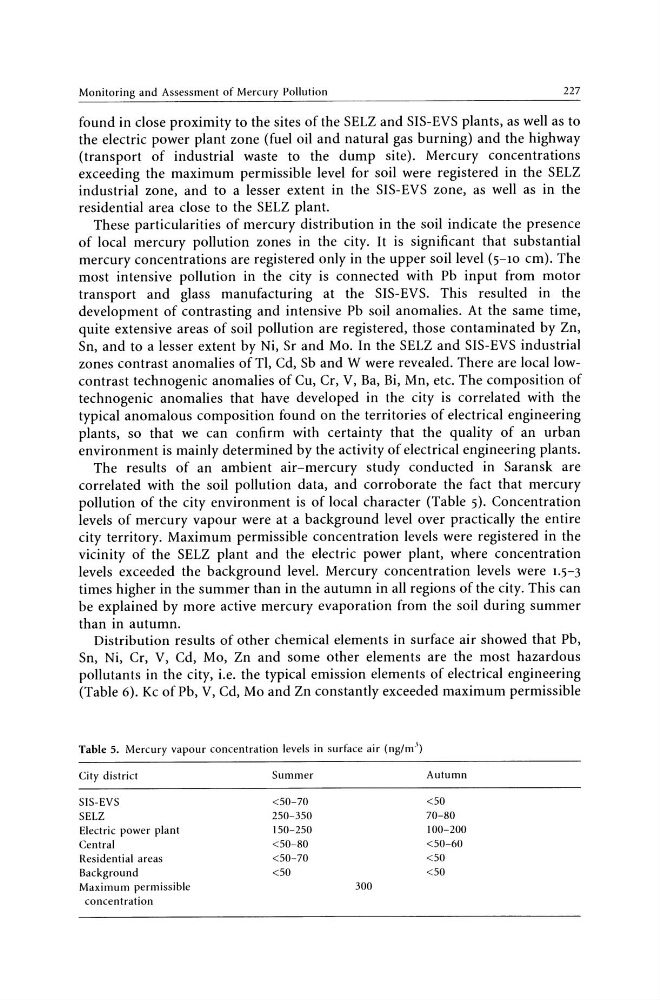
The results of an ambient air-mercury study conducted in Saransk are
correlated with the soil pollution data, and corroborate the fact that mercury
pollution of the city environment is of local character (Table 5). Concentration
levels of mercury vapour were at a background level over practically the entire
city territory. Maximum permissible concentration levels were registered in the
vicinity of the SELZ plant and the electric power plant, where concentration
levels exceeded the background level. Mercury concentration levels were 1.5-3
times higher in the summer than in the autumn in all regions of the city. This can
be explained by more active mercury evaporation from the soil during summer
than in autumn.
Distribution results of other chemical elements in surface air showed that Pb,
Sn, Ni, Cr, V, Cd, Mo, Zn and some other elements are the most hazardous
pollutants in the city, i.e. the typical emission elements of electrical engineering
(Table 6). Kc of Pb, V, Cd, Mo and Zn constantly exceeded maximum permissible
Table S. Mercury vapour concentration levels in surface air (ng/mJ)
City district
Summer
Autumn
SIS-EVS
<50-70
250-350
70-80
Electric power plant
150-250
100-200
Central
<50-80
<50-60
Residential areas
<50-70
<50
Background
<50
<50
Maximum permissible
300
concentration
227
found in close proximity to the sites of the SELZ and SIS-EVS plants, as well as to
the electric power plant zone (fuel oil and natural gas burning) and the highway
(transport of industrial waste to the dump site). Mercury concentrations
exceeding the maximum permissible level for soil were registered in the SELZ
industrial zone, and to a lesser extent in the SIS-EVS zone, as well as in the
residential area close to the SELZ plant.
These particularities of mercury distribution in the soil indicate the presence
of local mercury pollution zones in the city. It is significant that substantial
mercury concentrations are registered only in the upper soil level (5-10 cm). The
most intensive pollution in the city is connected with Pb input from motor
transport and glass manufacturing at the SIS-EVS. This resulted in the
development of contrasting and intensive Pb soil anomalies. At the same time,
quite extensive areas of soil pollution are registered, those contaminated by Zn,
Sn, and to a lesser extent by Ni, Sr and Mo. In the SELZ and SIS-EVS industrial
zones contrast anomalies of TI, Cd, Sb and W were revealed. There are local lowcontrast technogenic anomalies of Cu, Cr, V, Ba, Bi, Mn, etc. The composition of
technogenic anomalies that have developed in the city is correlated with the
typical anomalous composition found on the territories of electrical engineering
plants, so that we can confirm with certainty that the quality of an urban
environment is mainly determined by the activity of electrical engineering plants.
The results of an ambient air-mercury study conducted in Saransk are
correlated with the soil pollution data, and corroborate the fact that mercury
pollution of the city environment is of local character (Table 5). Concentration
levels of mercury vapour were at a background level over practically the entire
city territory. Maximum permissible concentration levels were registered in the
vicinity of the SELZ plant and the electric power plant, where concentration
levels exceeded the background level. Mercury concentration levels were 1.5-3
times higher in the summer than in the autumn in all regions of the city. This can
be explained by more active mercury evaporation from the soil during summer
than in autumn.
Distribution results of other chemical elements in surface air showed that Pb,
Sn, Ni, Cr, V, Cd, Mo, Zn and some other elements are the most hazardous
pollutants in the city, i.e. the typical emission elements of electrical engineering
(Table 6). Kc of Pb, V, Cd, Mo and Zn constantly exceeded maximum permissible
Table S. Mercury vapour concentration levels in surface air (ng/mJ)
City district
Summer
Autumn
SIS-EVS
<50-70
250-350
70-80
Electric power plant
150-250
100-200
Central
<50-80
<50-60
Residential areas
<50-70
<50
Background
<50
<50
Maximum permissible
300
concentration