

218
R.V. Marins et al.
30
atmospher~
/
' 9J
"00
Mobilization through
i~
Bay's ecosystems
560
Industrial and
urban sources
b
Total emission
340
Burial rate in
bottom sediments
'--'
rivers
(!!~
BAY
BASIN
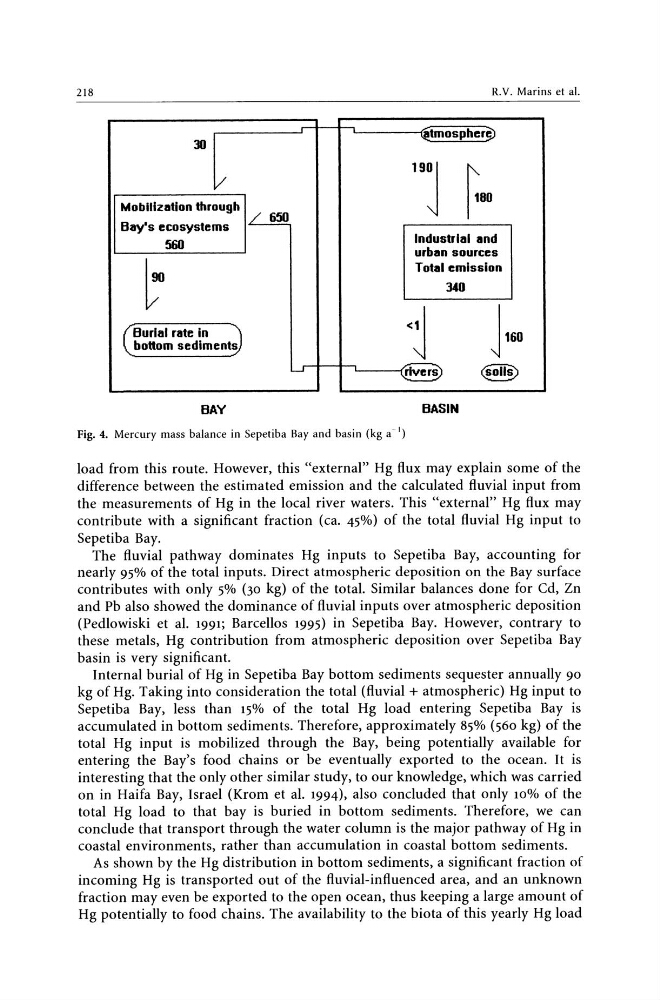
Fig. 4. Mercury mass balance in Sepetiba Bay and basin (kg a ')
load from this route. However, this "external" Hg flux may explain some of the
difference between the estimated emission and the calculated fluvial input from
the measurements of Hg in the local river waters. This "external" Hg flux may
contribute with a significant fraction (ca. 45%) of the total fluvial Hg input to
Sepetiba Bay.
The fluvial pathway dominates Hg inputs to Sepetiba Bay, accounting for
nearly 95% of the total inputs. Direct atmospheric deposition on the Bay surface
contributes with only 5% (30 kg) of the total. Similar balances done for Cd, Zn
and Pb also showed the dominance of fluvial inputs over atmospheric deposition
(Pedlowiski et al. 1991; Barcellos 1995) in Sepetiba Bay. However, contrary to
these metals, Hg contribution from atmospheric deposition over Sepetiba Bay
basin is very significant.
Internal burial of Hg in Sepetiba Bay bottom sediments sequester annually 90
kg of Hg. Taking into consideration the total (fluvial + atmospheric) Hg input to
Sepetiba Bay, less than 15% of the total Hg load entering Sepetiba Bay is
accumulated in bottom sediments. Therefore, approximately 85% (560 kg) of the
total Hg input is mobilized through the Bay, being potentially available for
entering the Bay's food chains or be eventually exported to the ocean. It is
interesting that the only other similar study, to our knowledge, which was carried
on in Haifa Bay, Israel (Krom et al. 1994), also concluded that only lO% of the
total Hg load to that bay is buried in bottom sediments. Therefore, we can
conclude that transport through the water column is the major pathway of Hg in
coastal environments, rather than accumulation in coastal bottom sediments.
As shown by the Hg distribution in bottom sediments, a significant fraction of
incoming Hg is transported out of the fluvial-influenced area, and an unknown
fraction may even be exported to the open ocean, thus keeping a large amount of
Hg potentially to food chains. The availability to the biota of this yearly Hg load
R.V. Marins et al.
30
atmospher~
/
' 9J
"00
Mobilization through
i~
Bay's ecosystems
560
Industrial and
urban sources
b
Total emission
340
Burial rate in
bottom sediments
'--'
rivers
(!!~
BAY
BASIN
Fig. 4. Mercury mass balance in Sepetiba Bay and basin (kg a ')
load from this route. However, this "external" Hg flux may explain some of the
difference between the estimated emission and the calculated fluvial input from
the measurements of Hg in the local river waters. This "external" Hg flux may
contribute with a significant fraction (ca. 45%) of the total fluvial Hg input to
Sepetiba Bay.
The fluvial pathway dominates Hg inputs to Sepetiba Bay, accounting for
nearly 95% of the total inputs. Direct atmospheric deposition on the Bay surface
contributes with only 5% (30 kg) of the total. Similar balances done for Cd, Zn
and Pb also showed the dominance of fluvial inputs over atmospheric deposition
(Pedlowiski et al. 1991; Barcellos 1995) in Sepetiba Bay. However, contrary to
these metals, Hg contribution from atmospheric deposition over Sepetiba Bay
basin is very significant.
Internal burial of Hg in Sepetiba Bay bottom sediments sequester annually 90
kg of Hg. Taking into consideration the total (fluvial + atmospheric) Hg input to
Sepetiba Bay, less than 15% of the total Hg load entering Sepetiba Bay is
accumulated in bottom sediments. Therefore, approximately 85% (560 kg) of the
total Hg input is mobilized through the Bay, being potentially available for
entering the Bay's food chains or be eventually exported to the ocean. It is
interesting that the only other similar study, to our knowledge, which was carried
on in Haifa Bay, Israel (Krom et al. 1994), also concluded that only lO% of the
total Hg load to that bay is buried in bottom sediments. Therefore, we can
conclude that transport through the water column is the major pathway of Hg in
coastal environments, rather than accumulation in coastal bottom sediments.
As shown by the Hg distribution in bottom sediments, a significant fraction of
incoming Hg is transported out of the fluvial-influenced area, and an unknown
fraction may even be exported to the open ocean, thus keeping a large amount of
Hg potentially to food chains. The availability to the biota of this yearly Hg load