

Relative Importance of Non-Point Sources of Mercury
217
sampled area only. However, shallow mud flats correspond to approximately
70% of the bay's area (ca. 320 km 2 ; Suguio et al. 1979). Using this area, yearly
burial rates of Hg in Sepetiba Bay sediments thus reach 89 kg.
Another assessment of the total Hg amount buried in the bay sediments can be
made through estimating the Hg inventory throughout the cores according to Eq.
(2), after Krom et al. (1994).
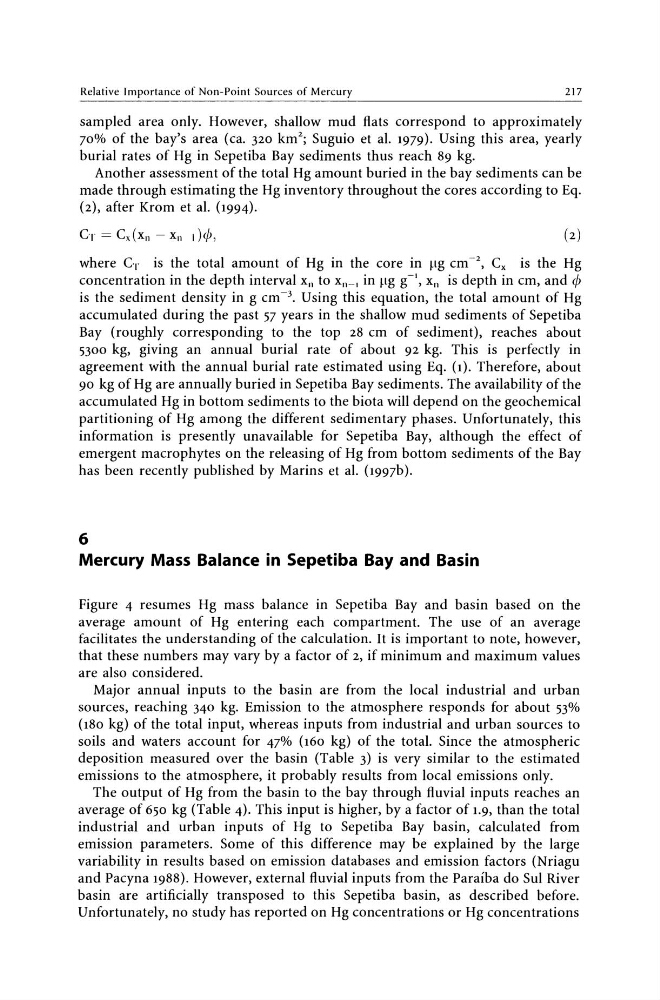
where C r is the total amount of Hg in the core in ~lg cm -\ ex is the Hg
concentration in the depth interval Xn to xn-, in ~lg g -', Xn is depth in cm, and (p
is the sediment density in g cm -3. Using this equation, the total amount of Hg
accumulated during the past 57 years in the shallow mud sediments of Sepetiba
Bay (roughly corresponding to the top 28 cm of sediment), reaches about
5300 kg, giving an annual burial rate of about 92 kg. This is perfectly in
agreement with the annual burial rate estimated using Eq. (1). Therefore, about
90 kg of Hg are annually buried in Sepetiba Bay sediments. The availability of the
accumulated Hg in bottom sediments to the biota will depend on the geochemical
partitioning of Hg among the different sedimentary phases. Unfortunately, this
information is presently unavailable for Sepetiba Bay, although the effect of
emergent macrophytes on the releasing of Hg from bottom sediments of the Bay
has been recently published by Marins et al. (1997b).
6
Mercury Mass Balance in Sepetiba Bay and Basin
Figure 4 resumes Hg mass balance in Sepetiba Bay and basin based on the
average amount of Hg entering each compartment. The use of an average
facilitates the understanding of the calculation. It is important to note, however,
that these numbers may vary by a factor of 2, if minimum and maximum values
are also considered.
Major annual inputs to the basin are from the local industrial and urban
sources, reaching 340 kg. Emission to the atmosphere responds for about 53%
(180 kg) of tlIe total input, whereas inputs from industrial and urban sources to
soils and waters account for 47% (160 kg) of the total. Since the atmospheric
deposition measured over the basin (Table 3) is very similar to the estimated
emissions to the atmosphere, it probably results from local emissions only.
The output of Hg from the basin to the bay through fluvial inputs reaches an
average of 650 kg (Table 4). This input is higher, by a factor of 1.9, than the total
industrial and urban inputs of Hg to Sepetiba Bay basin, calculated from
emission parameters. Some of this difference may be explained by the large
variability in results based on emission databases and emission factors (Nriagu
and Pacyna 1988). However, external fluvial inputs from the Paraiba do SuI River
basin are artificially transposed to this Sepetiba basin, as described before.
Unfortunately, no study has reported on Hg concentrations or Hg concentrations
217
sampled area only. However, shallow mud flats correspond to approximately
70% of the bay's area (ca. 320 km 2 ; Suguio et al. 1979). Using this area, yearly
burial rates of Hg in Sepetiba Bay sediments thus reach 89 kg.
Another assessment of the total Hg amount buried in the bay sediments can be
made through estimating the Hg inventory throughout the cores according to Eq.
(2), after Krom et al. (1994).
where C r is the total amount of Hg in the core in ~lg cm -\ ex is the Hg
concentration in the depth interval Xn to xn-, in ~lg g -', Xn is depth in cm, and (p
is the sediment density in g cm -3. Using this equation, the total amount of Hg
accumulated during the past 57 years in the shallow mud sediments of Sepetiba
Bay (roughly corresponding to the top 28 cm of sediment), reaches about
5300 kg, giving an annual burial rate of about 92 kg. This is perfectly in
agreement with the annual burial rate estimated using Eq. (1). Therefore, about
90 kg of Hg are annually buried in Sepetiba Bay sediments. The availability of the
accumulated Hg in bottom sediments to the biota will depend on the geochemical
partitioning of Hg among the different sedimentary phases. Unfortunately, this
information is presently unavailable for Sepetiba Bay, although the effect of
emergent macrophytes on the releasing of Hg from bottom sediments of the Bay
has been recently published by Marins et al. (1997b).
6
Mercury Mass Balance in Sepetiba Bay and Basin
Figure 4 resumes Hg mass balance in Sepetiba Bay and basin based on the
average amount of Hg entering each compartment. The use of an average
facilitates the understanding of the calculation. It is important to note, however,
that these numbers may vary by a factor of 2, if minimum and maximum values
are also considered.
Major annual inputs to the basin are from the local industrial and urban
sources, reaching 340 kg. Emission to the atmosphere responds for about 53%
(180 kg) of tlIe total input, whereas inputs from industrial and urban sources to
soils and waters account for 47% (160 kg) of the total. Since the atmospheric
deposition measured over the basin (Table 3) is very similar to the estimated
emissions to the atmosphere, it probably results from local emissions only.
The output of Hg from the basin to the bay through fluvial inputs reaches an
average of 650 kg (Table 4). This input is higher, by a factor of 1.9, than the total
industrial and urban inputs of Hg to Sepetiba Bay basin, calculated from
emission parameters. Some of this difference may be explained by the large
variability in results based on emission databases and emission factors (Nriagu
and Pacyna 1988). However, external fluvial inputs from the Paraiba do SuI River
basin are artificially transposed to this Sepetiba basin, as described before.
Unfortunately, no study has reported on Hg concentrations or Hg concentrations