

Relative Importance of Non -Point Sources of Mercury
215
I «·SO'W
Mangaraliba
2TS
8O~
~.
~~ 30
~
_~....;..=:==50 :=::=== s:::epetlba Bay
0
~
~Q
5 Ian
Atlantic OCeilfl
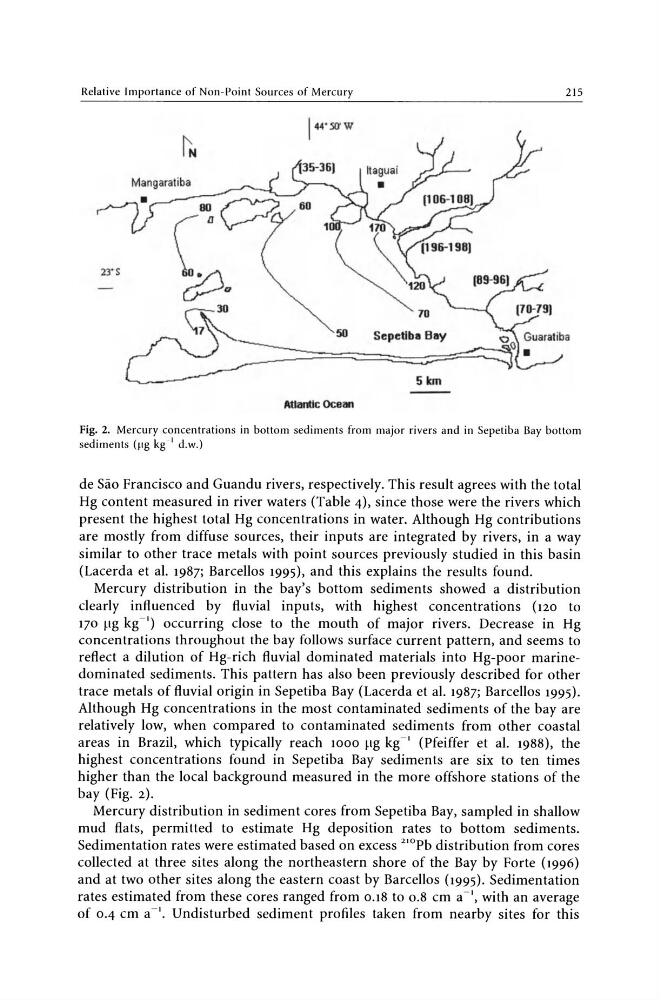
Fig. 2. Mercury concentrations in bottom sediments from major rivers and in Sepetiba Bay bottom
sediments (pg kg-' d.w.)
de Sao Francisco and Guandu rivers, respectively. This result agrees with the total
Hg content measured in river waters (Table 4), since those were the rivers which
present the highest total Hg concentrations in water. Although Hg contributions
are mostly from diffuse sources, their inputs are integrated by rivers, in a way
similar to other trace metals with point sources previously studied in this basin
(Lacerda et al. 1987; Barcellos 1995), and this explains the results found.
Mercury distribution in the bay's bottom sediments showed a distribution
clearly influenced by fluvial inputs, with highest concentrations (120 to
170 ~lg kg- I) occurring close to the mouth of major rivers. Decrease in Hg
concentrations throughout the bay follows surface current pattern, and seems to
reflect a dilution of Hg-rich fluvial dominated materials into Hg-poor marinedominated sediments. This pattern has also been previously described for other
trace metals of fluvial origin in Sepetiba Bay (Lacerda et al. 1987; Barcellos 1995).
Although Hg concentrations in the most contaminated sediments of the bay are
relatively low, when compared to contaminated sediments from other coastal
areas in Brazil, which typically reach 1000 pg kg - I (Pfeiffer et al. 1988), the
highest concentrations found in Sepetiba Bay sediments are six to ten times
higher than the local background measured in the more offshore stations of the
bay (Fig. 2).
Mercury distribution in sediment cores from Sepetiba Bay, sampled in shallow
mud flats, permitted to estimate Hg deposition rates to bottom sediments.
Sedimentation rates were estimated based on excess 21°Pb distribution from cores
collected at three sites along the northeastern shore of the Bay by Forte (1996)
and at two other sites along the eastern coast by Barcellos (1995). Sedimentation
rates estimated from these cores ranged from 0.18 to 0.8 em a- I, with an average
of 0-4 em a- I. Undisturbed sediment profiles taken from nearby sites for this
215
I «·SO'W
Mangaraliba
2TS
8O~
~.
~~ 30
~
_~....;..=:==50 :=::=== s:::epetlba Bay
0
~
~Q
5 Ian
Atlantic OCeilfl
Fig. 2. Mercury concentrations in bottom sediments from major rivers and in Sepetiba Bay bottom
sediments (pg kg-' d.w.)
de Sao Francisco and Guandu rivers, respectively. This result agrees with the total
Hg content measured in river waters (Table 4), since those were the rivers which
present the highest total Hg concentrations in water. Although Hg contributions
are mostly from diffuse sources, their inputs are integrated by rivers, in a way
similar to other trace metals with point sources previously studied in this basin
(Lacerda et al. 1987; Barcellos 1995), and this explains the results found.
Mercury distribution in the bay's bottom sediments showed a distribution
clearly influenced by fluvial inputs, with highest concentrations (120 to
170 ~lg kg- I) occurring close to the mouth of major rivers. Decrease in Hg
concentrations throughout the bay follows surface current pattern, and seems to
reflect a dilution of Hg-rich fluvial dominated materials into Hg-poor marinedominated sediments. This pattern has also been previously described for other
trace metals of fluvial origin in Sepetiba Bay (Lacerda et al. 1987; Barcellos 1995).
Although Hg concentrations in the most contaminated sediments of the bay are
relatively low, when compared to contaminated sediments from other coastal
areas in Brazil, which typically reach 1000 pg kg - I (Pfeiffer et al. 1988), the
highest concentrations found in Sepetiba Bay sediments are six to ten times
higher than the local background measured in the more offshore stations of the
bay (Fig. 2).
Mercury distribution in sediment cores from Sepetiba Bay, sampled in shallow
mud flats, permitted to estimate Hg deposition rates to bottom sediments.
Sedimentation rates were estimated based on excess 21°Pb distribution from cores
collected at three sites along the northeastern shore of the Bay by Forte (1996)
and at two other sites along the eastern coast by Barcellos (1995). Sedimentation
rates estimated from these cores ranged from 0.18 to 0.8 em a- I, with an average
of 0-4 em a- I. Undisturbed sediment profiles taken from nearby sites for this