

202
T. Schiindorf et al.
9.2.2
Results and Discussion
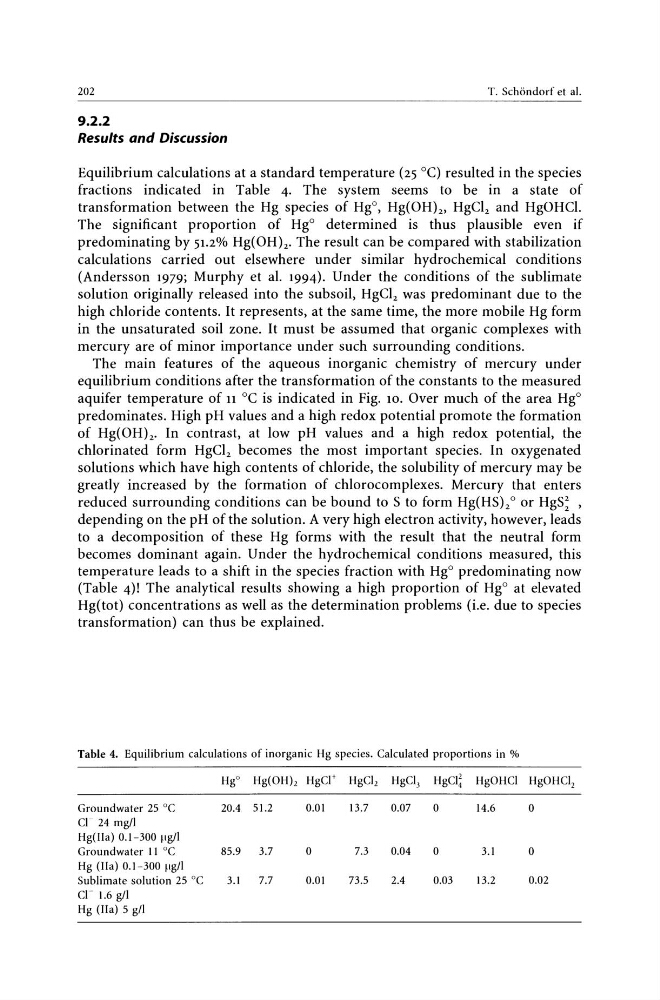
Equilibrium calculations at a standard temperature (25°C) resulted in the species
fractions indicated in Table 4. The system seems to be in a state of
transformation between the Hg species of HgO, Hg(OH)2' HgCl2 and HgOHCl.
The significant proportion of Hgo determined is thus plausible even if
predominating by 51.2% Hg(OH)2. The result can be compared with stabilization
calculations carried out elsewhere under similar hydrochemical conditions
(Andersson 1979; Murphy et al. 1994). Under the conditions of the sublimate
solution originally released into the subsoil, HgCl2 was predominant due to the
high chloride contents. It represents, at the same time, the more mobile Hg form
in the unsaturated soil zone. It must be assumed that organic complexes with
mercury are of minor importance under such surrounding conditions.
The main features of the aqueous inorganic chemistry of mercury under
equilibrium conditions after the transformation of the constants to the measured
aquifer temperature of 11 °C is indicated in Fig. 10. Over much of the area Hgo
predominates. High pH values and a high redox potential promote the formation
of Hg(OH)2. In contrast, at low pH values and a high redox potential, the
chlorinated form HgCl2 becomes the most important species. In oxygenated
solutions which have high contents of chloride, the solubility of mercury may be
greatly increased by the formation of chlorocomplexes. Mercury that enters
reduced surrounding conditions can be bound to S to form Hg(HS), ° or HgS~ ,
depending on the pH of the solution. A very high electron activity, however, leads
to a decomposition of these Hg forms with the result that the neutral form
becomes dominant again. Under the hydrochemical conditions measured, this
temperature leads to a shift in the species fraction with Hgo predominating now
(Table 4)! The analytical results showing a high proportion of Hgo at elevated
Hg(tot) concentrations as well as the determination problems (Le. due to species
transformation) can thus be explained.
Table 4. Equilibrium calculations of inorganic Hg species. Calculated proportions in %
HgD Hg(OHh HgCI+ HgCI, HgCI 3 HgCI! HgOHCI HgOHCI 2
Groundwater 25 DC
20.4 51.2
0.01
13.7
0.07
0
14.6
0
cr 24 mgll
Hg(lla) 0.1-300 flg/l
Groundwater II DC
85.9
3.7
0
7.3
0.04
0
3.1
0
Hg (lla) 0.1-300 Ilg/l
Sublimate solution 25 DC
3.1
7.7
om 73.5 2.4
0.03
13.2
0.02
Cl- 1.6 gIl
Hg (Ha) 5 gIl
T. Schiindorf et al.
9.2.2
Results and Discussion
Equilibrium calculations at a standard temperature (25°C) resulted in the species
fractions indicated in Table 4. The system seems to be in a state of
transformation between the Hg species of HgO, Hg(OH)2' HgCl2 and HgOHCl.
The significant proportion of Hgo determined is thus plausible even if
predominating by 51.2% Hg(OH)2. The result can be compared with stabilization
calculations carried out elsewhere under similar hydrochemical conditions
(Andersson 1979; Murphy et al. 1994). Under the conditions of the sublimate
solution originally released into the subsoil, HgCl2 was predominant due to the
high chloride contents. It represents, at the same time, the more mobile Hg form
in the unsaturated soil zone. It must be assumed that organic complexes with
mercury are of minor importance under such surrounding conditions.
The main features of the aqueous inorganic chemistry of mercury under
equilibrium conditions after the transformation of the constants to the measured
aquifer temperature of 11 °C is indicated in Fig. 10. Over much of the area Hgo
predominates. High pH values and a high redox potential promote the formation
of Hg(OH)2. In contrast, at low pH values and a high redox potential, the
chlorinated form HgCl2 becomes the most important species. In oxygenated
solutions which have high contents of chloride, the solubility of mercury may be
greatly increased by the formation of chlorocomplexes. Mercury that enters
reduced surrounding conditions can be bound to S to form Hg(HS), ° or HgS~ ,
depending on the pH of the solution. A very high electron activity, however, leads
to a decomposition of these Hg forms with the result that the neutral form
becomes dominant again. Under the hydrochemical conditions measured, this
temperature leads to a shift in the species fraction with Hgo predominating now
(Table 4)! The analytical results showing a high proportion of Hgo at elevated
Hg(tot) concentrations as well as the determination problems (Le. due to species
transformation) can thus be explained.
Table 4. Equilibrium calculations of inorganic Hg species. Calculated proportions in %
HgD Hg(OHh HgCI+ HgCI, HgCI 3 HgCI! HgOHCI HgOHCI 2
Groundwater 25 DC
20.4 51.2
0.01
13.7
0.07
0
14.6
0
cr 24 mgll
Hg(lla) 0.1-300 flg/l
Groundwater II DC
85.9
3.7
0
7.3
0.04
0
3.1
0
Hg (lla) 0.1-300 Ilg/l
Sublimate solution 25 DC
3.1
7.7
om 73.5 2.4
0.03
13.2
0.02
Cl- 1.6 gIl
Hg (Ha) 5 gIl