

Distribution, Bioavailability and Speciation of Mercury
203
pE
+20 r---~----'----------r--------~--------~
......
+10 r---------~---------+--+-----~~----~~ . . . . . .
~
May 1996
Hgo
0
...... ...... ...... ...... ...... ...... ...... ...... ......
H2
...... ...... ...... ......
-1 0 ' - - - - - - - L . . _ _ _ _ ..l...-_ _ _ ----L_.::......._......::::~
o
3
6
9
12
pH
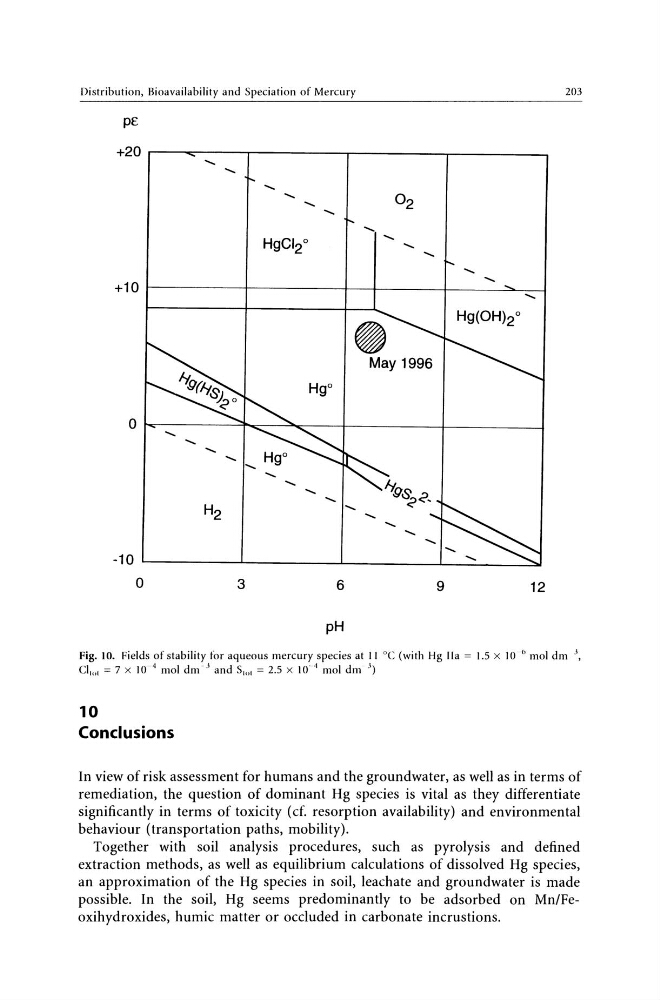
Fig. 10. Fields of stability for aqueous mercury species at 11°C (with Hg lIa = 1.5 x 10- 0 mol dm -'
Cl'o' = 7 X 10- 4 mol dm- J and Slot = 2.5 X 10- 4 mol dm- 3)
10
Conclusions
In view of risk assessment for humans and the groundwater, as well as in terms of
remediation, the question of dominant Hg species is vital as they differentiate
significantly in terms of toxicity (cf. resorption availability) and environmental
behaviour (transportation paths, mobility).
Together with soil analysis procedures, such as pyrolysis and defined
extraction methods, as well as equilibrium calculations of dissolved Hg species,
an approximation of the Hg species in soil, leachate and groundwater is made
possible. In the soil, Hg seems predominantly to be adsorbed on Mn/Feoxihydroxides, humic matter or occluded in carbonate incrustions.
203
pE
+20 r---~----'----------r--------~--------~
......
+10 r---------~---------+--+-----~~----~~ . . . . . .
~
May 1996
Hgo
0
...... ...... ...... ...... ...... ...... ...... ...... ......
H2
...... ...... ...... ......
-1 0 ' - - - - - - - L . . _ _ _ _ ..l...-_ _ _ ----L_.::......._......::::~
o
3
6
9
12
pH
Fig. 10. Fields of stability for aqueous mercury species at 11°C (with Hg lIa = 1.5 x 10- 0 mol dm -'
Cl'o' = 7 X 10- 4 mol dm- J and Slot = 2.5 X 10- 4 mol dm- 3)
10
Conclusions
In view of risk assessment for humans and the groundwater, as well as in terms of
remediation, the question of dominant Hg species is vital as they differentiate
significantly in terms of toxicity (cf. resorption availability) and environmental
behaviour (transportation paths, mobility).
Together with soil analysis procedures, such as pyrolysis and defined
extraction methods, as well as equilibrium calculations of dissolved Hg species,
an approximation of the Hg species in soil, leachate and groundwater is made
possible. In the soil, Hg seems predominantly to be adsorbed on Mn/Feoxihydroxides, humic matter or occluded in carbonate incrustions.