

Distribution, Bioavailability and Speciation of Mercury
201
indicate that the capacity for Hg-complex formation with organic substances
dissolved in groundwater (DOC 1-2 mg/l) is exhausted at concentrations of some
~lg/l of Hg. Individual lab samples did not determine any organomercurials, so
that the HgIIb fraction results mainly from these complex compounds and from
colloidal Hg compounds.
9.2
Equilibrium Calculations of Inorganic Mercury Species
9.2.1
Introduction
Both the described water analysis and direct Hgo measurements in the vapour
phase of soil samples from the aquifer zone indicated high contents of dissolved
elementary mercury. Plausibility tests were carried out in form of equilibrium
calculations to determine whether this can be explained by means of thermodynamic equilibrium between dissolved, inorganic Hg species as well as for
determination of species distribution under various conditions. The assumed
reactions and constants are from Hem (1970), Lindsay (1979), Andren and Nriagu
(1979), Wagman et al. (1982), Behra (1987), Stumm and Morgan (1996). The
calculations were performed by MICROQL (Westall 1986; Muller 1993). Initial
calculations assumed standard temperatures of 25°C, i.e. with the reaction
constants given in the cited works. As groundwater temperatures, however,
deviate with average temperatures of 11 °c, species calculations were also
conducted for relevant temperature conditions.
Interpolating known equilibrium constants at standard temperature to another
temperature, requires the following equation. If i1 Hro is not a function of the
temperature, what can be assumed in the temperature range of 5 to 35°C, the
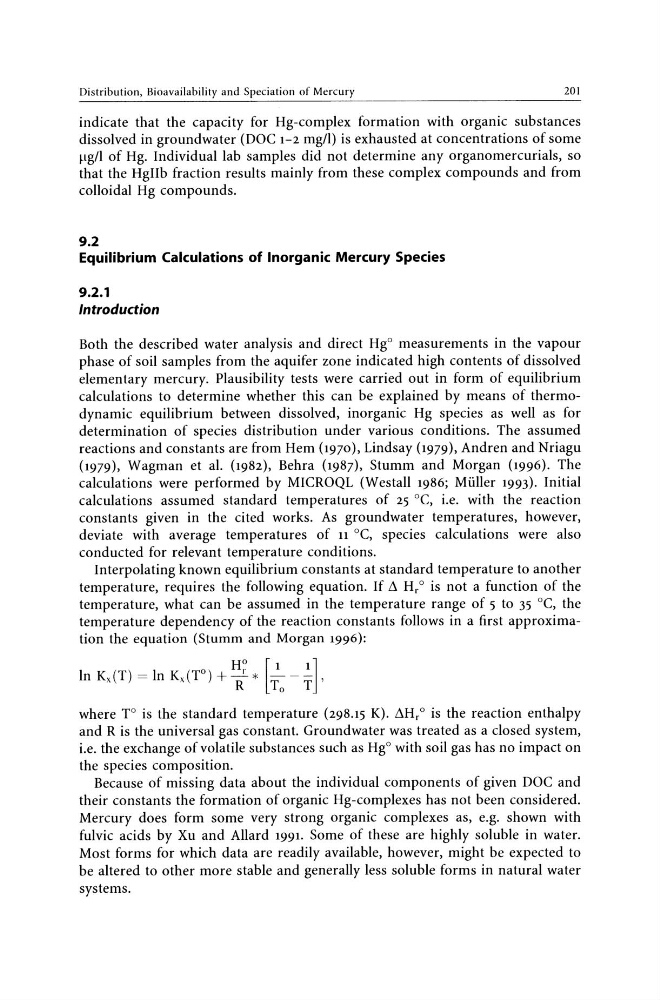
temperature dependency of the reaction constants follows in a first approximation the equation (Stumm and Morgan 1996):
where TO is the standard temperature (298.15 K). i1Hr ° is the reaction enthalpy
and R is the universal gas constant. Groundwater was treated as a closed system,
i.e. the exchange of volatile substances such as Hgo with soil gas has no impact on
the species composition.
Because of missing data about the individual components of given DOC and
their constants the formation of organic Hg-complexes has not been considered.
Mercury does form some very strong organic complexes as, e.g. shown with
fulvic acids by Xu and Allard 1991. Some of these are highly soluble in water.
Most forms for which data are readily available, however, might be expected to
be altered to other more stable and generally less soluble forms in natural water
systems.
201
indicate that the capacity for Hg-complex formation with organic substances
dissolved in groundwater (DOC 1-2 mg/l) is exhausted at concentrations of some
~lg/l of Hg. Individual lab samples did not determine any organomercurials, so
that the HgIIb fraction results mainly from these complex compounds and from
colloidal Hg compounds.
9.2
Equilibrium Calculations of Inorganic Mercury Species
9.2.1
Introduction
Both the described water analysis and direct Hgo measurements in the vapour
phase of soil samples from the aquifer zone indicated high contents of dissolved
elementary mercury. Plausibility tests were carried out in form of equilibrium
calculations to determine whether this can be explained by means of thermodynamic equilibrium between dissolved, inorganic Hg species as well as for
determination of species distribution under various conditions. The assumed
reactions and constants are from Hem (1970), Lindsay (1979), Andren and Nriagu
(1979), Wagman et al. (1982), Behra (1987), Stumm and Morgan (1996). The
calculations were performed by MICROQL (Westall 1986; Muller 1993). Initial
calculations assumed standard temperatures of 25°C, i.e. with the reaction
constants given in the cited works. As groundwater temperatures, however,
deviate with average temperatures of 11 °c, species calculations were also
conducted for relevant temperature conditions.
Interpolating known equilibrium constants at standard temperature to another
temperature, requires the following equation. If i1 Hro is not a function of the
temperature, what can be assumed in the temperature range of 5 to 35°C, the
temperature dependency of the reaction constants follows in a first approximation the equation (Stumm and Morgan 1996):
where TO is the standard temperature (298.15 K). i1Hr ° is the reaction enthalpy
and R is the universal gas constant. Groundwater was treated as a closed system,
i.e. the exchange of volatile substances such as Hgo with soil gas has no impact on
the species composition.
Because of missing data about the individual components of given DOC and
their constants the formation of organic Hg-complexes has not been considered.
Mercury does form some very strong organic complexes as, e.g. shown with
fulvic acids by Xu and Allard 1991. Some of these are highly soluble in water.
Most forms for which data are readily available, however, might be expected to
be altered to other more stable and generally less soluble forms in natural water
systems.