

152
1.6
1.4
1.2
Ci
:!!:
Cl
.§.
Cl 0.8
J:
~ 06
I0.4
4
4
0.2
0
1975
1980
1985
Date
A. Kudo and R.R. Turner
Source: Kumamoto Prefecture
o o
1990
I
0 Scorpion fish I
4 Sea bass
o
o
o 0
1995
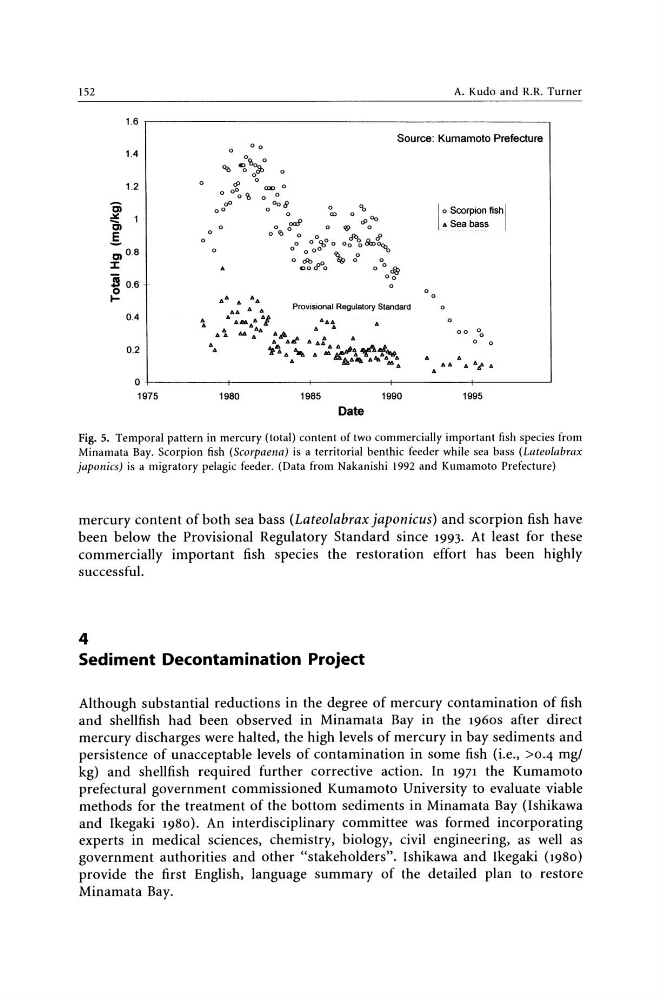
Fig. 5. Temporal pattern in mercury (total) content of two commercially important fish species from
Minamata Bay. Scorpion fish (Scorpaena) is a territorial benthic feeder while sea bass (Lateolabrax
japonics) is a migratory pelagic feeder. (Data from Nakanishi 1992 and Kumamoto Prefecture)
mercury content of both sea bass (Lateolabrax japonicus) and scorpion fish have
been below the Provisional Regulatory Standard since 1993. At least for these
commercially important fish species the restoration effort has been highly
successful.
4
Sediment Decontamination Project
Although substantial reductions in the degree of mercury contamination of fish
and shellfish had been observed in Minamata Bay in the 1960s after direct
mercury discharges were halted, the high levels of mercury in bay sediments and
persistence of unacceptable levels of contamination in some fish (i.e., >0.4 mgt
kg) and shellfish required further corrective action. In 1971 the Kumamoto
prefectural government commissioned Kumamoto University to evaluate viable
methods for the treatment of the bottom sediments in Minamata Bay (Ishikawa
and Ikegaki 1980). An interdisciplinary committee was formed incorporating
experts in medical sciences, chemistry, biology, civil engineering, as well as
government authorities and other "stakeholders". Ishikawa and Ikegaki (1980)
provide the first English, language summary of the detailed plan to restore
Minamata Bay.
1.6
1.4
1.2
Ci
:!!:
Cl
.§.
Cl 0.8
J:
~ 06
I0.4
4
4
0.2
0
1975
1980
1985
Date
A. Kudo and R.R. Turner
Source: Kumamoto Prefecture
o o
1990
I
0 Scorpion fish I
4 Sea bass
o
o
o 0
1995
Fig. 5. Temporal pattern in mercury (total) content of two commercially important fish species from
Minamata Bay. Scorpion fish (Scorpaena) is a territorial benthic feeder while sea bass (Lateolabrax
japonics) is a migratory pelagic feeder. (Data from Nakanishi 1992 and Kumamoto Prefecture)
mercury content of both sea bass (Lateolabrax japonicus) and scorpion fish have
been below the Provisional Regulatory Standard since 1993. At least for these
commercially important fish species the restoration effort has been highly
successful.
4
Sediment Decontamination Project
Although substantial reductions in the degree of mercury contamination of fish
and shellfish had been observed in Minamata Bay in the 1960s after direct
mercury discharges were halted, the high levels of mercury in bay sediments and
persistence of unacceptable levels of contamination in some fish (i.e., >0.4 mgt
kg) and shellfish required further corrective action. In 1971 the Kumamoto
prefectural government commissioned Kumamoto University to evaluate viable
methods for the treatment of the bottom sediments in Minamata Bay (Ishikawa
and Ikegaki 1980). An interdisciplinary committee was formed incorporating
experts in medical sciences, chemistry, biology, civil engineering, as well as
government authorities and other "stakeholders". Ishikawa and Ikegaki (1980)
provide the first English, language summary of the detailed plan to restore
Minamata Bay.