

Mercury Contamination of Minamata Bay
153
4.1
Establishment of Cleanup Level
The Japanese government promulgated a "tentative standard for removal of
mercury-contaminated bottom sediments" in 1973. This standard took into
consideration dissolution and diffusion of mercury out of bottom sediments,
mixing of sediment-derived mercury with surface water and mercury accumulation in food chains. The detailed basis for this standard is difficult to extract
from the sparse English language literature on the subject. An equation
incorporating tidal range, sediment-to-water transfer rate and a safety factor
(100 in fishing zones) is given in Fujiki and Tajima (1992) and thus the standard
seems to be somewhat "site-specific", at least for marine environments. For
sediments in Minamata Bay the standard value was calculated as 25 mg/kg.
4.2
Nature and Extent of Decontamination
Based on the standard value of 25 mg/kg approximately 1.5 million m 3 of
sediment distributed over 2 km 2 of the bay was identified as contaminated above
the standard. Because contamination was more serious in terms of both mercury
concentrations and sediment thickness in the inner area of the bay, the inner area
covering about 0.6 km 2 was enclosed with a line of highly watertight revetments
and used as a disposal area for dredge spoil from the rest of the contaminated
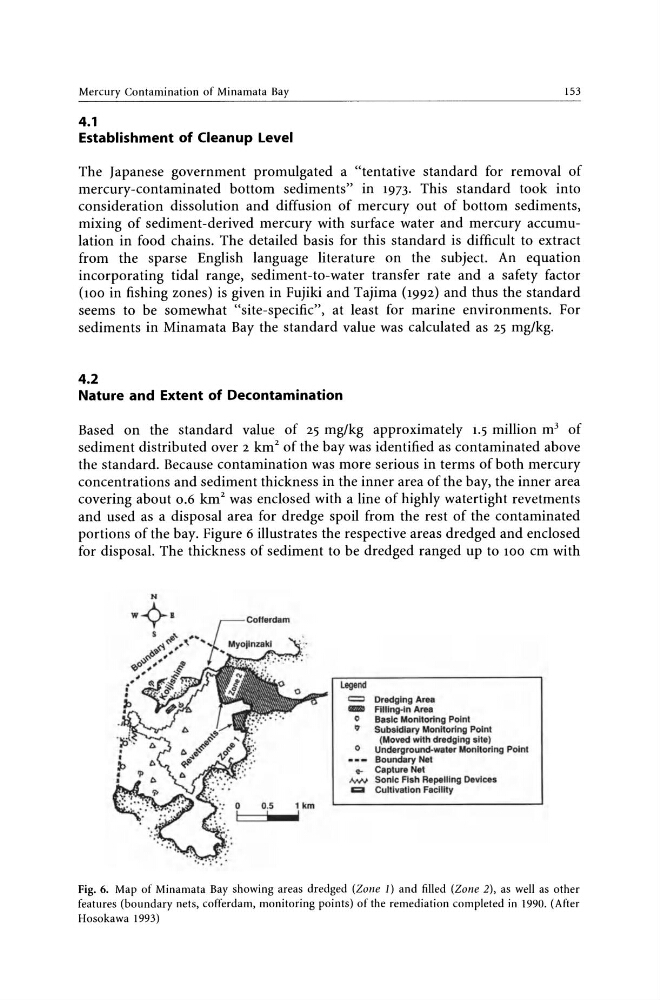
portions of the bay. Figure 6 illustrates the respective areas dredged and enclosed
for disposal. The thickness of sediment to be dredged ranged up to 100 cm with
N
w- 0.5
I km
t=:=:J'_IIIIIII'
Legend
= Dredging Area
_
Flillng.in Area
o
Basic Montlorlng Polnl
'1
Subsidiary Monitoring Polnl
(Moved wllh dredging site)
o
Underground·waler Monitoring Polnl
Boundary Net
~
Capture Net
NN Sonic Fish Repelling Devices
co Cultivation Facility
Fig. 6. Map of Minamata Bay showing areas dredged (Zone 1) and tilled (Zone 2), as well as other
features (boundary nets, cofferdam, monitoring points) of the remediation completed in 1990. (After
Hosokawa 1993)
153
4.1
Establishment of Cleanup Level
The Japanese government promulgated a "tentative standard for removal of
mercury-contaminated bottom sediments" in 1973. This standard took into
consideration dissolution and diffusion of mercury out of bottom sediments,
mixing of sediment-derived mercury with surface water and mercury accumulation in food chains. The detailed basis for this standard is difficult to extract
from the sparse English language literature on the subject. An equation
incorporating tidal range, sediment-to-water transfer rate and a safety factor
(100 in fishing zones) is given in Fujiki and Tajima (1992) and thus the standard
seems to be somewhat "site-specific", at least for marine environments. For
sediments in Minamata Bay the standard value was calculated as 25 mg/kg.
4.2
Nature and Extent of Decontamination
Based on the standard value of 25 mg/kg approximately 1.5 million m 3 of
sediment distributed over 2 km 2 of the bay was identified as contaminated above
the standard. Because contamination was more serious in terms of both mercury
concentrations and sediment thickness in the inner area of the bay, the inner area
covering about 0.6 km 2 was enclosed with a line of highly watertight revetments
and used as a disposal area for dredge spoil from the rest of the contaminated
portions of the bay. Figure 6 illustrates the respective areas dredged and enclosed
for disposal. The thickness of sediment to be dredged ranged up to 100 cm with
N
w- 0.5
I km
t=:=:J'_IIIIIII'
Legend
= Dredging Area
_
Flillng.in Area
o
Basic Montlorlng Polnl
'1
Subsidiary Monitoring Polnl
(Moved wllh dredging site)
o
Underground·waler Monitoring Polnl
Boundary Net
~
Capture Net
NN Sonic Fish Repelling Devices
co Cultivation Facility
Fig. 6. Map of Minamata Bay showing areas dredged (Zone 1) and tilled (Zone 2), as well as other
features (boundary nets, cofferdam, monitoring points) of the remediation completed in 1990. (After
Hosokawa 1993)