

140
::E
C 6
c:
o
== "
~
' " .
iii
o
u 3
C .. E 2
iii . .
>
.E
o
10000
25000
50000
Gas Volume m3/h
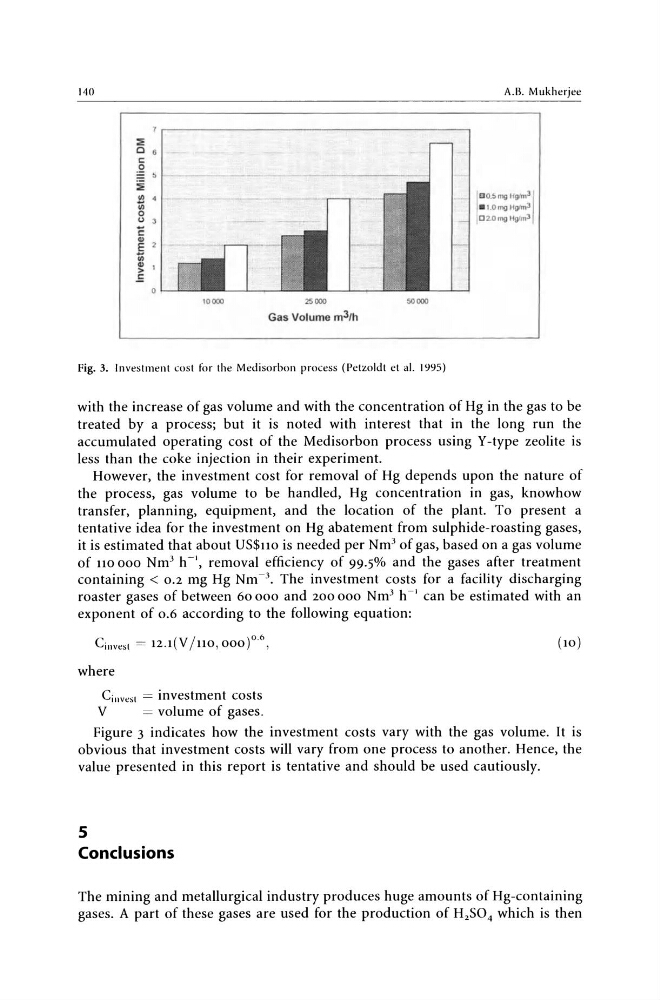
Fig. 3. Investment cost for the Medisorbon process (Petzoldt et al. 1995)
A.B. Mukherjee
l
o o.;mg"glm3
1
. 1,0 mg HgfmJ
0 2.0 mg fig/m3
with the increase of gas volume and with the concentration of Hg in the gas to be
treated by a process; but it is noted with interest that in the long run the
accumulated operating cost of the Medisorbon process using Y -type zeolite is
less than the coke injection in their experiment.
However, the investment cost for removal of Hg depends upon the nature of
the process, gas volume to be handled, Hg concentration in gas, knowhow
transfer, planning, equipment, and the location of the plant. To present a
tentative idea for the investment on Hg abatement from sulphide-roasting gases,
it is estimated that about US$1I0 is needed per Nm 3 of gas, based on a gas volume
of 110000 Nm 3 h - I, removal efficiency of 99.5% and the gases after treatment
containing < 0.2 mg Hg Nm- 3 • The investment costs for a facility discharging
roaster gases of between 60000 and 200000 Nm 3 hI
can be estimated with an
exponent of 0.6 according to the following equation:
CinveSI = 12 . I(V / 110,000 )0.0,
where
Cinvesl = investment costs
V
= volume of gases.
(10)
Figure 3 indicates how the investment costs vary with the gas volume. It is
obvious that investment costs will vary from one process to another. Hence, the
value presented in this report is tentative and should be used cautiously.
5
Conclusions
The mining and metallurgical industry produces huge amounts of Hg-containing
gases. A part of these gases are used for the production of H2 S0 4 which is then
::E
C 6
c:
o
== "
~
' " .
iii
o
u 3
C .. E 2
iii . .
>
.E
o
10000
25000
50000
Gas Volume m3/h
Fig. 3. Investment cost for the Medisorbon process (Petzoldt et al. 1995)
A.B. Mukherjee
l
o o.;mg"glm3
1
. 1,0 mg HgfmJ
0 2.0 mg fig/m3
with the increase of gas volume and with the concentration of Hg in the gas to be
treated by a process; but it is noted with interest that in the long run the
accumulated operating cost of the Medisorbon process using Y -type zeolite is
less than the coke injection in their experiment.
However, the investment cost for removal of Hg depends upon the nature of
the process, gas volume to be handled, Hg concentration in gas, knowhow
transfer, planning, equipment, and the location of the plant. To present a
tentative idea for the investment on Hg abatement from sulphide-roasting gases,
it is estimated that about US$1I0 is needed per Nm 3 of gas, based on a gas volume
of 110000 Nm 3 h - I, removal efficiency of 99.5% and the gases after treatment
containing < 0.2 mg Hg Nm- 3 • The investment costs for a facility discharging
roaster gases of between 60000 and 200000 Nm 3 hI
can be estimated with an
exponent of 0.6 according to the following equation:
CinveSI = 12 . I(V / 110,000 )0.0,
where
Cinvesl = investment costs
V
= volume of gases.
(10)
Figure 3 indicates how the investment costs vary with the gas volume. It is
obvious that investment costs will vary from one process to another. Hence, the
value presented in this report is tentative and should be used cautiously.
5
Conclusions
The mining and metallurgical industry produces huge amounts of Hg-containing
gases. A part of these gases are used for the production of H2 S0 4 which is then