

Advanced Technology Available for the Abatement of Mercury Pollution
139
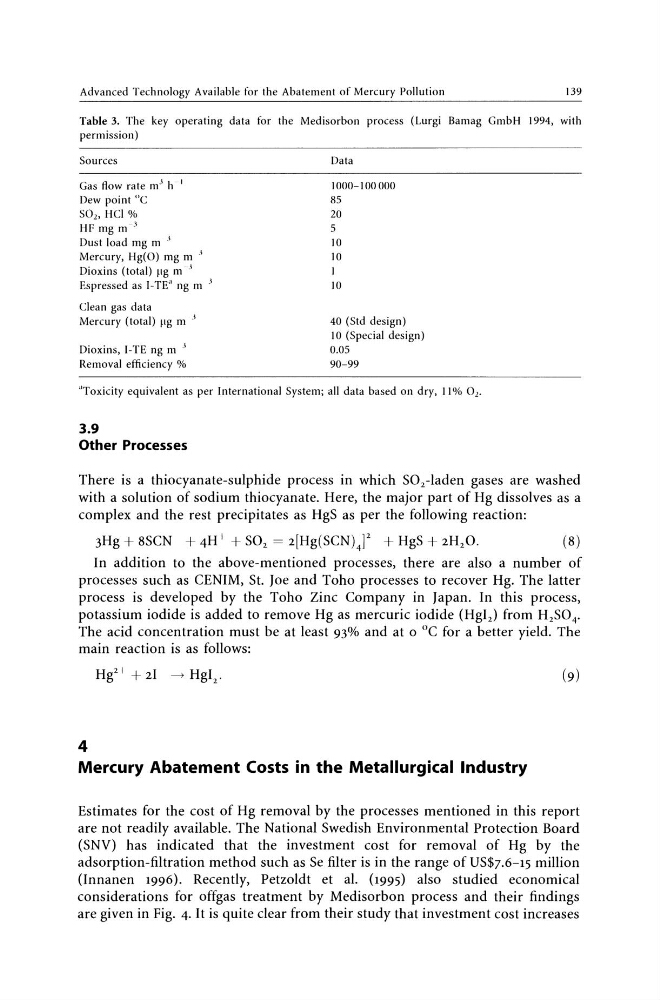
Table 3. The key operating data for the Medisorbon process (Lurgi Bamag GmbH 1994, with
permission)
Sources
Gas flow rate m
j h- I
Dew point "c
Sal> HCI 0/0
HF mg m- 3
Dust load mg m j
Mercury, Hg(O) mg m j
Dioxins (total) ~lg m -oJ
Espressed as I-TEa ng m j
Clean gas data
Mercury (total) pg m j
Dioxins, I-TE ng m j
Removal efficiency 0/0
Data
1000-100 000
85
20
5
10
10
10
40 (Std design)
10 (Special design)
0.05
90-99
"Toxicity equivalent as per International System; all data based on dry, 110/0 O2,
3.9
Other Processes
There is a thiocyanate-sulphide process in which S02-laden gases are washed
with a solution of sodium thiocyanate. Here, the major part of Hg dissolves as a
complex and the rest precipitates as HgS as per the following reaction:
3Hg + SSCN + 4H I + S02 = 2[Hg(SCN)l + HgS + 2H20.
(S)
In addition to the above-mentioned processes, there are also a number of
processes such as CENIM, st. Joe and Toho processes to recover Hg. The latter
process is developed by the Toho Zinc Company in Japan. In this process,
potassium iodide is added to remove Hg as mercuric iodide (HgI2) from H2S0 4 ,
The acid concentration must be at least 93% and at 0 °c for a better yield. The
main reaction is as follows:
Hg2 I + 21 ---+ Hg12'
4
Mercury Abatement Costs in the Metallurgical Industry
Estimates for the cost of Hg removal by the processes mentioned in this report
are not readily available. The National Swedish Environmental Protection Board
(SNV) has indicated that the investment cost for removal of Hg by the
adsorption-filtration method such as Se filter is in the range of US$7.6-15 million
(Innanen 1996). Recently, Petzoldt et al. (1995) also studied economical
considerations for off gas treatment by Medisorbon process and their findings
are given in Fig. 4. It is quite clear from their study that investment cost increases
139
Table 3. The key operating data for the Medisorbon process (Lurgi Bamag GmbH 1994, with
permission)
Sources
Gas flow rate m
j h- I
Dew point "c
Sal> HCI 0/0
HF mg m- 3
Dust load mg m j
Mercury, Hg(O) mg m j
Dioxins (total) ~lg m -oJ
Espressed as I-TEa ng m j
Clean gas data
Mercury (total) pg m j
Dioxins, I-TE ng m j
Removal efficiency 0/0
Data
1000-100 000
85
20
5
10
10
10
40 (Std design)
10 (Special design)
0.05
90-99
"Toxicity equivalent as per International System; all data based on dry, 110/0 O2,
3.9
Other Processes
There is a thiocyanate-sulphide process in which S02-laden gases are washed
with a solution of sodium thiocyanate. Here, the major part of Hg dissolves as a
complex and the rest precipitates as HgS as per the following reaction:
3Hg + SSCN + 4H I + S02 = 2[Hg(SCN)l + HgS + 2H20.
(S)
In addition to the above-mentioned processes, there are also a number of
processes such as CENIM, st. Joe and Toho processes to recover Hg. The latter
process is developed by the Toho Zinc Company in Japan. In this process,
potassium iodide is added to remove Hg as mercuric iodide (HgI2) from H2S0 4 ,
The acid concentration must be at least 93% and at 0 °c for a better yield. The
main reaction is as follows:
Hg2 I + 21 ---+ Hg12'
4
Mercury Abatement Costs in the Metallurgical Industry
Estimates for the cost of Hg removal by the processes mentioned in this report
are not readily available. The National Swedish Environmental Protection Board
(SNV) has indicated that the investment cost for removal of Hg by the
adsorption-filtration method such as Se filter is in the range of US$7.6-15 million
(Innanen 1996). Recently, Petzoldt et al. (1995) also studied economical
considerations for off gas treatment by Medisorbon process and their findings
are given in Fig. 4. It is quite clear from their study that investment cost increases