

138
A.B. Mukherjee
Half of the chlorine gas generated is used for the reaction (5) and the rest is
used in the recovery step. Table 2 shows the typical analyses of solids, gases and
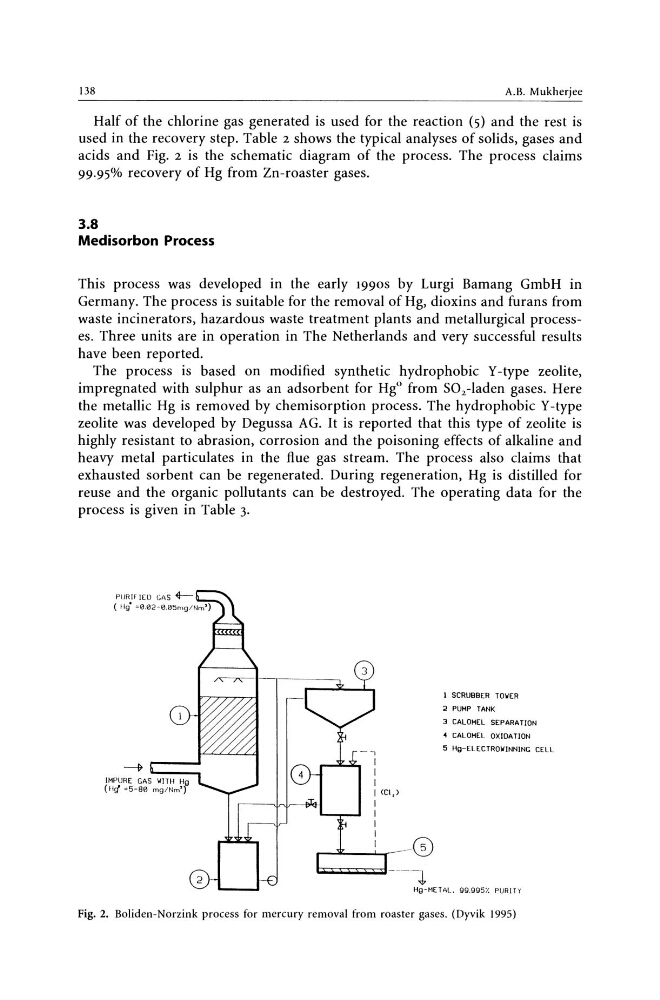
acids and Fig. 2 is the schematic diagram of the process. The process claims
99.95% recovery of Hg from Zn-roaster gases.
3.8
Medisorbon Process
This process was developed in the early 1990S by Lurgi Bamang GmbH in
Germany. The process is suitable for the removal of Hg, dioxins and furans from
waste incinerators, hazardous waste treatment plants and metallurgical processes. Three units are in operation in The Netherlands and very successful results
have been reported.
The process is based on modified synthetic hydrophobic Y -type zeolite,
impregnated with sulphur as an adsorbent for Hgo from S02-laden gases. Here
the metallic Hg is removed by chemisorption process. The hydrophobic Y -type
zeolite was developed by Degussa AG. It is reported that this type of zeolite is
highly resistant to abrasion, corrosion and the poisoning effects of alkaline and
heavy metal particulates in the flue gas stream. The process also claims that
exhausted sorbent can be regenerated. During regeneration, Hg is distilled for
reuse and the organic pollutants can be destroyed. The operating data for the
process is given in Table 3.
~r--""'"
IMPURE GAS WITH Hg
(11g' =5-80 mg/Nm')
,..--."----'--r----G)
t.= .... ~------:J,
1 SCRUBBER TOWER
2 PUMP TANK
3 CALOMEL SEPARATION
4 CALOMEL OXIOA TlON
S Hg-ELECTROWINNING CELL
Hg-METAL 99,9g5'l. PURITY
Fig. 2. Boliden-Norzink process for mercury removal from roaster gases. (Dyvik 1995)
A.B. Mukherjee
Half of the chlorine gas generated is used for the reaction (5) and the rest is
used in the recovery step. Table 2 shows the typical analyses of solids, gases and
acids and Fig. 2 is the schematic diagram of the process. The process claims
99.95% recovery of Hg from Zn-roaster gases.
3.8
Medisorbon Process
This process was developed in the early 1990S by Lurgi Bamang GmbH in
Germany. The process is suitable for the removal of Hg, dioxins and furans from
waste incinerators, hazardous waste treatment plants and metallurgical processes. Three units are in operation in The Netherlands and very successful results
have been reported.
The process is based on modified synthetic hydrophobic Y -type zeolite,
impregnated with sulphur as an adsorbent for Hgo from S02-laden gases. Here
the metallic Hg is removed by chemisorption process. The hydrophobic Y -type
zeolite was developed by Degussa AG. It is reported that this type of zeolite is
highly resistant to abrasion, corrosion and the poisoning effects of alkaline and
heavy metal particulates in the flue gas stream. The process also claims that
exhausted sorbent can be regenerated. During regeneration, Hg is distilled for
reuse and the organic pollutants can be destroyed. The operating data for the
process is given in Table 3.
~r--""'"
IMPURE GAS WITH Hg
(11g' =5-80 mg/Nm')
,..--."----'--r----G)
t.= .... ~------:J,
1 SCRUBBER TOWER
2 PUMP TANK
3 CALOMEL SEPARATION
4 CALOMEL OXIOA TlON
S Hg-ELECTROWINNING CELL
Hg-METAL 99,9g5'l. PURITY
Fig. 2. Boliden-Norzink process for mercury removal from roaster gases. (Dyvik 1995)