

Advanced Technology Available for the Abatement of Mercury Pollution
137
selenite, thus reducing the Hg removal efficiency. The Hg collection efficiency of
the process is about 90%.
3.6
Acid Purification Method
This process has been described in detail by several authors (Sundstrom 1975;
Habashi 1978). It is based on the addition of thiosulphate to sulphuric acid of
concentration of 80-85%. Colloidal sulphur is formed according to the following
reaction:
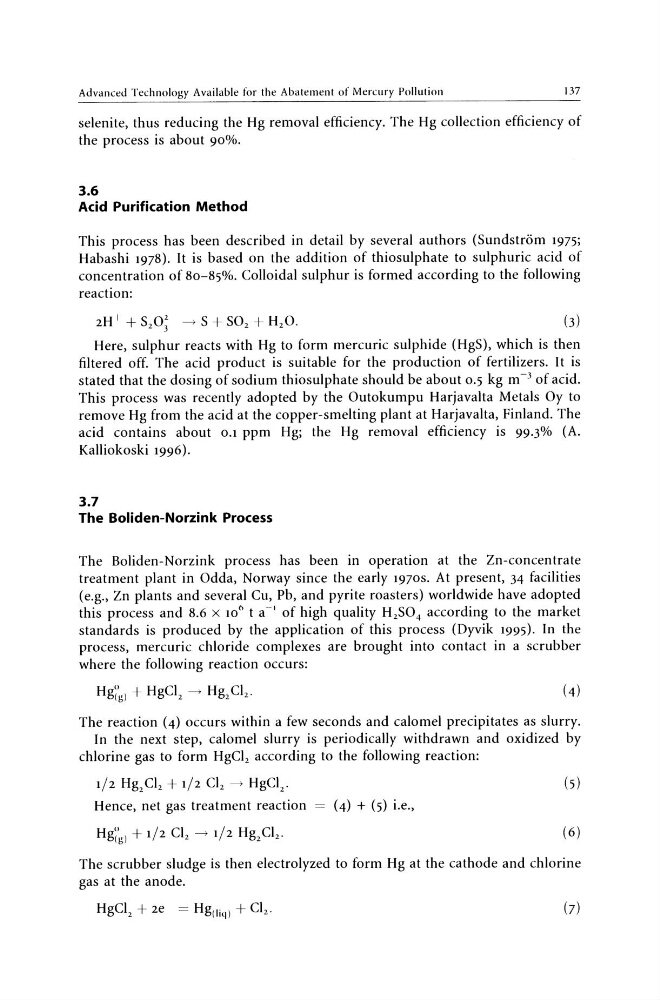
2H I + 520; ---+ 5 + 502 + H20.
Here, sulphur reacts with Hg to form mercuric sulphide (HgS), which is then
filtered off. The acid product is suitable for the production of fertilizers. It is
stated that the dosing of sodium thiosulphate should be about 0.5 kg m- 3 of acid.
This process was recently adopted by the Outokumpu Harjavalta Metals Oy to
remove Hg from the acid at the copper-smelting plant at Harjavalta, Finland. The
acid contains about 0.1 ppm Hg; the Hg removal efficiency is 99.3% (A.
Kalliokoski 1996).
3.7
The Boliden-Norzink Process
The Boliden-Norzink process has been in operation at the Zn-concentrate
treatment plant in Odda, Norway since the early 1970S. At present, 34 facilities
(e.g., Zn plants and several Cu, Pb, and pyrite roasters) worldwide have adopted
this process and 8.6 x 10 6 t a-- I of high quality H2S0 4 according to the market
standards is produced by the application of this process (Dyvik 1995). Tn the
process, mercuric chloride complexes are brought into contact in a scrubber
where the following reaction occurs:
Hgi'g) + HgCI2 --, Hg2 C12.
The reaction (4) occurs within a few seconds and calomel precipitates as slurry.
In the next step, calomel slurry is periodically withdrawn and oxidized by
chlorine gas to form HgCl2 according to the following reaction:
1/2 Hg2 Cl2 + 1/2 Cl2 ---+ HgCI 2 ·
Hence, net gas treatment reaction
Hgi'g) + 1/2 Cl2 ---+ 1/2 Hg 2 C12.
(5 )
(6)
The scrubber sludge is then electrolyzed to form Hg at the cathode and chlorine
gas at the anode.
HgCI2 + 2e = Hg(liq) + C12·
137
selenite, thus reducing the Hg removal efficiency. The Hg collection efficiency of
the process is about 90%.
3.6
Acid Purification Method
This process has been described in detail by several authors (Sundstrom 1975;
Habashi 1978). It is based on the addition of thiosulphate to sulphuric acid of
concentration of 80-85%. Colloidal sulphur is formed according to the following
reaction:
2H I + 520; ---+ 5 + 502 + H20.
Here, sulphur reacts with Hg to form mercuric sulphide (HgS), which is then
filtered off. The acid product is suitable for the production of fertilizers. It is
stated that the dosing of sodium thiosulphate should be about 0.5 kg m- 3 of acid.
This process was recently adopted by the Outokumpu Harjavalta Metals Oy to
remove Hg from the acid at the copper-smelting plant at Harjavalta, Finland. The
acid contains about 0.1 ppm Hg; the Hg removal efficiency is 99.3% (A.
Kalliokoski 1996).
3.7
The Boliden-Norzink Process
The Boliden-Norzink process has been in operation at the Zn-concentrate
treatment plant in Odda, Norway since the early 1970S. At present, 34 facilities
(e.g., Zn plants and several Cu, Pb, and pyrite roasters) worldwide have adopted
this process and 8.6 x 10 6 t a-- I of high quality H2S0 4 according to the market
standards is produced by the application of this process (Dyvik 1995). Tn the
process, mercuric chloride complexes are brought into contact in a scrubber
where the following reaction occurs:
Hgi'g) + HgCI2 --, Hg2 C12.
The reaction (4) occurs within a few seconds and calomel precipitates as slurry.
In the next step, calomel slurry is periodically withdrawn and oxidized by
chlorine gas to form HgCl2 according to the following reaction:
1/2 Hg2 Cl2 + 1/2 Cl2 ---+ HgCI 2 ·
Hence, net gas treatment reaction
Hgi'g) + 1/2 Cl2 ---+ 1/2 Hg 2 C12.
(5 )
(6)
The scrubber sludge is then electrolyzed to form Hg at the cathode and chlorine
gas at the anode.
HgCI2 + 2e = Hg(liq) + C12·