

Advanced Technology Available for the Abatement of Mercury Pollution
16 ~----------------------------------------------------~
14
Cl 12
(/)
:::l 10
~
:l
I/)
6
o
()
4
o ~ . --------+--------+--------~------__ ----------------~
20
60
80
100
120
'50
Gas Vo lume 1000 x Nm3/hr
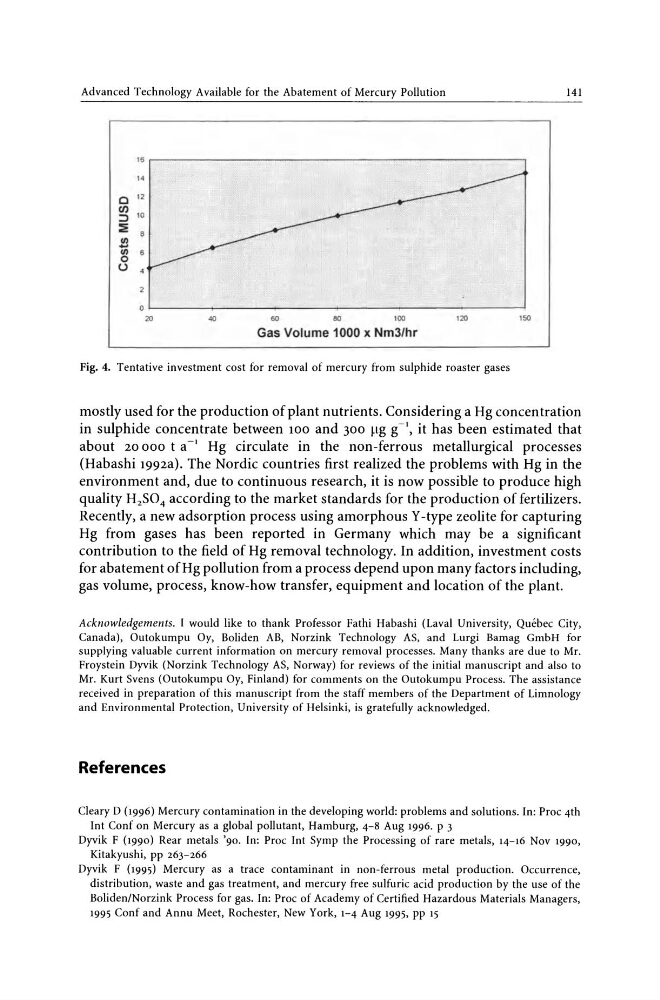
Fig. 4. Tentative investment cost for removal of mercury from sulphide roaster gases
141
mostly used for the production of plant nutrients. Considering a Hg concentration
in sulphide concentrate between 100 and 300 ~lg g- ', it has been estimated that
about 20000 t a - I Hg circulate in the non-ferrous metallurgical processes
(Habashi 1992a). The Nordic countries first realized the problems with Hg in the
environment and, due to continuous research, it is now possible to produce high
quality H2S0 4 according to the market standards for the production of fertilizers.
Recently, a new adsorption process using amorphous V-type zeolite for capturing
Hg from gases has been reported in Germany which may be a significant
contribution to the field of Hg removal technology. In addition, investment costs
for abatement ofHg pollution from a process depend upon many factors including,
gas volume, process, know-how transfer, equipment and location of the plant.
Acknowledgements. I would like to thank Professor Fathi Habashi (Laval University, Quebec City,
Canada), Outokumpu Oy, Boliden AB, Norzink Technology AS, and Lurgi Bamag GmbH for
supplying valuable current information on mercury removal processes. Many thanks are due to Mr.
Froystein Dyvik (Norzink Technology AS, Norway) for reviews of the initial manuscript and also to
Mr. Kurt Svens (Outokumpu Oy, Finland) for comments on the Outokumpu Process. The assistance
received in preparation of this manuscript from the staff members of the Department of Limnology
and Environmental Protection, University of Helsinki, is gratefully acknowledged.
References
Cleary D (1996) Mercury contamination in the developing world: problems and solutions. In: Proc 4th
In! Conf on Mercury as a global pollutant, Hamburg, 4-8 Aug 1996. P 3
Dyvik F (1990) Rear metals '90. In: Proc Int Symp the Processing of rare metals, 14-16 Nov 1990,
Kitakyushi, pp 263-266
Dyvik F (1995) Mercury as a trace contaminant in non-ferrous metal production. Occurrence,
distribution, waste and gas treatment, and mercury free sulfuric acid production by the use of the
Boliden/Norzink Process for gas. In: Proc of Academy of Certified Hazardous Materials Managers,
1995 Conf and Annu Meet, Rochester, New York, 1-4 Aug 1995, PP 15
16 ~----------------------------------------------------~
14
Cl 12
(/)
:::l 10
~
:l
I/)
6
o
()
4
o ~ . --------+--------+--------~------__ ----------------~
20
60
80
100
120
'50
Gas Vo lume 1000 x Nm3/hr
Fig. 4. Tentative investment cost for removal of mercury from sulphide roaster gases
141
mostly used for the production of plant nutrients. Considering a Hg concentration
in sulphide concentrate between 100 and 300 ~lg g- ', it has been estimated that
about 20000 t a - I Hg circulate in the non-ferrous metallurgical processes
(Habashi 1992a). The Nordic countries first realized the problems with Hg in the
environment and, due to continuous research, it is now possible to produce high
quality H2S0 4 according to the market standards for the production of fertilizers.
Recently, a new adsorption process using amorphous V-type zeolite for capturing
Hg from gases has been reported in Germany which may be a significant
contribution to the field of Hg removal technology. In addition, investment costs
for abatement ofHg pollution from a process depend upon many factors including,
gas volume, process, know-how transfer, equipment and location of the plant.
Acknowledgements. I would like to thank Professor Fathi Habashi (Laval University, Quebec City,
Canada), Outokumpu Oy, Boliden AB, Norzink Technology AS, and Lurgi Bamag GmbH for
supplying valuable current information on mercury removal processes. Many thanks are due to Mr.
Froystein Dyvik (Norzink Technology AS, Norway) for reviews of the initial manuscript and also to
Mr. Kurt Svens (Outokumpu Oy, Finland) for comments on the Outokumpu Process. The assistance
received in preparation of this manuscript from the staff members of the Department of Limnology
and Environmental Protection, University of Helsinki, is gratefully acknowledged.
References
Cleary D (1996) Mercury contamination in the developing world: problems and solutions. In: Proc 4th
In! Conf on Mercury as a global pollutant, Hamburg, 4-8 Aug 1996. P 3
Dyvik F (1990) Rear metals '90. In: Proc Int Symp the Processing of rare metals, 14-16 Nov 1990,
Kitakyushi, pp 263-266
Dyvik F (1995) Mercury as a trace contaminant in non-ferrous metal production. Occurrence,
distribution, waste and gas treatment, and mercury free sulfuric acid production by the use of the
Boliden/Norzink Process for gas. In: Proc of Academy of Certified Hazardous Materials Managers,
1995 Conf and Annu Meet, Rochester, New York, 1-4 Aug 1995, PP 15