

58
F. Dietz
Iron is not generally classed as a trace element by physiologists, but it is characterized
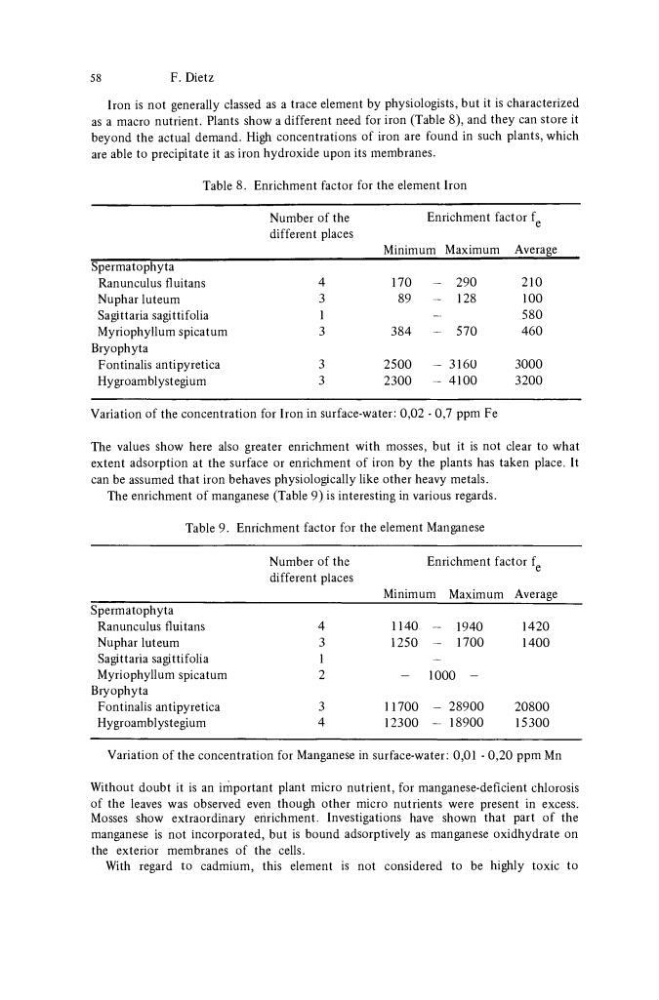
as a macro nutrient. Plants show a different need for iron (Table 8), and they can store it
beyond the actual demand. High concentrations of iron are found in such plants, which
are able to precipitate it as iron hydroxide upon its membranes.
Table 8. Enrichment factor for the element Iron
Number of the
different places
Enrichment factor f
Minimum Maximum Average
Spermatophyta
Ranunculus fluitans
Nuphar luteum
Sagittaria sagittifolia
Myriophyllum spicatum
Bryophyta
Fontinalis antipyretica
Hygroamblystegium
4
3
1
3
3
3
170
89
384
2500
2300
- 290
-
128
—
- 570
- 3160
- 4100
210
100
580
460
3000
3200
Variation of the concentration for Iron in surface-water: 0,02 - 0,7 ppm Fe
The values show here also greater enrichment with mosses, but it is not clear to what
extent adsorption at the surface or enrichment of iron by the plants has taken place. It
can be assumed that iron behaves physiologically like other heavy metals.
The enrichment of manganese (Table 9) is interesting in various regards.
Table 9. Enrichment factor for the element Manganese
Spermatophyta
Ranunculus fluitans
Nuphar luteum
Sagittaria sagittifolia
Myriophyllum spicatum
Bryophyta
Fontinalis antipyretica
Hygroamblystegium
Numbei r of the
different places
4
3
1
2
3
4
Enrichment factor f p
Minimum Maximum
1140 - 1940
1250 - 1700
-
-
1000 -
11700 - 28900
12300 - 18900
Average
1420
1400
20800
15300
Variation of the concentration for Manganese in surface-water: 0,01 - 0,20 ppm Mn
Without doubt it is an important plant micro nutrient, for manganese-deficient chlorosis
of the leaves was observed even though other micro nutrients were present in excess.
Mosses show extraordinary enrichment. Investigations have shown that part of the
manganese is not incorporated, but is bound adsorptively as manganese oxidhydrate on
the exterior membranes of the cells.
With regard to cadmium, this element is not considered to be highly toxic to
F. Dietz
Iron is not generally classed as a trace element by physiologists, but it is characterized
as a macro nutrient. Plants show a different need for iron (Table 8), and they can store it
beyond the actual demand. High concentrations of iron are found in such plants, which
are able to precipitate it as iron hydroxide upon its membranes.
Table 8. Enrichment factor for the element Iron
Number of the
different places
Enrichment factor f
Minimum Maximum Average
Spermatophyta
Ranunculus fluitans
Nuphar luteum
Sagittaria sagittifolia
Myriophyllum spicatum
Bryophyta
Fontinalis antipyretica
Hygroamblystegium
4
3
1
3
3
3
170
89
384
2500
2300
- 290
-
128
—
- 570
- 3160
- 4100
210
100
580
460
3000
3200
Variation of the concentration for Iron in surface-water: 0,02 - 0,7 ppm Fe
The values show here also greater enrichment with mosses, but it is not clear to what
extent adsorption at the surface or enrichment of iron by the plants has taken place. It
can be assumed that iron behaves physiologically like other heavy metals.
The enrichment of manganese (Table 9) is interesting in various regards.
Table 9. Enrichment factor for the element Manganese
Spermatophyta
Ranunculus fluitans
Nuphar luteum
Sagittaria sagittifolia
Myriophyllum spicatum
Bryophyta
Fontinalis antipyretica
Hygroamblystegium
Numbei r of the
different places
4
3
1
2
3
4
Enrichment factor f p
Minimum Maximum
1140 - 1940
1250 - 1700
-
-
1000 -
11700 - 28900
12300 - 18900
Average
1420
1400
20800
15300
Variation of the concentration for Manganese in surface-water: 0,01 - 0,20 ppm Mn
Without doubt it is an important plant micro nutrient, for manganese-deficient chlorosis
of the leaves was observed even though other micro nutrients were present in excess.
Mosses show extraordinary enrichment. Investigations have shown that part of the
manganese is not incorporated, but is bound adsorptively as manganese oxidhydrate on
the exterior membranes of the cells.
With regard to cadmium, this element is not considered to be highly toxic to