

The Enrichment of Heavy Metals in Submerged Plants
59
macrophytes, but it is to animal organisms. The values found showed small variations of
the order of 20 ppm in the dry material. Higher values up to 250 ppm were found only
for Hygroamblystegium. The factors of enrichment could not be calculated, because the
concentration of cadmium in the water samples was below the analytical detection limit.
Information of the enrichment of mercury compounds in water plants appeared to be
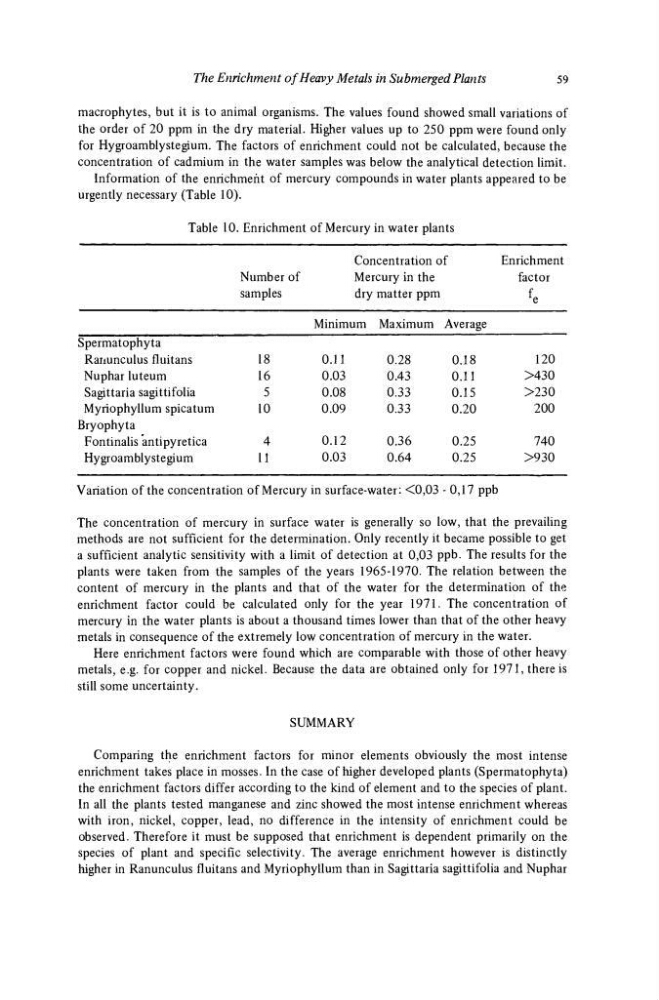
urgently necessary (Table 10).
Table 10. Enrichment of Mercury in water plants
Concentration of
Enrichment
Number of
Mercury in the
factor
samples
dry matter ppm
f
Minimum Maximum Average
Spermatophyta
Ranunculus fluitans
Nuphar luteum
Sagittaria sagittifolia
Myriophyllum spicatum
Bryophyta
Fontinalis antipyretica
Hygroamblystegium
18
16
5
10
4
11
0.11
0.03
0.08
0.09
0.12
0.03
0.28
0.43
0.33
0.33
0.36
0.64
0.18
0.11
0.15
0.20
0.25
0.25
Variation of the concentration of Mercury in surface-water: <0,03 - 0,17 ppb
The concentration of mercury in surface water is generally so low, that the prevailing
methods are not sufficient for the determination. Only recently it became possible to get
a sufficient analytic sensitivity with a limit of detection at 0,03 ppb. The results for the
plants were taken from the samples of the years 1965-1970. The relation between the
content of mercury in the plants and that of the water for the determination of the
enrichment factor could be calculated only for the year 1971. The concentration of
mercury in the water plants is about a thousand times lower than that of the other heavy
metals in consequence of the extremely low concentration of mercury in the water.
Here enrichment factors were found which are comparable with those of other heavy
metals, e.g. for copper and nickel. Because the data are obtained only for 1971, there is
still some uncertainty.
SUMMARY
Comparing the enrichment factors for minor elements obviously the most intense
enrichment takes place in mosses. In the case of higher developed plants (Spermatophyta)
the enrichment factors differ according to the kind of element and to the species of plant.
In all the plants tested manganese and zinc showed the most intense enrichment whereas
with iron, nickel, copper, lead, no difference in the intensity of enrichment could be
observed. Therefore it must be supposed that enrichment is dependent primarily on the
species of plant and specific selectivity. The average enrichment however is distinctly
higher in Ranunculus fluitans and Myriophyllum than in Sagittaria sagittifolia and Nuphar
120
>430
>230
200
740
>930
59
macrophytes, but it is to animal organisms. The values found showed small variations of
the order of 20 ppm in the dry material. Higher values up to 250 ppm were found only
for Hygroamblystegium. The factors of enrichment could not be calculated, because the
concentration of cadmium in the water samples was below the analytical detection limit.
Information of the enrichment of mercury compounds in water plants appeared to be
urgently necessary (Table 10).
Table 10. Enrichment of Mercury in water plants
Concentration of
Enrichment
Number of
Mercury in the
factor
samples
dry matter ppm
f
Minimum Maximum Average
Spermatophyta
Ranunculus fluitans
Nuphar luteum
Sagittaria sagittifolia
Myriophyllum spicatum
Bryophyta
Fontinalis antipyretica
Hygroamblystegium
18
16
5
10
4
11
0.11
0.03
0.08
0.09
0.12
0.03
0.28
0.43
0.33
0.33
0.36
0.64
0.18
0.11
0.15
0.20
0.25
0.25
Variation of the concentration of Mercury in surface-water: <0,03 - 0,17 ppb
The concentration of mercury in surface water is generally so low, that the prevailing
methods are not sufficient for the determination. Only recently it became possible to get
a sufficient analytic sensitivity with a limit of detection at 0,03 ppb. The results for the
plants were taken from the samples of the years 1965-1970. The relation between the
content of mercury in the plants and that of the water for the determination of the
enrichment factor could be calculated only for the year 1971. The concentration of
mercury in the water plants is about a thousand times lower than that of the other heavy
metals in consequence of the extremely low concentration of mercury in the water.
Here enrichment factors were found which are comparable with those of other heavy
metals, e.g. for copper and nickel. Because the data are obtained only for 1971, there is
still some uncertainty.
SUMMARY
Comparing the enrichment factors for minor elements obviously the most intense
enrichment takes place in mosses. In the case of higher developed plants (Spermatophyta)
the enrichment factors differ according to the kind of element and to the species of plant.
In all the plants tested manganese and zinc showed the most intense enrichment whereas
with iron, nickel, copper, lead, no difference in the intensity of enrichment could be
observed. Therefore it must be supposed that enrichment is dependent primarily on the
species of plant and specific selectivity. The average enrichment however is distinctly
higher in Ranunculus fluitans and Myriophyllum than in Sagittaria sagittifolia and Nuphar
120
>430
>230
200
740
>930