

The Enrichment of Heavy Metals in Submerged Plants
57
It is not yet known how copper ions are absorbed. Copper is also taken up more by
water-mosses than by other plants.
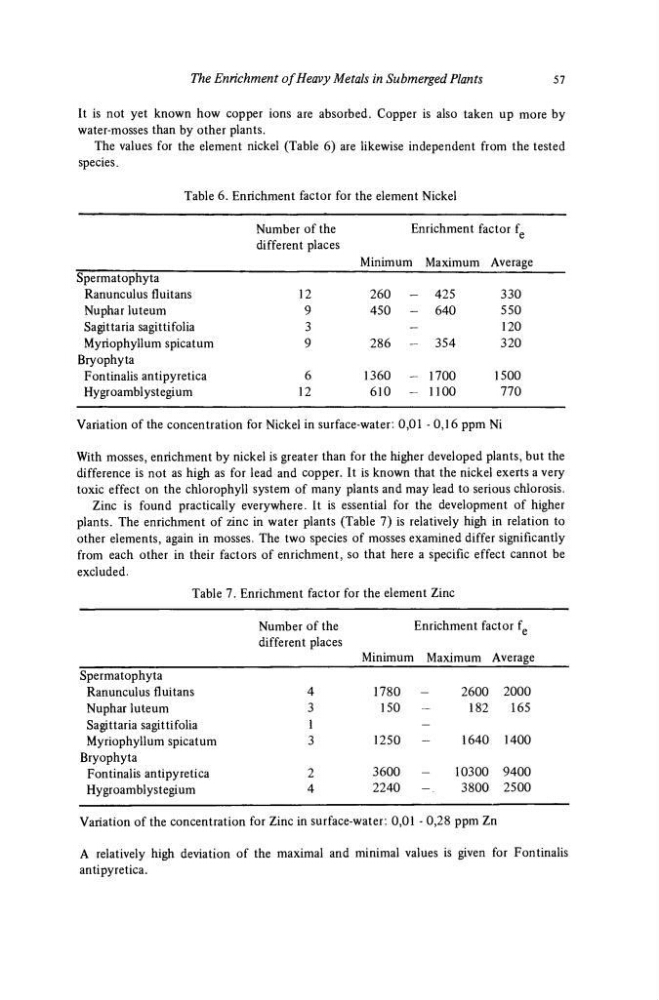
The values for the element nickel (Table 6) are likewise independent from the tested
species.
Table 6. Enrichment factor for the element Nickel
Number of the
different places
Enrichment factor f
Minimum Maximum Average
Spermatophyta
Ranunculus fluitans
Nuphar luteum
Sagittaria sagitti folia
Myriophyllum spicatum
Bryophyta
Fontinalis antipyretica
Hygroamblystegium
12
9
3
9
6
12
260
450
286
1360
610
-
425
-
640
-
-
354
- 1700
- 1100
330
550
120
320
1500
770
Variation of the concentration for Nickel in surface-water: 0,01 - 0,16 ppm Ni
With mosses, enrichment by nickel is greater than for the higher developed plants, but the
difference is not as high as for lead and copper. It is known that the nickel exerts a very
toxic effect on the chlorophyll system of many plants and may lead to serious chlorosis.
Zinc is found practically everywhere. It is essential for the development of higher
plants. The enrichment of zinc in water plants (Table 7) is relatively high in relation to
other elements, again in mosses. The two species of mosses examined differ significantly
from each other in their factors of enrichment, so that here a specific effect cannot be
excluded.
Table 7. Enrichment factor for the element Zinc
Spermatophyta
Ranunculus fluitans
Nuphar luteum
Sagittaria sagitti folia
Myriophyllum spicatum
Bryophyta
Fontinalis antipyretica
Hygroamblystegium
Number of the
different places
4
3
1
3
2
4
Minimum
1780
150
1250
3600
2240
Enrichment factor f
[ Maximum Average
2600 2000
182
165
1640 1400
10300 9400
3800 2500
Variation of the concentration for Zinc in surface-water: 0,01 - 0,28 ppm Zn
A relatively high deviation of the maximal and minimal values is given for Fontinalis
antipyretica.
57
It is not yet known how copper ions are absorbed. Copper is also taken up more by
water-mosses than by other plants.
The values for the element nickel (Table 6) are likewise independent from the tested
species.
Table 6. Enrichment factor for the element Nickel
Number of the
different places
Enrichment factor f
Minimum Maximum Average
Spermatophyta
Ranunculus fluitans
Nuphar luteum
Sagittaria sagitti folia
Myriophyllum spicatum
Bryophyta
Fontinalis antipyretica
Hygroamblystegium
12
9
3
9
6
12
260
450
286
1360
610
-
425
-
640
-
-
354
- 1700
- 1100
330
550
120
320
1500
770
Variation of the concentration for Nickel in surface-water: 0,01 - 0,16 ppm Ni
With mosses, enrichment by nickel is greater than for the higher developed plants, but the
difference is not as high as for lead and copper. It is known that the nickel exerts a very
toxic effect on the chlorophyll system of many plants and may lead to serious chlorosis.
Zinc is found practically everywhere. It is essential for the development of higher
plants. The enrichment of zinc in water plants (Table 7) is relatively high in relation to
other elements, again in mosses. The two species of mosses examined differ significantly
from each other in their factors of enrichment, so that here a specific effect cannot be
excluded.
Table 7. Enrichment factor for the element Zinc
Spermatophyta
Ranunculus fluitans
Nuphar luteum
Sagittaria sagitti folia
Myriophyllum spicatum
Bryophyta
Fontinalis antipyretica
Hygroamblystegium
Number of the
different places
4
3
1
3
2
4
Minimum
1780
150
1250
3600
2240
Enrichment factor f
[ Maximum Average
2600 2000
182
165
1640 1400
10300 9400
3800 2500
Variation of the concentration for Zinc in surface-water: 0,01 - 0,28 ppm Zn
A relatively high deviation of the maximal and minimal values is given for Fontinalis
antipyretica.