

Removal ofChromates from Pickling Liquors
619
25
50
mmol/l F*
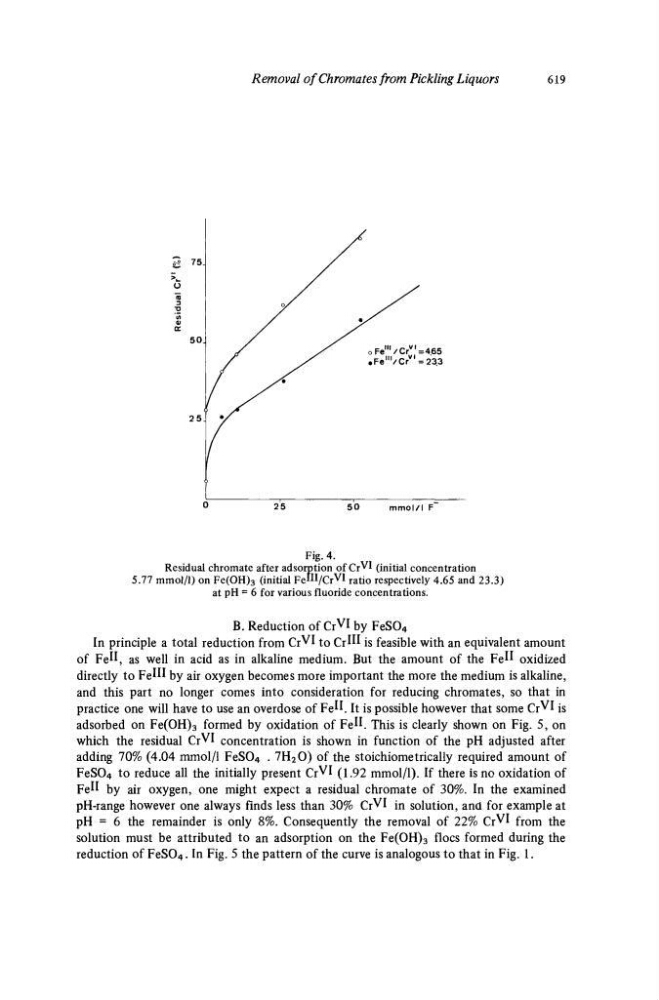
Fig. 4.
Residual chromate after adsorption of Cr^I (initial concentration
5.77 mmol/l) on Fe(OH) 3 (initial Fe
i n /Cr
V I ratio respectively 4.65 and 23.3)
at pH = 6 for various fluoride concentrations.
B. Reduction of CrVI by FeS0 4
In principle a total reduction from CrVI to CrIH is feasible with an equivalent amount
of Fell, a s W ell in acid as in alkaline medium. But the amount of the Fell oxidized
directly to Fe^I by air oxygen becomes more important the more the medium is alkaline,
and this part no longer comes into consideration for reducing chromates, so that in
practice one will have to use an overdose of Fell. It is possible however that some CrVI IS
adsorbed on Fe(0H) 3 formed by oxidation of Fell. This is clearly shown on Fig. 5, on
which the residual CrVI concentration is shown in function of the pH adjusted after
adding 70% (4.04 mmol/l FeS0 4 . 7H 2 0) of the stoichiometrically required amount of
FeS0 4 to reduce all the initially present CrVI (1.92 mmol/l). If there is no oxidation of
Fe^I by air oxygen, one might expect a residual chromate of 30%. In the examined
pH-range however one always finds less than 30% CrVI in solution, and for example at
pH = 6 the remainder is only 8%. Consequently the removal of 22% CrVI f r0 m the
solution must be attributed to an adsorption on the Fe(OH) 3 floes formed during the
reduction of FeS0 4 . In Fig. 5 the pattern of the curve is analogous to that in Fig. 1.
619
25
50
mmol/l F*
Fig. 4.
Residual chromate after adsorption of Cr^I (initial concentration
5.77 mmol/l) on Fe(OH) 3 (initial Fe
i n /Cr
V I ratio respectively 4.65 and 23.3)
at pH = 6 for various fluoride concentrations.
B. Reduction of CrVI by FeS0 4
In principle a total reduction from CrVI to CrIH is feasible with an equivalent amount
of Fell, a s W ell in acid as in alkaline medium. But the amount of the Fell oxidized
directly to Fe^I by air oxygen becomes more important the more the medium is alkaline,
and this part no longer comes into consideration for reducing chromates, so that in
practice one will have to use an overdose of Fell. It is possible however that some CrVI IS
adsorbed on Fe(0H) 3 formed by oxidation of Fell. This is clearly shown on Fig. 5, on
which the residual CrVI concentration is shown in function of the pH adjusted after
adding 70% (4.04 mmol/l FeS0 4 . 7H 2 0) of the stoichiometrically required amount of
FeS0 4 to reduce all the initially present CrVI (1.92 mmol/l). If there is no oxidation of
Fe^I by air oxygen, one might expect a residual chromate of 30%. In the examined
pH-range however one always finds less than 30% CrVI in solution, and for example at
pH = 6 the remainder is only 8%. Consequently the removal of 22% CrVI f r0 m the
solution must be attributed to an adsorption on the Fe(OH) 3 floes formed during the
reduction of FeS0 4 . In Fig. 5 the pattern of the curve is analogous to that in Fig. 1.