

618
D.A. Wilms, F.F. Notebaert and A.A. Van Haute
This is a direct result of the characteristics of an adsorption, which corresponds to the
Freundlich equation(^):
M
R -
7n
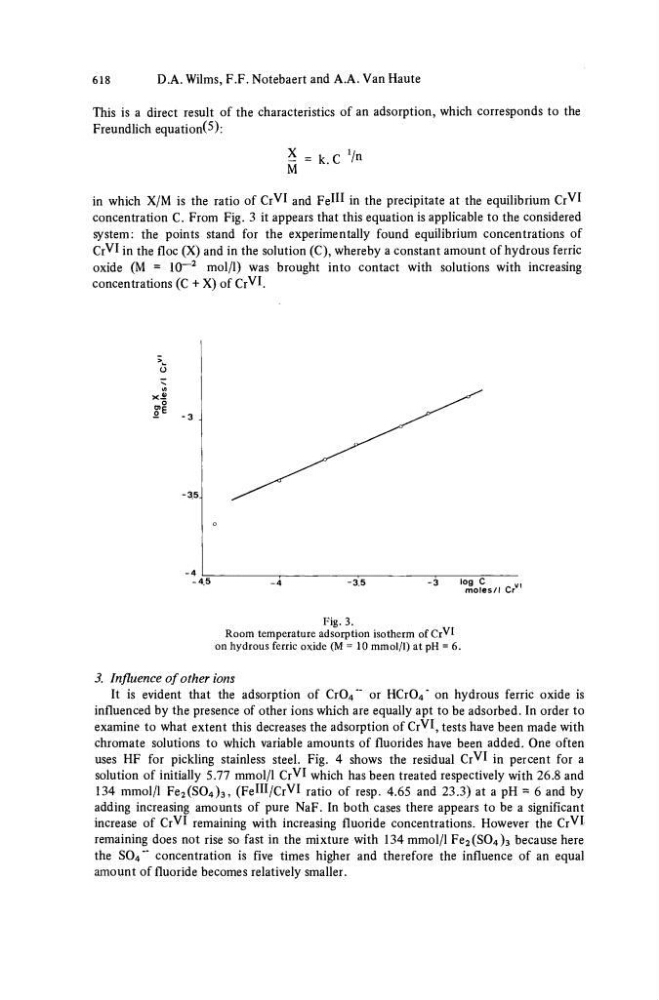
in which X/M is the ratio of CrVI and FeHI in the precipitate at the equilibrium CrVI
concentration C. From Fig. 3 it appears that this equation is applicable to the considered
system: the points stand for the experimentally found equilibrium concentrations of
CrVI i n the floe (X) and in the solution (C), whereby a constant amount of hydrous ferric
oxide (M = 10~~
2 mol/1) was brought into contact with solutions with increasing
concentrations (C + X) of CrVI.
"3 J
-3.5
- 4 . 5
- 3 . 5
log C
m o l e s / I Cr
Fig. 3.
Room temperature adsorption isotherm of CrVI
on hydrous ferric oxide (M = 10 mmol/1) at pH = 6.
3. Influence of other ions
It is evident that the adsorption of Cr0 4 ~~ or HCr0 4 " on hydrous ferric oxide is
influenced by the presence of other ions which are equally apt to be adsorbed. In order to
examine to what extent this decreases the adsorption of CrVI, tests have been made with
chromate solutions to which variable amounts of fluorides have been added. One often
uses HF for pickling stainless steel. Fig. 4 shows the residual CrVI m percent for a
solution of initially 5.77 mmol/1 CrVI which has been treated respectively with 26.8 and
134 mmol/1 Fe 2 (S0 4 ) 3 , (FeM/CrVI ratio of resp. 4.65 and 23.3) at a pH = 6 and by
adding increasing amounts of pure NaF. In both cases there appears to be a significant
increase of CrVI remaining with increasing fluoride concentrations. However the CrVI
remaining does not rise so fast in the mixture with 134 mmol/1 Fe 2 (S0 4 ) 3 because here
the S0 4 "~ concentration is five times higher and therefore the influence of an equal
amount of fluoride becomes relatively smaller.
D.A. Wilms, F.F. Notebaert and A.A. Van Haute
This is a direct result of the characteristics of an adsorption, which corresponds to the
Freundlich equation(^):
M
R -
7n
in which X/M is the ratio of CrVI and FeHI in the precipitate at the equilibrium CrVI
concentration C. From Fig. 3 it appears that this equation is applicable to the considered
system: the points stand for the experimentally found equilibrium concentrations of
CrVI i n the floe (X) and in the solution (C), whereby a constant amount of hydrous ferric
oxide (M = 10~~
2 mol/1) was brought into contact with solutions with increasing
concentrations (C + X) of CrVI.
"3 J
-3.5
- 4 . 5
- 3 . 5
log C
m o l e s / I Cr
Fig. 3.
Room temperature adsorption isotherm of CrVI
on hydrous ferric oxide (M = 10 mmol/1) at pH = 6.
3. Influence of other ions
It is evident that the adsorption of Cr0 4 ~~ or HCr0 4 " on hydrous ferric oxide is
influenced by the presence of other ions which are equally apt to be adsorbed. In order to
examine to what extent this decreases the adsorption of CrVI, tests have been made with
chromate solutions to which variable amounts of fluorides have been added. One often
uses HF for pickling stainless steel. Fig. 4 shows the residual CrVI m percent for a
solution of initially 5.77 mmol/1 CrVI which has been treated respectively with 26.8 and
134 mmol/1 Fe 2 (S0 4 ) 3 , (FeM/CrVI ratio of resp. 4.65 and 23.3) at a pH = 6 and by
adding increasing amounts of pure NaF. In both cases there appears to be a significant
increase of CrVI remaining with increasing fluoride concentrations. However the CrVI
remaining does not rise so fast in the mixture with 134 mmol/1 Fe 2 (S0 4 ) 3 because here
the S0 4 "~ concentration is five times higher and therefore the influence of an equal
amount of fluoride becomes relatively smaller.