

Removal of Chromates from Pickling Liquors
617
The decreasing adsorption for values of pH higher than 6, can partly be attributed to the
fact that with an increasing pH the charge of the hydrous ferric oxide becomes less
positive; a decrease of adsorption for values of pH lower than 6 is amongst others
attributable to the fact that above pH = 6.45 the Cr^I occurs in solution mainly as
Cr0 4 ", but below this pH mainly as the less negative HCr0 4 ".
2. Influence of the FeM/CrW ratio
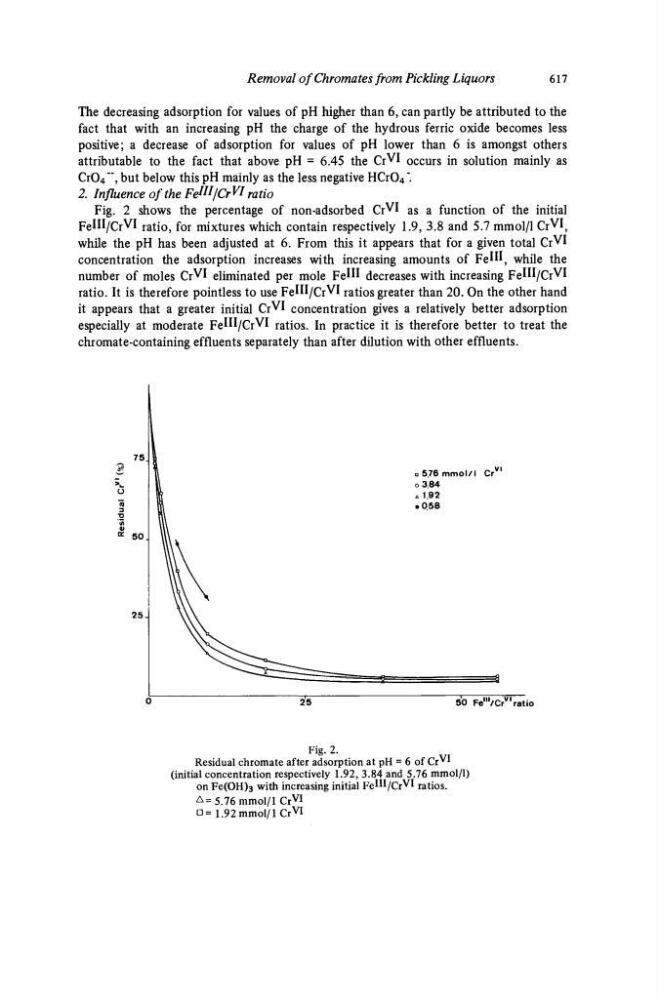
Fig. 2 shows the percentage of non-adsorbed Cr^I as a function of the initial
FeM/CrVI ratio, for mixtures which contain respectively 1.9, 3.8 and 5.7 mmol/1 CrVI,
while the pH has been adjusted at 6. From this it appears that for a given total CrVI
concentration the adsorption increases with increasing amounts of FelH, while the
number of moles Cr^I eliminated per mole FelH decreases with increasing FelH/CrVI
ratio. It is therefore pointless to use FeHI/CrVI ratios greater than 20. On the other hand
it appears that a greater initial CrVI concentration gives a relatively better adsorption
especially at moderate FeHtyCrVI ratios. In practice it is therefore better to treat the
chromate-containing effluents separately than after dilution with other effluents.
a 5.76 mmol/l
o384
*1.92
. 0 5 8
50 Fe"7Cr ratio
Fig. 2.
Residual chromate after adsorption at pH = 6 of Cr^I
(initial concentration respectively 1.92, 3.84 and 5.76 mmol/1)
on Fe(OH) 3 with increasing initial Fe
nl /Cr
VI ratios.
Δ= 5.76 mmol/1 CrVI
= 1.92 mmol/1 CrVI
617
The decreasing adsorption for values of pH higher than 6, can partly be attributed to the
fact that with an increasing pH the charge of the hydrous ferric oxide becomes less
positive; a decrease of adsorption for values of pH lower than 6 is amongst others
attributable to the fact that above pH = 6.45 the Cr^I occurs in solution mainly as
Cr0 4 ", but below this pH mainly as the less negative HCr0 4 ".
2. Influence of the FeM/CrW ratio
Fig. 2 shows the percentage of non-adsorbed Cr^I as a function of the initial
FeM/CrVI ratio, for mixtures which contain respectively 1.9, 3.8 and 5.7 mmol/1 CrVI,
while the pH has been adjusted at 6. From this it appears that for a given total CrVI
concentration the adsorption increases with increasing amounts of FelH, while the
number of moles Cr^I eliminated per mole FelH decreases with increasing FelH/CrVI
ratio. It is therefore pointless to use FeHI/CrVI ratios greater than 20. On the other hand
it appears that a greater initial CrVI concentration gives a relatively better adsorption
especially at moderate FeHtyCrVI ratios. In practice it is therefore better to treat the
chromate-containing effluents separately than after dilution with other effluents.
a 5.76 mmol/l
o384
*1.92
. 0 5 8
50 Fe"7Cr ratio
Fig. 2.
Residual chromate after adsorption at pH = 6 of Cr^I
(initial concentration respectively 1.92, 3.84 and 5.76 mmol/1)
on Fe(OH) 3 with increasing initial Fe
nl /Cr
VI ratios.
Δ= 5.76 mmol/1 CrVI
= 1.92 mmol/1 CrVI