

616
D.A. Wilms, F.F. Notebaert and A.A. Van Haute
adjustment of the desired end-pH. When the precipitate of Fe(OH) 3 has just been formed
the CrVI-concentration in solution appears to vary rapidly during the first minutes; after
a contact time of 1 hour the residual-Cr^I concentration remains substantially constant.
At higher temperature the amount of adsorbed Cr^I is somewhat lower than at lower
temperature. Therefore in later experiments we used the following conditions:
The desired initial concentration of Cr^I is prepared starting from pure K 2 Cr 2 0 7 . The
desired amount of FeHI is added to the first solution as a solution of pure Fe 2 (S0 4 ) 3 ,
and the mixture brought to the desired pH by adding NaOH solution. The mixture is
thoroughly mixed by magnetic stirrer for 1 hour, the decrease in pH being corrected by
adding NaOH. After 1 hour the mixture is filtered, and the residual CrVI [ s determined in
the filtrate by titration with iodide for CrVI concentrations higher than approximately 20
mg Cr/1, and spectrophotometrically with diphenylcarbazide for lower concentrations.^)
The experiments were done at room temperature.
1. Influence ofpH on the adsorption
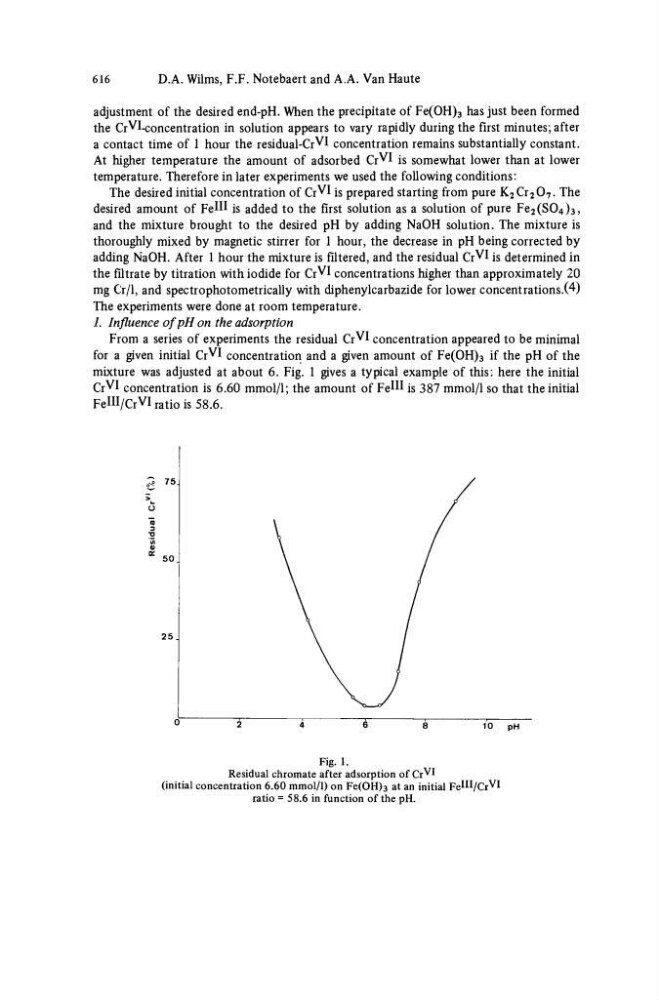
From a series of experiments the residual CrVI concentration appeared to be minimal
for a given initial CrVI concentration and a given amount of Fe(OH) 3 if the pH of the
mixture was adjusted at about 6. Fig. 1 gives a typical example of this: here the initial
CrVI concentration is 6.60 mmol/1; the amount of Fe^I is 387 mmol/1 so that the initial
Felll/CrVI ratio is 58.6.
3
75
1
>
o
3
Ό
* 50
25 I
0
2
4
6
8
10
pH
Fig. 1.
Residual chromate after adsorption of Cr^I
(initial concentration 6.60 mmol/1) on Fe(OH) 3 at an initial FeHtyCr
VI
ratio = 58.6 in function of the pH.
D.A. Wilms, F.F. Notebaert and A.A. Van Haute
adjustment of the desired end-pH. When the precipitate of Fe(OH) 3 has just been formed
the CrVI-concentration in solution appears to vary rapidly during the first minutes; after
a contact time of 1 hour the residual-Cr^I concentration remains substantially constant.
At higher temperature the amount of adsorbed Cr^I is somewhat lower than at lower
temperature. Therefore in later experiments we used the following conditions:
The desired initial concentration of Cr^I is prepared starting from pure K 2 Cr 2 0 7 . The
desired amount of FeHI is added to the first solution as a solution of pure Fe 2 (S0 4 ) 3 ,
and the mixture brought to the desired pH by adding NaOH solution. The mixture is
thoroughly mixed by magnetic stirrer for 1 hour, the decrease in pH being corrected by
adding NaOH. After 1 hour the mixture is filtered, and the residual CrVI [ s determined in
the filtrate by titration with iodide for CrVI concentrations higher than approximately 20
mg Cr/1, and spectrophotometrically with diphenylcarbazide for lower concentrations.^)
The experiments were done at room temperature.
1. Influence ofpH on the adsorption
From a series of experiments the residual CrVI concentration appeared to be minimal
for a given initial CrVI concentration and a given amount of Fe(OH) 3 if the pH of the
mixture was adjusted at about 6. Fig. 1 gives a typical example of this: here the initial
CrVI concentration is 6.60 mmol/1; the amount of Fe^I is 387 mmol/1 so that the initial
Felll/CrVI ratio is 58.6.
3
75
1
>
o
3
Ό
* 50
25 I
0
2
4
6
8
10
pH
Fig. 1.
Residual chromate after adsorption of Cr^I
(initial concentration 6.60 mmol/1) on Fe(OH) 3 at an initial FeHtyCr
VI
ratio = 58.6 in function of the pH.