

620
D.A. Wilms, F.F. Notebaert and A.A. Van Haute
>
ό
75
i
30
1
"55
0)
cr
20 J
10 I
2
4
6
8
pH
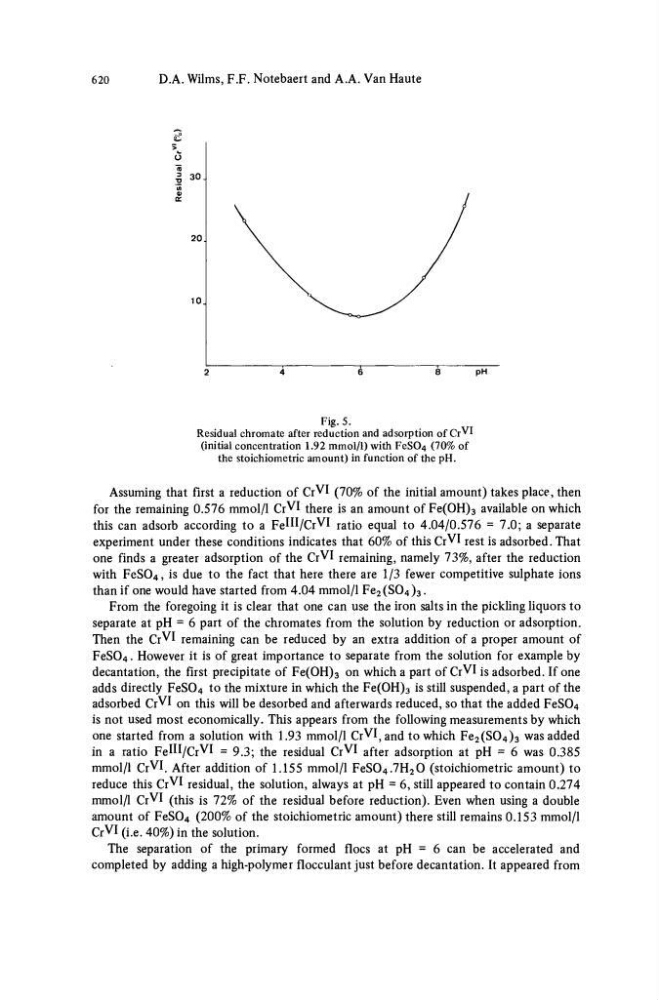
Fig. 5.
Residual chromate after reduction and adsorption of CrVI
(initial concentration 1.92 mmol/1) with FeS0 4 (70% of
the stoichiometric amount) in function of the pH.
Assuming that first a reduction of CrVI (70% of the initial amount) takes place, then
for the remaining 0.576 mmol/1 CrVI there is an amount of Fe(OH) 3 available on which
this can adsorb according to a FeHI/CrVI ratio equal to 4.04/0.576 = 7.0; a separate
experiment under these conditions indicates that 60% of this CrVI r e s t i s adsorbed. That
one finds a greater adsorption of the CrVI remaining, namely 73%, after the reduction
with FeS0 4 , is due to the fact that here there are 1/3 fewer competitive sulphate ions
than if one would have started from 4.04 mmol/1 Fe 2 (S0 4 ) 3 .
From the foregoing it is clear that one can use the iron salts in the pickling liquors to
separate at pH = 6 part of the chromates from the solution by reduction or adsorption.
Then the CrVI remaining can be reduced by an extra addition of a proper amount of
FeS0 4 . However it is of great importance to separate from the solution for example by
decantation, the first precipitate of Fe(OH) 3 on which a part of CrVI is adsorbed. If one
adds directly FeS0 4 to the mixture in which the Fe(OH) 3 is still suspended, a part of the
adsorbed CrVI o n this will be desorbed and afterwards reduced, so that the added FeS0 4
is not used most economically. This appears from the following measurements by which
one started from a solution with 1.93 mmol/1 CrVI, anc [ to which Fe 2 (S0 4 ) 3 was added
in a ratio FeHI/CrVI = 9.3; the residual CrVI a ft er adsorption at pH = 6 was 0.385
mmol/1 CrVI. After addition of 1.155 mmol/1 FeS0 4 .7H 2 0 (stoichiometric amount) to
reduce this CrVI residual, the solution, always at pH = 6, still appeared to contain 0.274
mmol/1 CrVI (this is 72% of the residual before reduction). Even when using a double
amount of FeS0 4 (200% of the stoichiometric amount) there still remains 0.153 mmol/1
CrVI (i.e. 40%) in the solution.
The separation of the primary formed floes at pH = 6 can be accelerated and
completed by adding a high-polymer flocculant just before decantation. It appeared from
D.A. Wilms, F.F. Notebaert and A.A. Van Haute
>
ό
75
i
30
1
"55
0)
cr
20 J
10 I
2
4
6
8
pH
Fig. 5.
Residual chromate after reduction and adsorption of CrVI
(initial concentration 1.92 mmol/1) with FeS0 4 (70% of
the stoichiometric amount) in function of the pH.
Assuming that first a reduction of CrVI (70% of the initial amount) takes place, then
for the remaining 0.576 mmol/1 CrVI there is an amount of Fe(OH) 3 available on which
this can adsorb according to a FeHI/CrVI ratio equal to 4.04/0.576 = 7.0; a separate
experiment under these conditions indicates that 60% of this CrVI r e s t i s adsorbed. That
one finds a greater adsorption of the CrVI remaining, namely 73%, after the reduction
with FeS0 4 , is due to the fact that here there are 1/3 fewer competitive sulphate ions
than if one would have started from 4.04 mmol/1 Fe 2 (S0 4 ) 3 .
From the foregoing it is clear that one can use the iron salts in the pickling liquors to
separate at pH = 6 part of the chromates from the solution by reduction or adsorption.
Then the CrVI remaining can be reduced by an extra addition of a proper amount of
FeS0 4 . However it is of great importance to separate from the solution for example by
decantation, the first precipitate of Fe(OH) 3 on which a part of CrVI is adsorbed. If one
adds directly FeS0 4 to the mixture in which the Fe(OH) 3 is still suspended, a part of the
adsorbed CrVI o n this will be desorbed and afterwards reduced, so that the added FeS0 4
is not used most economically. This appears from the following measurements by which
one started from a solution with 1.93 mmol/1 CrVI, anc [ to which Fe 2 (S0 4 ) 3 was added
in a ratio FeHI/CrVI = 9.3; the residual CrVI a ft er adsorption at pH = 6 was 0.385
mmol/1 CrVI. After addition of 1.155 mmol/1 FeS0 4 .7H 2 0 (stoichiometric amount) to
reduce this CrVI residual, the solution, always at pH = 6, still appeared to contain 0.274
mmol/1 CrVI (this is 72% of the residual before reduction). Even when using a double
amount of FeS0 4 (200% of the stoichiometric amount) there still remains 0.153 mmol/1
CrVI (i.e. 40%) in the solution.
The separation of the primary formed floes at pH = 6 can be accelerated and
completed by adding a high-polymer flocculant just before decantation. It appeared from