

598
J. Bebin, P. Boulenger and J.C. Bourdelot
l§
ioofe
90
80 +
70·
60
504 ^
Colour
.-JLQD
_^f■30
20
110
4
5
6
7 pH
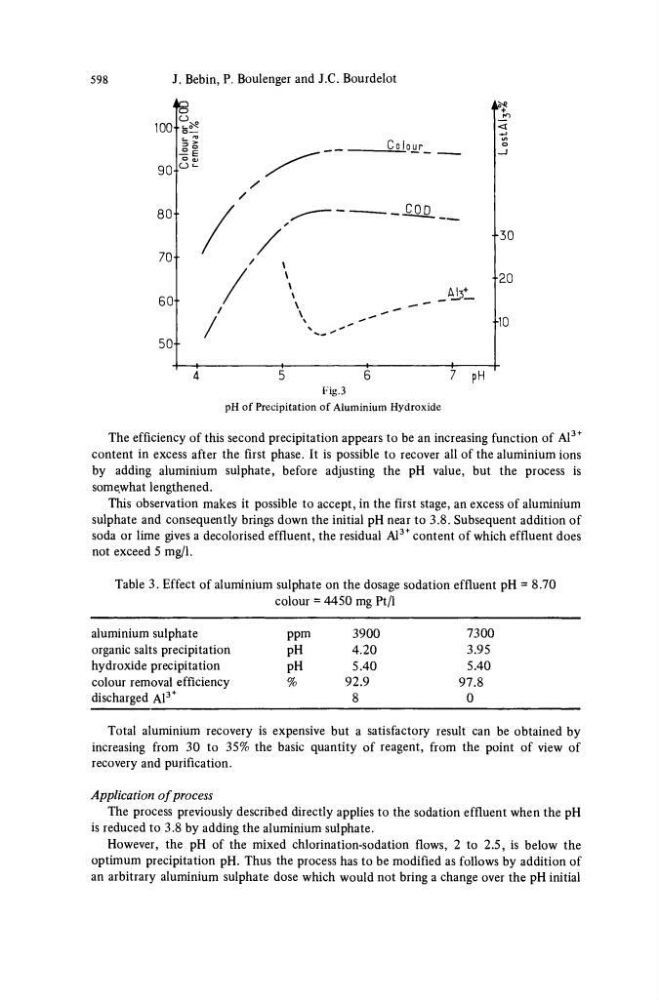
Fig.3
pH of Precipitation of Aluminium Hydroxide
The efficiency of this second precipitation appears to be an increasing function of Al
3+
content in excess after the first phase. It is possible to recover all of the aluminium ions
by adding aluminium sulphate, before adjusting the pH value, but the process is
somewhat lengthened.
This observation makes it possible to accept, in the first stage, an excess of aluminium
sulphate and consequently brings down the initial pH near to 3.8. Subsequent addition of
soda or lime gives a decolorised effluent, the residual Al
3+ content of which effluent does
not exceed 5 mg/1.
Table 3. Effect of aluminium sulphate on the dosage sodation effluent pH
colour = 4450 mg Pt/1
8.70
aluminium sulphate
organic salts precipitation
hydroxide precipitation
colour removal efficiency
discharged Al
3+
ppm
pH
pH
%
3900
4.20
5.40
92.9
8
7300
3.95
5.40
97.8
0
Total aluminium recovery is expensive but a satisfactory result can be obtained by
increasing from 30 to 35% the basic quantity of reagent, from the point of view of
recovery and purification.
Application of process
The process previously described directly applies to the sodation effluent when the pH
is reduced to 3.8 by adding the aluminium sulphate.
However, the pH of the mixed chlorination-sodation flows, 2 to 2.5, is below the
optimum precipitation pH. Thus the process has to be modified as follows by addition of
an arbitrary aluminium sulphate dose which would not bring a change over the pH initial
J. Bebin, P. Boulenger and J.C. Bourdelot
l§
ioofe
90
80 +
70·
60
504 ^
Colour
.-JLQD
_^f■30
20
110
4
5
6
7 pH
Fig.3
pH of Precipitation of Aluminium Hydroxide
The efficiency of this second precipitation appears to be an increasing function of Al
3+
content in excess after the first phase. It is possible to recover all of the aluminium ions
by adding aluminium sulphate, before adjusting the pH value, but the process is
somewhat lengthened.
This observation makes it possible to accept, in the first stage, an excess of aluminium
sulphate and consequently brings down the initial pH near to 3.8. Subsequent addition of
soda or lime gives a decolorised effluent, the residual Al
3+ content of which effluent does
not exceed 5 mg/1.
Table 3. Effect of aluminium sulphate on the dosage sodation effluent pH
colour = 4450 mg Pt/1
8.70
aluminium sulphate
organic salts precipitation
hydroxide precipitation
colour removal efficiency
discharged Al
3+
ppm
pH
pH
%
3900
4.20
5.40
92.9
8
7300
3.95
5.40
97.8
0
Total aluminium recovery is expensive but a satisfactory result can be obtained by
increasing from 30 to 35% the basic quantity of reagent, from the point of view of
recovery and purification.
Application of process
The process previously described directly applies to the sodation effluent when the pH
is reduced to 3.8 by adding the aluminium sulphate.
However, the pH of the mixed chlorination-sodation flows, 2 to 2.5, is below the
optimum precipitation pH. Thus the process has to be modified as follows by addition of
an arbitrary aluminium sulphate dose which would not bring a change over the pH initial