

Colour Removal from Bleached Kraft Pulp Waste Waters
599
value, and then adding alkali to increase the pH value to 5.4. Simultaneous precipitation
of the organic matter and excess aluminium hydroxide occurs. This double precipitation
can take place in the same tank divided in two compartments, provided there is ample
contact time between the two successive applications of reagent doses.
Sludge characteristics
Organic salts and aluminium hydroxide are precipitated as a sludge of high water
content; after 2 hours settlement and polyelectrolyte addition, it would represent a
volume of 0.2 m
3 with 3 kg of dry matter per cu.m of treated waste.
The utilization of lime instead of soda to raise the pH value has the advantage of
cheapness: it also improves sludge settlement. However, the presence of calcium ion in
this type of sludge requires special attention. Care should be taken that the dose of Ca
does not result in the solubility value of calcium sulphate being exceeded.
Recovery of aluminium sulphate from settled sludge
Our work shows the impossibility of recovering the aluminium from the sludge by
concentration and acidification. A bad redissolution of aluminium and a reversion of
colour is noted. To recover the aluminium the drawn off sludge is thickened, in order to
raise the suspended matter concentration to 30-40 g/1. Further dewatering, by
centrifugation and conditioning by anionic polyelectrolyte will bring the dry matter
content up to 18 to 23%.
Incineration
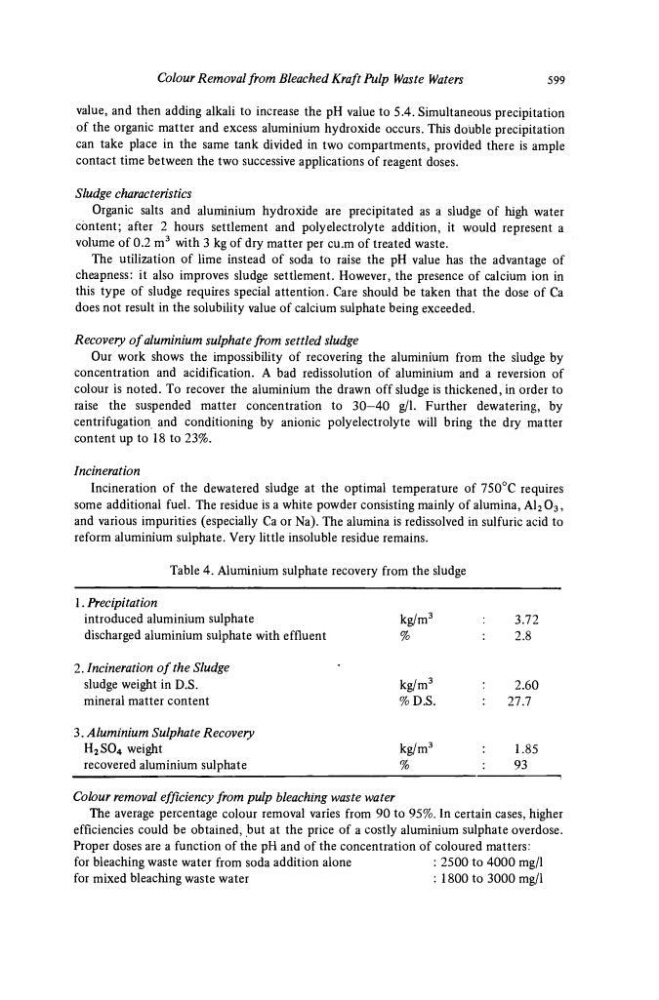
Incineration of the dewatered sludge at the optimal temperature of 750°C requires
some additional fuel. The residue is a white powder consisting mainly of alumina, A1 2 0 3 ,
and various impurities (especially Ca or Na). The alumina is redissolved in sulfuric acid to
reform aluminium sulphate. Very little insoluble residue remains.
Table 4. Aluminium sulphate recovery from the sludge
1. Precipitation
introduced aluminium sulphate
kg/m
3
3.72
discharged aluminium sulphate with effluent
%
:
2.8
2. Incineration of the Sludge
sludge weight in D.S.
kg/m
3
:
2.60
mineral matter content
%D.S.
:
27.7
3. Aluminium Sulphate Recovery
H 2 S0 4 weight
kg/m
3
:
1.85
recovered aluminium sulphate
%
93
Colour removal efficiency from pulp bleaching waste water
The average percentage colour removal varies from 90 to 95%. In certain cases, higher
efficiencies could be obtained, but at the price of a costly aluminium sulphate overdose.
Proper doses are a function of the pH and of the concentration of coloured matters:
for bleaching waste water from soda addition alone
: 2500 to 4000 mg/1
for mixed bleaching waste water
: 1800 to 3000 mg/1
599
value, and then adding alkali to increase the pH value to 5.4. Simultaneous precipitation
of the organic matter and excess aluminium hydroxide occurs. This double precipitation
can take place in the same tank divided in two compartments, provided there is ample
contact time between the two successive applications of reagent doses.
Sludge characteristics
Organic salts and aluminium hydroxide are precipitated as a sludge of high water
content; after 2 hours settlement and polyelectrolyte addition, it would represent a
volume of 0.2 m
3 with 3 kg of dry matter per cu.m of treated waste.
The utilization of lime instead of soda to raise the pH value has the advantage of
cheapness: it also improves sludge settlement. However, the presence of calcium ion in
this type of sludge requires special attention. Care should be taken that the dose of Ca
does not result in the solubility value of calcium sulphate being exceeded.
Recovery of aluminium sulphate from settled sludge
Our work shows the impossibility of recovering the aluminium from the sludge by
concentration and acidification. A bad redissolution of aluminium and a reversion of
colour is noted. To recover the aluminium the drawn off sludge is thickened, in order to
raise the suspended matter concentration to 30-40 g/1. Further dewatering, by
centrifugation and conditioning by anionic polyelectrolyte will bring the dry matter
content up to 18 to 23%.
Incineration
Incineration of the dewatered sludge at the optimal temperature of 750°C requires
some additional fuel. The residue is a white powder consisting mainly of alumina, A1 2 0 3 ,
and various impurities (especially Ca or Na). The alumina is redissolved in sulfuric acid to
reform aluminium sulphate. Very little insoluble residue remains.
Table 4. Aluminium sulphate recovery from the sludge
1. Precipitation
introduced aluminium sulphate
kg/m
3
3.72
discharged aluminium sulphate with effluent
%
:
2.8
2. Incineration of the Sludge
sludge weight in D.S.
kg/m
3
:
2.60
mineral matter content
%D.S.
:
27.7
3. Aluminium Sulphate Recovery
H 2 S0 4 weight
kg/m
3
:
1.85
recovered aluminium sulphate
%
93
Colour removal efficiency from pulp bleaching waste water
The average percentage colour removal varies from 90 to 95%. In certain cases, higher
efficiencies could be obtained, but at the price of a costly aluminium sulphate overdose.
Proper doses are a function of the pH and of the concentration of coloured matters:
for bleaching waste water from soda addition alone
: 2500 to 4000 mg/1
for mixed bleaching waste water
: 1800 to 3000 mg/1