

Colour Removal from Bleached Kraft Pulp Waste Waters
597
ALUMINIUM SULPHATE PROCESS
By this process coloured substances are removed as an aluminium organic precipitate,
which is settled and incinerated in order to recover the aluminium. The results are given
of a laboratory study carried out for many months in a modern pulp bleached Kraft
factory.
Laboratory procedures. Optimum conditions for the precipitation of organic salts
Precipitation with commercial aluminium sulphate, A1 2 (S0 4 ) 3 , 18 H 2 0, occurs in an
acid medium in a well defined pH zone close to 4.1. Above and below this zone, whatever
the quantity of added aluminium, the reaction is not apparently improved.
Table 2. Precipitation at different initial pH values
initial pH
optimum precipitation pH
Colour (mg Pt/1)
reduction %
sludge volume after
30 mins in %
8.0
3.7
1780
63
52
9.2
3.85
1680
65
53
10.25
4.1
1100
77
63
11.2
5.2
2400
50
32.5
12.0
10.95
4800
0
0
The required dose of aluminium sulphate to attain the optimum pH depends on various
factors amongst which the initial pH of the effluent to be treated and its buffering
capacity; the dose might vary from 2000 to 4000 ppm.
Definition of optimum conditions of precipitation of aluminium hydroxide
The efficiency of the reaction is limited and a large quantity of aluminium ions as Al
3+
still remain in solution. The second stage aims at precipitating it, in order to recover it
later.
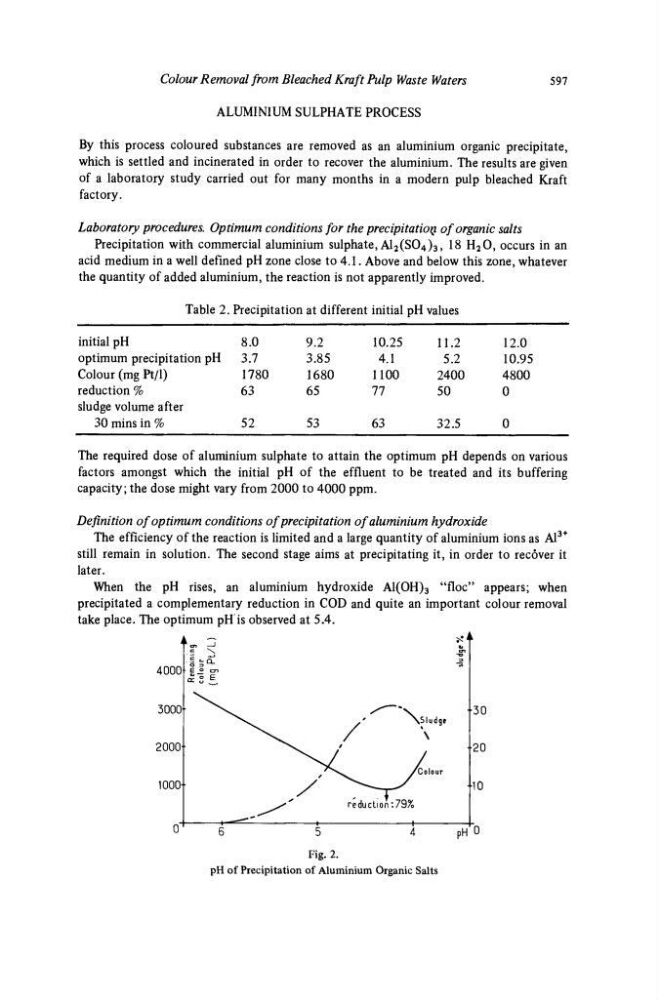
When the pH rises, an aluminium hydroxide Al(OH) 3 "floe" appears; when
precipitated a complementary reduction in COD and quite an important colour removal
take place. The optimum pH is observed at 5.4.
T \
4000f | J ^
1000Colour
reduction: 79%
30
20
10
P H 0
Fig. 2.
pH of Precipitation of Aluminium Organic Salts
597
ALUMINIUM SULPHATE PROCESS
By this process coloured substances are removed as an aluminium organic precipitate,
which is settled and incinerated in order to recover the aluminium. The results are given
of a laboratory study carried out for many months in a modern pulp bleached Kraft
factory.
Laboratory procedures. Optimum conditions for the precipitation of organic salts
Precipitation with commercial aluminium sulphate, A1 2 (S0 4 ) 3 , 18 H 2 0, occurs in an
acid medium in a well defined pH zone close to 4.1. Above and below this zone, whatever
the quantity of added aluminium, the reaction is not apparently improved.
Table 2. Precipitation at different initial pH values
initial pH
optimum precipitation pH
Colour (mg Pt/1)
reduction %
sludge volume after
30 mins in %
8.0
3.7
1780
63
52
9.2
3.85
1680
65
53
10.25
4.1
1100
77
63
11.2
5.2
2400
50
32.5
12.0
10.95
4800
0
0
The required dose of aluminium sulphate to attain the optimum pH depends on various
factors amongst which the initial pH of the effluent to be treated and its buffering
capacity; the dose might vary from 2000 to 4000 ppm.
Definition of optimum conditions of precipitation of aluminium hydroxide
The efficiency of the reaction is limited and a large quantity of aluminium ions as Al
3+
still remain in solution. The second stage aims at precipitating it, in order to recover it
later.
When the pH rises, an aluminium hydroxide Al(OH) 3 "floe" appears; when
precipitated a complementary reduction in COD and quite an important colour removal
take place. The optimum pH is observed at 5.4.
T \
4000f | J ^
1000Colour
reduction: 79%
30
20
10
P H 0
Fig. 2.
pH of Precipitation of Aluminium Organic Salts