

596
J. Bebin, P. Boulenger and J.C. Bourdelot
COLOUR REMOVAL WITH LIME
It was assumed that colour removal with lime would result from a chemical reaction
where enolic and phenolic groups of the structures which themselves are bound with
chromophoric groups, would combine with lime within an alkaline medium, and produce
insoluble organic calcium compounds, whereas the molecular weight of the solids
contained in the spent liquor would be of importance.
LIME KILN
VACUUM FILTER
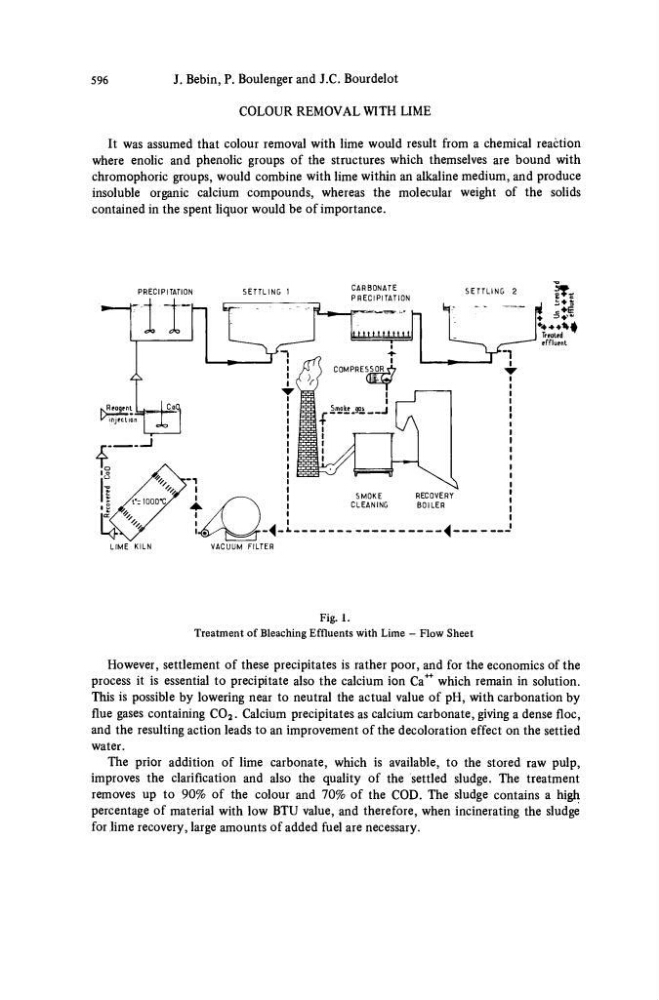
Fig. 1.
Treatment of Bleaching Effluents with Lime - Flow Sheet
However, settlement of these precipitates is rather poor, and for the economics of the
process it is essential to precipitate also the calcium ion Ca
++ which remain in solution.
This is possible by lowering near to neutral the actual value of pH, with carbonation by
flue gases containing C0 2 . Calcium precipitates as calcium carbonate, giving a dense floe,
and the resulting action leads to an improvement of the decoloration effect on the settled
water.
The prior addition of lime carbonate, which is available, to the stored raw pulp,
improves the clarification and also the quality of the settled sludge. The treatment
removes up to 90% of the colour and 70% of the COD. The sludge contains a high
percentage of material with low BTU value, and therefore, when incinerating the sludge
for lime recovery, large amounts of added fuel are necessary.
J. Bebin, P. Boulenger and J.C. Bourdelot
COLOUR REMOVAL WITH LIME
It was assumed that colour removal with lime would result from a chemical reaction
where enolic and phenolic groups of the structures which themselves are bound with
chromophoric groups, would combine with lime within an alkaline medium, and produce
insoluble organic calcium compounds, whereas the molecular weight of the solids
contained in the spent liquor would be of importance.
LIME KILN
VACUUM FILTER
Fig. 1.
Treatment of Bleaching Effluents with Lime - Flow Sheet
However, settlement of these precipitates is rather poor, and for the economics of the
process it is essential to precipitate also the calcium ion Ca
++ which remain in solution.
This is possible by lowering near to neutral the actual value of pH, with carbonation by
flue gases containing C0 2 . Calcium precipitates as calcium carbonate, giving a dense floe,
and the resulting action leads to an improvement of the decoloration effect on the settled
water.
The prior addition of lime carbonate, which is available, to the stored raw pulp,
improves the clarification and also the quality of the settled sludge. The treatment
removes up to 90% of the colour and 70% of the COD. The sludge contains a high
percentage of material with low BTU value, and therefore, when incinerating the sludge
for lime recovery, large amounts of added fuel are necessary.