

COLOUR REMOVAL FROM BLEACHED
KRAFT-PULP WASTE WATERS
J. BEBIN, P. BOULENGER and J.C. BOURDELOT
5, Boulevard du General de Gaulle, 92 Rueil Malmaison, France
INTRODUCTION
The paper-pulp industry produces 10% of the pollution of all the French industries.
The effluents are strongly coloured, and high in content of non-biodegradable products
which are mostly due to the presence of lignin upon which biological treatment has
almost no effect. In order to solve this problem, it is necessary to rely on new techniques.
So far only coagulation with lime and precipitation have been applied on an industrial
scale. We describe in this paper a new process of colour removal with aluminium sulphate
coagulation, taking as an example waste water from the manufacture of bleached Kraft
pulp.
CHARACTERISTICS OF THE EFFLUENTS
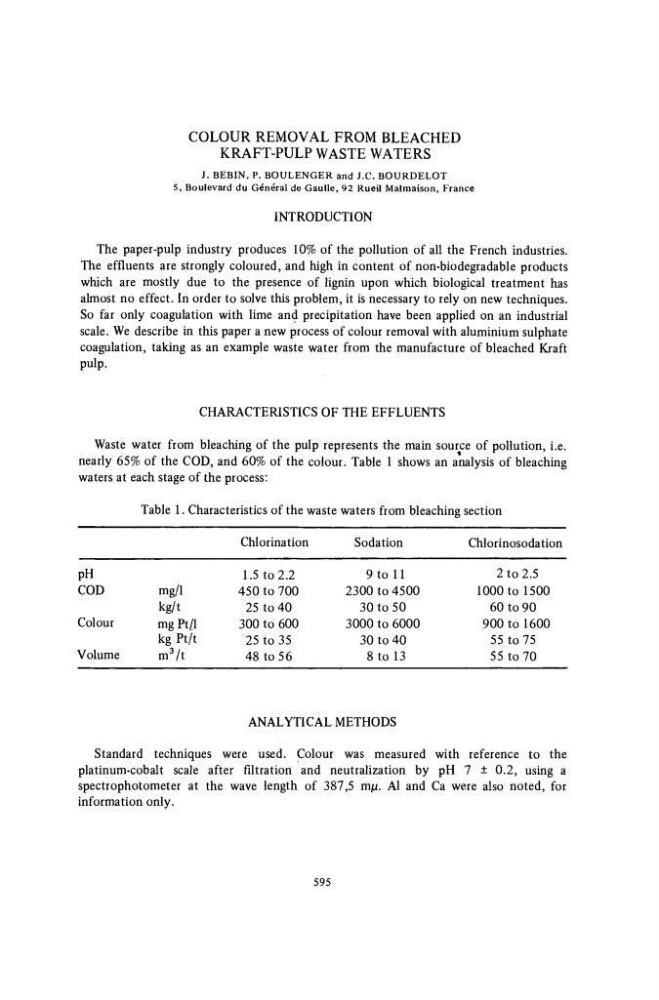
Waste water from bleaching of the pulp represents the main source of pollution, i.e.
nearly 65% of the COD, and 60% of the colour. Table 1 shows an analysis of bleaching
waters at each stage of the process:
Table 1. Characteristics of the waste waters from bleaching section
pH
COD
Colour
Volume
mg/1
kg/t
mg Pt/1
kg Pt/t
m
3 /t
Chlorination
1.5 to 2.2
450 to 700
25 to 40
300 to 600
25 to 35
48 to 56
Sodation
9 to 11
2300 to 4500
30 to 50
3000 to 6000
30 to 40
8 to 13
Chlorinosodation
2 to 2.5
1000 to 1500
60 to 90
900 to 1600
55 to 75
55 to 70
ANALYTICAL METHODS
Standard techniques were used. Colour was measured with reference to the
platinum-cobalt scale after filtration and neutralization by pH 7 ± 0.2, using a
spectrophotometer at the wave length of 387,5 ιτιμ. AI and Ca were also noted, for
information only.
595
KRAFT-PULP WASTE WATERS
J. BEBIN, P. BOULENGER and J.C. BOURDELOT
5, Boulevard du General de Gaulle, 92 Rueil Malmaison, France
INTRODUCTION
The paper-pulp industry produces 10% of the pollution of all the French industries.
The effluents are strongly coloured, and high in content of non-biodegradable products
which are mostly due to the presence of lignin upon which biological treatment has
almost no effect. In order to solve this problem, it is necessary to rely on new techniques.
So far only coagulation with lime and precipitation have been applied on an industrial
scale. We describe in this paper a new process of colour removal with aluminium sulphate
coagulation, taking as an example waste water from the manufacture of bleached Kraft
pulp.
CHARACTERISTICS OF THE EFFLUENTS
Waste water from bleaching of the pulp represents the main source of pollution, i.e.
nearly 65% of the COD, and 60% of the colour. Table 1 shows an analysis of bleaching
waters at each stage of the process:
Table 1. Characteristics of the waste waters from bleaching section
pH
COD
Colour
Volume
mg/1
kg/t
mg Pt/1
kg Pt/t
m
3 /t
Chlorination
1.5 to 2.2
450 to 700
25 to 40
300 to 600
25 to 35
48 to 56
Sodation
9 to 11
2300 to 4500
30 to 50
3000 to 6000
30 to 40
8 to 13
Chlorinosodation
2 to 2.5
1000 to 1500
60 to 90
900 to 1600
55 to 75
55 to 70
ANALYTICAL METHODS
Standard techniques were used. Colour was measured with reference to the
platinum-cobalt scale after filtration and neutralization by pH 7 ± 0.2, using a
spectrophotometer at the wave length of 387,5 ιτιμ. AI and Ca were also noted, for
information only.
595