

Mesophilic Digestion of Beet Molasses Distillery Waste Water
583
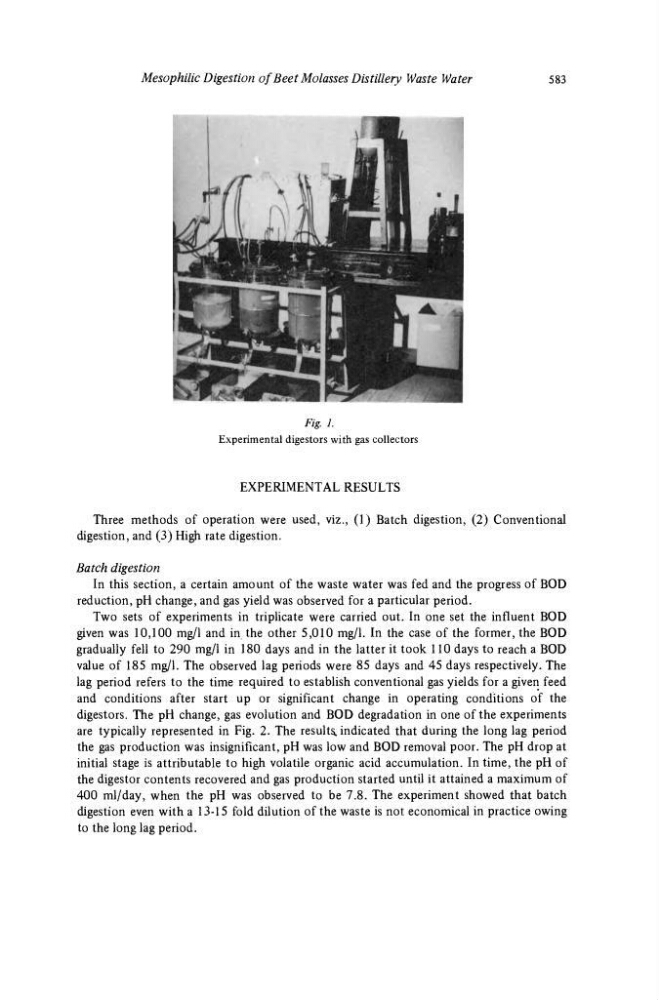
Fig. L
Experimental digestors with gas collectors
EXPERIMENTAL RESULTS
Three methods of operation were used, viz., (1) Batch digestion, (2) Conventional
digestion, and (3) High rate digestion.
Batch digestion
In this section, a certain amount of the waste water was fed and the progress of BOD
reduction, pH change, and gas yield was observed for a particular period.
Two sets of experiments in triplicate were carried out. In one set the influent BOD
given was 10,100 mg/1 and in the other 5,010 mg/1. In the case of the former, the BOD
gradually fell to 290 mg/1 in 180 days and in the latter it took 110 days to reach a BOD
value of 185 mg/1. The observed lag periods were 85 days and 45 days respectively. The
lag period refers to the time required to establish conventional gas yields for a given feed
and conditions after start up or significant change in operating conditions of the
digestors. The pH change, gas evolution and BOD degradation in one of the experiments
are typically represented in Fig. 2. The results, indicated that during the long lag period
the gas production was insignificant, pH was low and BOD removal poor. The pH drop at
initial stage is attributable to high volatile organic acid accumulation. In time, the pH of
the digestor contents recovered and gas production started until it attained a maximum of
400 ml/day, when the pH was observed to be 7.8. The experiment showed that batch
digestion even with a 13-15 fold dilution of the waste is not economical in practice owing
to the long lag period.
583
Fig. L
Experimental digestors with gas collectors
EXPERIMENTAL RESULTS
Three methods of operation were used, viz., (1) Batch digestion, (2) Conventional
digestion, and (3) High rate digestion.
Batch digestion
In this section, a certain amount of the waste water was fed and the progress of BOD
reduction, pH change, and gas yield was observed for a particular period.
Two sets of experiments in triplicate were carried out. In one set the influent BOD
given was 10,100 mg/1 and in the other 5,010 mg/1. In the case of the former, the BOD
gradually fell to 290 mg/1 in 180 days and in the latter it took 110 days to reach a BOD
value of 185 mg/1. The observed lag periods were 85 days and 45 days respectively. The
lag period refers to the time required to establish conventional gas yields for a given feed
and conditions after start up or significant change in operating conditions of the
digestors. The pH change, gas evolution and BOD degradation in one of the experiments
are typically represented in Fig. 2. The results, indicated that during the long lag period
the gas production was insignificant, pH was low and BOD removal poor. The pH drop at
initial stage is attributable to high volatile organic acid accumulation. In time, the pH of
the digestor contents recovered and gas production started until it attained a maximum of
400 ml/day, when the pH was observed to be 7.8. The experiment showed that batch
digestion even with a 13-15 fold dilution of the waste is not economical in practice owing
to the long lag period.