

582
A.K. Basu and Edmond Leclerc
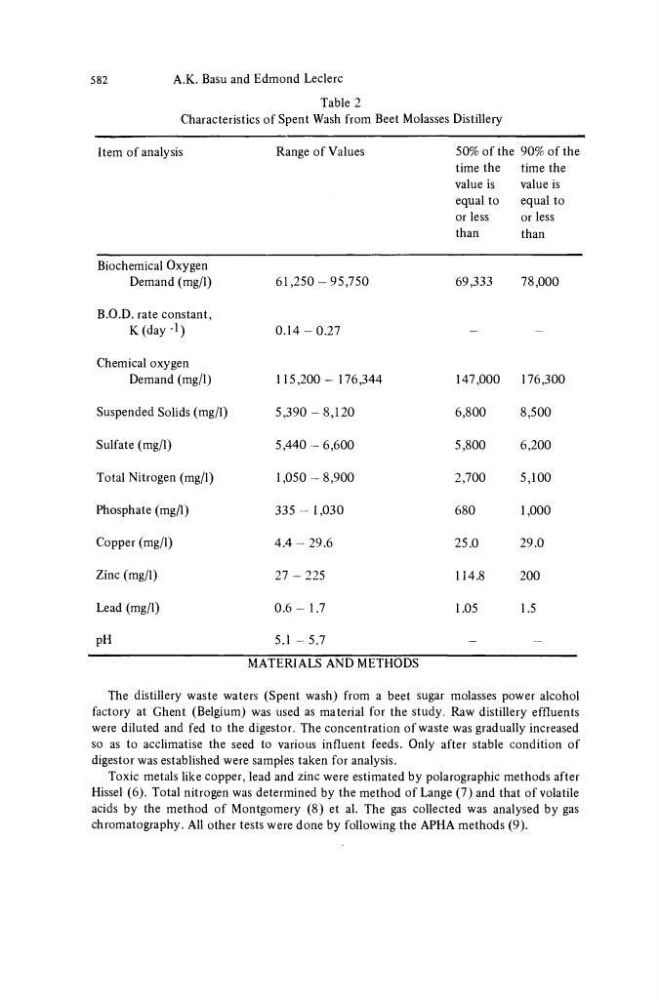
Table 2
Characteristics of Spent Wash from Beet Molasses Distillery
Item of analysis
Biochemical Oxygen
Demand (mg/1)
B.O.D. rate constant,
K(day-l)
Chemical oxygen
Demand (mg/1)
Suspended Solids (mg/1)
Sulfate (mg/1)
Total Nitrogen (mg/1)
Phosphate (mg/1)
Copper (mg/1)
Zinc (mg/1)
Lead (mg/1)
pH
Range of Values
61,250-95,750
0.14-0.27
115,200- 176,344
5,390-8,120
5,440 - 6,600
1,050-8,900
3 3 5 - 1,030
4.4 - 29.6
27 - 225
0 . 6 - 1.7
5.1 - 5 . 7
50% of the 90% of the
time the
value is
equal to
or less
than
69,333
-
147,000
6,800
5,800
2,700
680
25.0
114.8
1.05
-
time the
value is
equal to
or less
than
78,000
-
176,300
8,500
6,200
5,100
1,000
29.0
200
1.5
-
MATERIALS AND METHODS
The distillery waste waters (Spent wash) from a beet sugar molasses power alcohol
factory at Ghent (Belgium) was used as material for the study. Raw distillery effluents
were diluted and fed to the digestor. The concentration of waste was gradually increased
so as to acclimatise the seed to various influent feeds. Only after stable condition of
digestor was established were samples taken for analysis.
Toxic metals like copper, lead and zinc were estimated by polarographic methods after
Hissel (6). Total nitrogen was determined by the method of Lange (7) and that of volatile
acids by the method of Montgomery (8) et al. The gas collected was analysed by gas
chromatography. All other tests were done by following the APHA methods (9).
A.K. Basu and Edmond Leclerc
Table 2
Characteristics of Spent Wash from Beet Molasses Distillery
Item of analysis
Biochemical Oxygen
Demand (mg/1)
B.O.D. rate constant,
K(day-l)
Chemical oxygen
Demand (mg/1)
Suspended Solids (mg/1)
Sulfate (mg/1)
Total Nitrogen (mg/1)
Phosphate (mg/1)
Copper (mg/1)
Zinc (mg/1)
Lead (mg/1)
pH
Range of Values
61,250-95,750
0.14-0.27
115,200- 176,344
5,390-8,120
5,440 - 6,600
1,050-8,900
3 3 5 - 1,030
4.4 - 29.6
27 - 225
0 . 6 - 1.7
5.1 - 5 . 7
50% of the 90% of the
time the
value is
equal to
or less
than
69,333
-
147,000
6,800
5,800
2,700
680
25.0
114.8
1.05
-
time the
value is
equal to
or less
than
78,000
-
176,300
8,500
6,200
5,100
1,000
29.0
200
1.5
-
MATERIALS AND METHODS
The distillery waste waters (Spent wash) from a beet sugar molasses power alcohol
factory at Ghent (Belgium) was used as material for the study. Raw distillery effluents
were diluted and fed to the digestor. The concentration of waste was gradually increased
so as to acclimatise the seed to various influent feeds. Only after stable condition of
digestor was established were samples taken for analysis.
Toxic metals like copper, lead and zinc were estimated by polarographic methods after
Hissel (6). Total nitrogen was determined by the method of Lange (7) and that of volatile
acids by the method of Montgomery (8) et al. The gas collected was analysed by gas
chromatography. All other tests were done by following the APHA methods (9).