

MESOPHILIC DIGESTION
OF BEET MOLASSES DISTILLERY
WASTE WATER
A.K. BASU* and E. LECLERC .
»Scientist in Charge, CPHERI Zonal Laboratory, 23 R.N. Mukherjee Road,
Calcutta 1, India
Treatment of beet molasses spent wash is a challenging task because of its high organic
content and the presence of toxic materials in the spent wash.
NATURE AND COMPOSITION OF WASTE
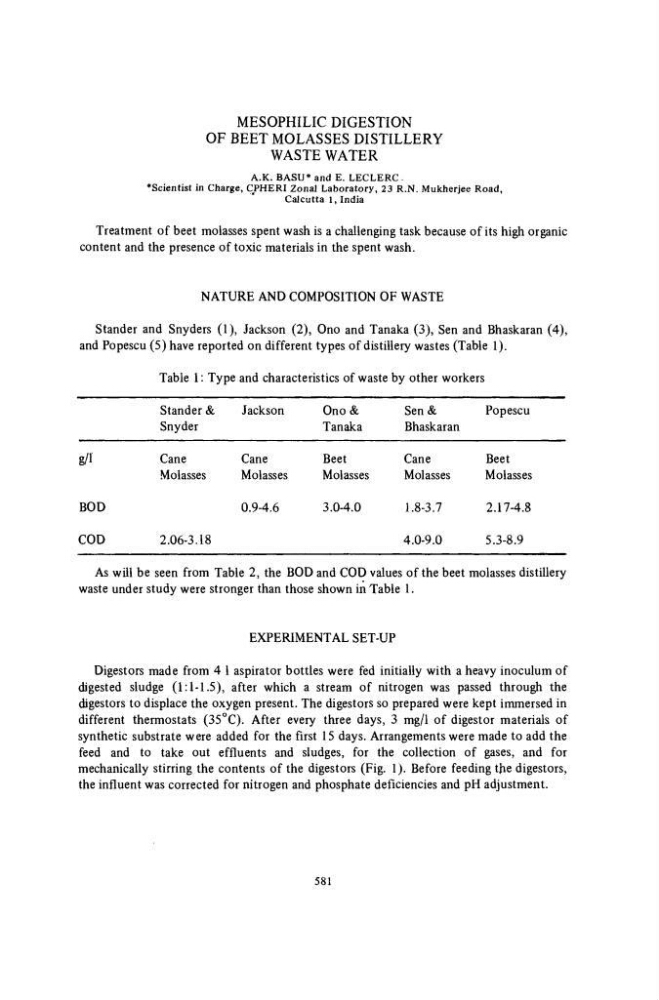
Stander and Snyders (1), Jackson (2), Ono and Tanaka (3), Sen and Bhaskaran (4),
and Popescu (5) have reported on different types of distillery wastes (Table 1).
Table 1: Type and characteristics of waste by other workers
Stander &
Jackson
Ono &
Sen &
Popescu
Snyder
Tanaka
Bhaskaran
g/1
Cane
Cane
Beet
Cane
Beet
Molasses
Molasses
Molasses
Molasses
Molasses
B O D
0.9-4.6
3.0-4.0
1.8-3.7
2.17-4.8
C O D
2.06-3.18
4.0-9.0
5.3-8.9
As will be seen from Table 2, the BOD and COD values of the beet molasses distillery
waste under study were stronger than those shown in Table 1.
EXPERIMENTAL SET-UP
Digestors made from 4 1 aspirator bottles were fed initially with a heavy inoculum of
digested sludge (1:1-1.5), after which a stream of nitrogen was passed through the
digestors to displace the oxygen present. The digestors so prepared were kept immersed in
different thermostats (35°C). After every three days, 3 mg/1 of digestor materials of
synthetic substrate were added for the first 15 days. Arrangements were made to add the
feed and to take out effluents and sludges, for the collection of gases, and for
mechanically stirring the contents of the digestors (Fig. 1). Before feeding the digestors,
the influent was corrected for nitrogen and phosphate deficiencies and pH adjustment.
581
OF BEET MOLASSES DISTILLERY
WASTE WATER
A.K. BASU* and E. LECLERC .
»Scientist in Charge, CPHERI Zonal Laboratory, 23 R.N. Mukherjee Road,
Calcutta 1, India
Treatment of beet molasses spent wash is a challenging task because of its high organic
content and the presence of toxic materials in the spent wash.
NATURE AND COMPOSITION OF WASTE
Stander and Snyders (1), Jackson (2), Ono and Tanaka (3), Sen and Bhaskaran (4),
and Popescu (5) have reported on different types of distillery wastes (Table 1).
Table 1: Type and characteristics of waste by other workers
Stander &
Jackson
Ono &
Sen &
Popescu
Snyder
Tanaka
Bhaskaran
g/1
Cane
Cane
Beet
Cane
Beet
Molasses
Molasses
Molasses
Molasses
Molasses
B O D
0.9-4.6
3.0-4.0
1.8-3.7
2.17-4.8
C O D
2.06-3.18
4.0-9.0
5.3-8.9
As will be seen from Table 2, the BOD and COD values of the beet molasses distillery
waste under study were stronger than those shown in Table 1.
EXPERIMENTAL SET-UP
Digestors made from 4 1 aspirator bottles were fed initially with a heavy inoculum of
digested sludge (1:1-1.5), after which a stream of nitrogen was passed through the
digestors to displace the oxygen present. The digestors so prepared were kept immersed in
different thermostats (35°C). After every three days, 3 mg/1 of digestor materials of
synthetic substrate were added for the first 15 days. Arrangements were made to add the
feed and to take out effluents and sludges, for the collection of gases, and for
mechanically stirring the contents of the digestors (Fig. 1). Before feeding the digestors,
the influent was corrected for nitrogen and phosphate deficiencies and pH adjustment.
581