

584
A.K. Basu and Edmond Leclerc
Days
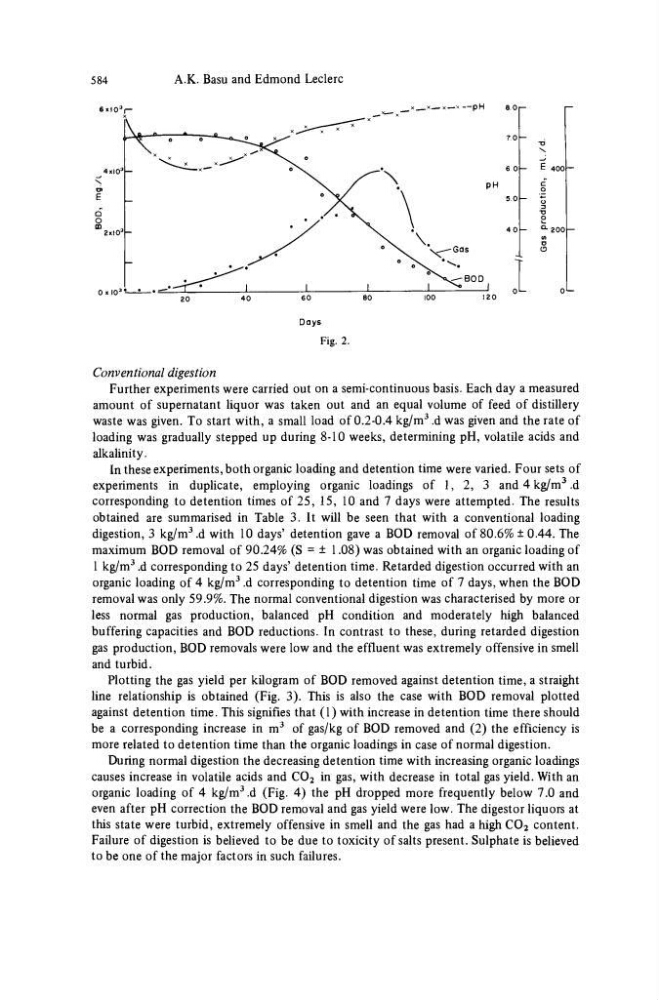
Fig. 2.
Conventional digestion
Further experiments were carried out on a semi-continuous basis. Each day a measured
amount of supernatant liquor was taken out and an equal volume of feed of distillery
waste was given. To start with, a small load of 0.2-0.4 kg/m
3 .d was given and the rate of
loading was gradually stepped up during 8-10 weeks, determining pH, volatile acids and
alkalinity.
In these experiments, both organic loading and detention time were varied. Four sets of
experiments in duplicate, employing organic loadings of 1, 2, 3 and 4kg/m
3 .d
corresponding to detention times of 25, 15, 10 and 7 days were attempted. The results
obtained are summarised in Table 3. It will be seen that with a conventional loading
digestion, 3 kg/m
3 .d with 10 days' detention gave a BOD removal of 80.6% ± 0.44. The
maximum BOD removal of 90.24% (S = ± 1.08) was obtained with an organic loading of
1 kg/m
3 .d corresponding to 25 days' detention time. Retarded digestion occurred with an
organic loading of 4 kg/m
3 .d corresponding to detention time of 7 days, when the BOD
removal was only 59.9%. The normal conventional digestion was characterised by more or
less normal gas production, balanced pH condition and moderately high balanced
buffering capacities and BOD reductions. In contrast to these, during retarded digestion
gas production, BOD removals were low and the effluent was extremely offensive in smell
and turbid.
Plotting the gas yield per kilogram of BOD removed against detention time, a straight
line relationship is obtained (Fig. 3). This is also the case with BOD removal plotted
against detention time. This signifies that (1) with increase in detention time there should
be a corresponding increase in m
3 of gas/kg of BOD removed and (2) the efficiency is
more related to detention time than the organic loadings in case of normal digestion.
During normal digestion the decreasing detention time with increasing organic loadings
causes increase in volatile acids and C0 2 in gas, with decrease in total gas yield. With an
organic loading of 4 kg/m
3 .d (Fig. 4) the pH dropped more frequently below 7.0 and
even after pH correction the BOD removal and gas yield were low. The digestor liquors at
this state were turbid, extremely offensive in smell and the gas had a high C0 2 content.
Failure of digestion is believed to be due to toxicity of salts present. Sulphate is believed
to be one of the major factors in such failures.
L E
A.K. Basu and Edmond Leclerc
Days
Fig. 2.
Conventional digestion
Further experiments were carried out on a semi-continuous basis. Each day a measured
amount of supernatant liquor was taken out and an equal volume of feed of distillery
waste was given. To start with, a small load of 0.2-0.4 kg/m
3 .d was given and the rate of
loading was gradually stepped up during 8-10 weeks, determining pH, volatile acids and
alkalinity.
In these experiments, both organic loading and detention time were varied. Four sets of
experiments in duplicate, employing organic loadings of 1, 2, 3 and 4kg/m
3 .d
corresponding to detention times of 25, 15, 10 and 7 days were attempted. The results
obtained are summarised in Table 3. It will be seen that with a conventional loading
digestion, 3 kg/m
3 .d with 10 days' detention gave a BOD removal of 80.6% ± 0.44. The
maximum BOD removal of 90.24% (S = ± 1.08) was obtained with an organic loading of
1 kg/m
3 .d corresponding to 25 days' detention time. Retarded digestion occurred with an
organic loading of 4 kg/m
3 .d corresponding to detention time of 7 days, when the BOD
removal was only 59.9%. The normal conventional digestion was characterised by more or
less normal gas production, balanced pH condition and moderately high balanced
buffering capacities and BOD reductions. In contrast to these, during retarded digestion
gas production, BOD removals were low and the effluent was extremely offensive in smell
and turbid.
Plotting the gas yield per kilogram of BOD removed against detention time, a straight
line relationship is obtained (Fig. 3). This is also the case with BOD removal plotted
against detention time. This signifies that (1) with increase in detention time there should
be a corresponding increase in m
3 of gas/kg of BOD removed and (2) the efficiency is
more related to detention time than the organic loadings in case of normal digestion.
During normal digestion the decreasing detention time with increasing organic loadings
causes increase in volatile acids and C0 2 in gas, with decrease in total gas yield. With an
organic loading of 4 kg/m
3 .d (Fig. 4) the pH dropped more frequently below 7.0 and
even after pH correction the BOD removal and gas yield were low. The digestor liquors at
this state were turbid, extremely offensive in smell and the gas had a high C0 2 content.
Failure of digestion is believed to be due to toxicity of salts present. Sulphate is believed
to be one of the major factors in such failures.
L E