

Photosynthetic Yields and Byproduct Recovery
529
produced in California were used to replace 75% of fishmeal on a weight basis in a
commercial diet at the 9% dietary level and fed to Cornish x White Rock chickens
(Rachapaetyakorn and McGarry, 1971). No significant reduction in weight gains,
conversion ratios or feathering scores were observed. The locally produced algae were not
as successful, having been produced under suboptimal conditions and containing large
quantities of aluminium. Tests did reveal that the chickens could withstand dietary
aluminium at levels up to 0.15%. Aluminium recovery and reuse, as reported above,
reduced levels of Al in the algae to an average of 1.25%. Chickens might well tolerate such
levels when fed 12% algae diets.
Costs
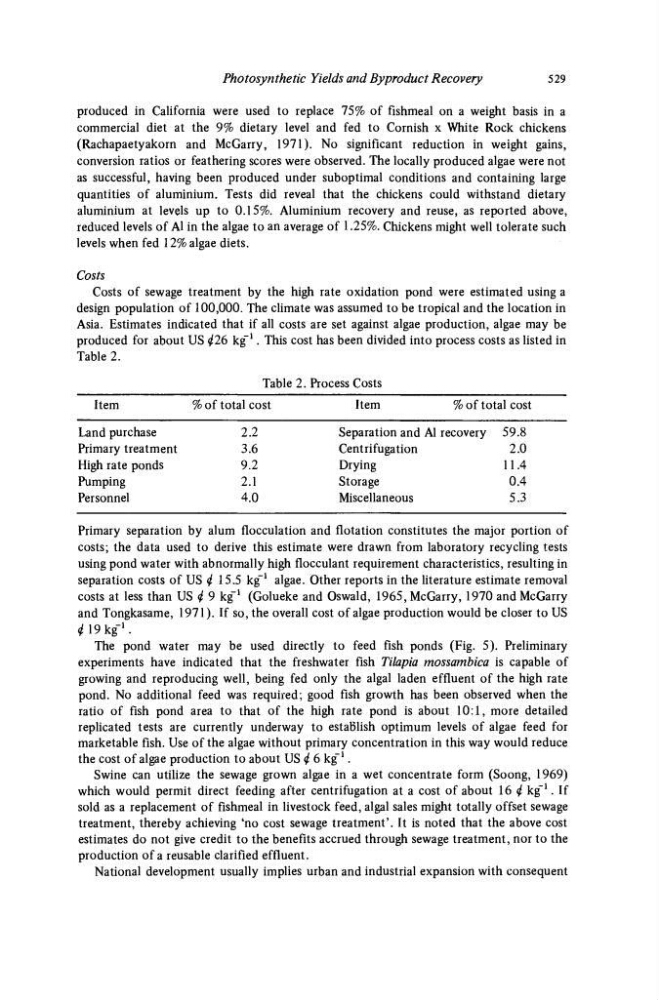
Costs of sewage treatment by the high rate oxidation pond were estimated using a
design population of 100,000. The climate was assumed to be tropical and the location in
Asia. Estimates indicated that if all costs are set against algae production, algae may be
produced for about US φ2β kg"
1 . This cost has been divided into process costs as listed in
Table 2.
Table 2. Process Costs
Item
% of total cost
Item
% of total cost
Land purchase
Primary treatment
High rate ponds
Pumping
Personnel
2.2
3.6
9.2
2.1
4.0
Separation and Al recovery 59.8
Centrifugation
2.0
Drying
11.4
Storage
0.4
Miscellaneous
5.3
Primary separation by alum flocculation and flotation constitutes the major portion of
costs; the data used to derive this estimate were drawn from laboratory recycling tests
using pond water with abnormally high flocculant requirement characteristics, resulting in
separation costs of US 4 15.5 kg
-1 algae. Other reports in the literature estimate removal
costs at less than US 4 9 kg"
1 (Golueke and Oswald, 1965, McGarry, 1970 and McGarry
and Tongkasame, 1971). If so, the overall cost of algae production would be closer to US
4 19 kg
1 .
The pond water may be used directly to feed fish ponds (Fig. 5). Preliminary
experiments have indicated that the freshwater fish Tilapia mossambica is capable of
growing and reproducing well, being fed only the algal laden effluent of the high rate
pond. No additional feed was required; good fish growth has been observed when the
ratio of fish pond area to that of the high rate pond is about 10:1, more detailed
replicated tests are currently underway to establish optimum levels of algae feed for
marketable fish. Use of the algae without primary concentration in this way would reduce
the cost of algae production to about US 4 6 kg
-1 .
Swine can utilize the sewage grown algae in a wet concentrate form (Soong, 1969)
which would permit direct feeding after centrifugation at a cost of about 16 φ kg"
1 . If
sold as a replacement of fishmeal in livestock feed, algal sales might totally offset sewage
treatment, thereby achieving 'no cost sewage treatment'. It is noted that the above cost
estimates do not give credit to the benefits accrued through sewage treatment, nor to the
production of a reusable clarified effluent.
National development usually implies urban and industrial expansion with consequent
529
produced in California were used to replace 75% of fishmeal on a weight basis in a
commercial diet at the 9% dietary level and fed to Cornish x White Rock chickens
(Rachapaetyakorn and McGarry, 1971). No significant reduction in weight gains,
conversion ratios or feathering scores were observed. The locally produced algae were not
as successful, having been produced under suboptimal conditions and containing large
quantities of aluminium. Tests did reveal that the chickens could withstand dietary
aluminium at levels up to 0.15%. Aluminium recovery and reuse, as reported above,
reduced levels of Al in the algae to an average of 1.25%. Chickens might well tolerate such
levels when fed 12% algae diets.
Costs
Costs of sewage treatment by the high rate oxidation pond were estimated using a
design population of 100,000. The climate was assumed to be tropical and the location in
Asia. Estimates indicated that if all costs are set against algae production, algae may be
produced for about US φ2β kg"
1 . This cost has been divided into process costs as listed in
Table 2.
Table 2. Process Costs
Item
% of total cost
Item
% of total cost
Land purchase
Primary treatment
High rate ponds
Pumping
Personnel
2.2
3.6
9.2
2.1
4.0
Separation and Al recovery 59.8
Centrifugation
2.0
Drying
11.4
Storage
0.4
Miscellaneous
5.3
Primary separation by alum flocculation and flotation constitutes the major portion of
costs; the data used to derive this estimate were drawn from laboratory recycling tests
using pond water with abnormally high flocculant requirement characteristics, resulting in
separation costs of US 4 15.5 kg
-1 algae. Other reports in the literature estimate removal
costs at less than US 4 9 kg"
1 (Golueke and Oswald, 1965, McGarry, 1970 and McGarry
and Tongkasame, 1971). If so, the overall cost of algae production would be closer to US
4 19 kg
1 .
The pond water may be used directly to feed fish ponds (Fig. 5). Preliminary
experiments have indicated that the freshwater fish Tilapia mossambica is capable of
growing and reproducing well, being fed only the algal laden effluent of the high rate
pond. No additional feed was required; good fish growth has been observed when the
ratio of fish pond area to that of the high rate pond is about 10:1, more detailed
replicated tests are currently underway to establish optimum levels of algae feed for
marketable fish. Use of the algae without primary concentration in this way would reduce
the cost of algae production to about US 4 6 kg
-1 .
Swine can utilize the sewage grown algae in a wet concentrate form (Soong, 1969)
which would permit direct feeding after centrifugation at a cost of about 16 φ kg"
1 . If
sold as a replacement of fishmeal in livestock feed, algal sales might totally offset sewage
treatment, thereby achieving 'no cost sewage treatment'. It is noted that the above cost
estimates do not give credit to the benefits accrued through sewage treatment, nor to the
production of a reusable clarified effluent.
National development usually implies urban and industrial expansion with consequent