

528
M.G. McGarry, CD. Lin and J.L. Merto
100
8 0
- 6 0
>Ϊ
a 40
2 0 h AI recovered
I
I
I
I
I
AI loss to algae
+ •
"AI loss to clarified·
effluent
' losst tc
Λ loss to clarified
x|ffluent
*>-*sgjS\
recovered AI
A v g 7 5 %
3
4
ACIDIFICATION pH
100
80
60
- ] 4 0
H 2 0
I 2 3 4 5 6 7 8 9
10
CYCLE
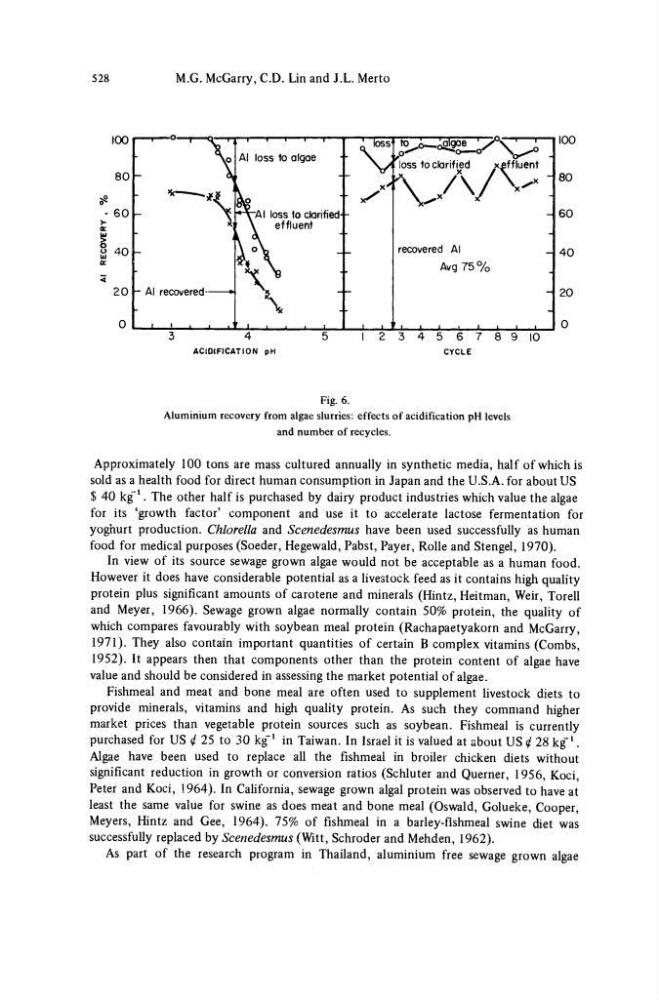
Fig. 6.
Aluminium recovery from algae slurries: effects of acidification pH levels
and number of recycles.
Approximately 100 tons are mass cultured annually in synthetic media, half of which is
sold as a health food for direct human consumption in Japan and the U.S.A. for about US
$ 40 kg"
1 . The other half is purchased by dairy product industries which value the algae
for its 'growth factor' component and use it to accelerate lactose fermentation for
yoghurt production. Chlorella and Scenedesmus have been used successfully as human
food for medical purposes (Soeder, Hegewald, Pabst, Payer, Rolle and Stengel, 1970).
In view of its source sewage grown algae would not be acceptable as a human food.
However it does have considerable potential as a livestock feed as it contains high quality
protein plus significant amounts of carotene and minerals (Hintz, Heitman, Weir, Torell
and Meyer, 1966). Sewage grown algae normally contain 50% protein, the quality of
which compares favourably with soybean meal protein (Rachapaetyakorn and McGarry,
1971). They also contain important quantities of certain B complex vitamins (Combs,
1952). It appears then that components other than the protein content of algae have
value and should be considered in assessing the market potential of algae.
Fishmeal and meat and bone meal are often used to supplement livestock diets to
provide minerals, vitamins and high quality protein. As such they command higher
market prices than vegetable protein sources such as soybean. Fishmeal is currently
purchased for US φ 25 to 30 kg"
1 in Taiwan. In Israel it is valued at about US 4 28 kg"
1 .
Algae have been used to replace all the fishmeal in broiler chicken diets without
significant reduction in growth or conversion ratios (Schlόter and Querner, 1956, Koci,
Peter and Koci, 1964). In California, sewage grown algal protein was observed to have at
least the same value for swine as does meat and bone meal (Oswald, Golueke, Cooper,
Meyers, Hintz and Gee, 1964). 75% of fishmeal in a barley-fishmeal swine diet was
successfully replaced by Scenedesmus (Witt, Schroder and Mehden, 1962).
As part of the research program in Thailand, aluminium free sewage grown algae
M.G. McGarry, CD. Lin and J.L. Merto
100
8 0
- 6 0
>Ϊ
a 40
2 0 h AI recovered
I
I
I
I
I
AI loss to algae
+ •
"AI loss to clarified·
effluent
' losst tc
Λ loss to clarified
x|ffluent
*>-*sgjS\
recovered AI
A v g 7 5 %
3
4
ACIDIFICATION pH
100
80
60
- ] 4 0
H 2 0
I 2 3 4 5 6 7 8 9
10
CYCLE
Fig. 6.
Aluminium recovery from algae slurries: effects of acidification pH levels
and number of recycles.
Approximately 100 tons are mass cultured annually in synthetic media, half of which is
sold as a health food for direct human consumption in Japan and the U.S.A. for about US
$ 40 kg"
1 . The other half is purchased by dairy product industries which value the algae
for its 'growth factor' component and use it to accelerate lactose fermentation for
yoghurt production. Chlorella and Scenedesmus have been used successfully as human
food for medical purposes (Soeder, Hegewald, Pabst, Payer, Rolle and Stengel, 1970).
In view of its source sewage grown algae would not be acceptable as a human food.
However it does have considerable potential as a livestock feed as it contains high quality
protein plus significant amounts of carotene and minerals (Hintz, Heitman, Weir, Torell
and Meyer, 1966). Sewage grown algae normally contain 50% protein, the quality of
which compares favourably with soybean meal protein (Rachapaetyakorn and McGarry,
1971). They also contain important quantities of certain B complex vitamins (Combs,
1952). It appears then that components other than the protein content of algae have
value and should be considered in assessing the market potential of algae.
Fishmeal and meat and bone meal are often used to supplement livestock diets to
provide minerals, vitamins and high quality protein. As such they command higher
market prices than vegetable protein sources such as soybean. Fishmeal is currently
purchased for US φ 25 to 30 kg"
1 in Taiwan. In Israel it is valued at about US 4 28 kg"
1 .
Algae have been used to replace all the fishmeal in broiler chicken diets without
significant reduction in growth or conversion ratios (Schlόter and Querner, 1956, Koci,
Peter and Koci, 1964). In California, sewage grown algal protein was observed to have at
least the same value for swine as does meat and bone meal (Oswald, Golueke, Cooper,
Meyers, Hintz and Gee, 1964). 75% of fishmeal in a barley-fishmeal swine diet was
successfully replaced by Scenedesmus (Witt, Schroder and Mehden, 1962).
As part of the research program in Thailand, aluminium free sewage grown algae