

Nitrogen Removal through Ammonia Release from Holding Ponds
505
k $ being the absorption coefficient of the gas.
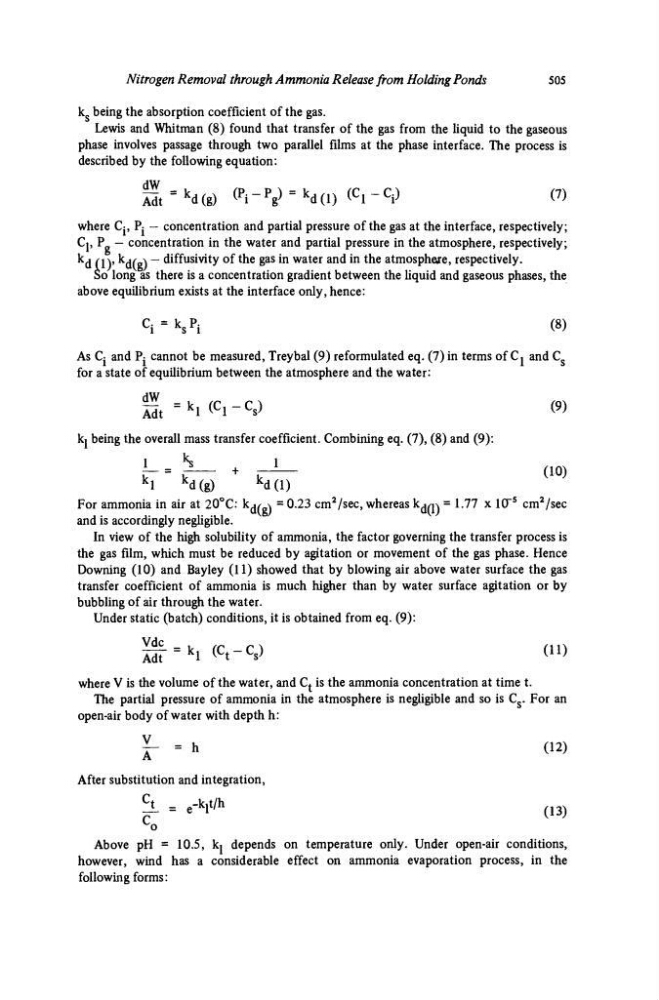
Lewis and Whitman (8) found that transfer of the gas from the liquid to the gaseous
phase involves passage through two parallel films at the phase interface. The process is
described by the following equation:
ft
= k
d(g) (
p
ip
g)
= k
d(D (
c
ic
i>
CD
where C^, P^ - concentration and partial pressure of the gas at the interface, respectively;
Cj, P - concentration in the water and partial pressure in the atmosphere, respectively;
k d (1)'
k d(e) ~~ diffusivity of the gas in water and in the atmosphere, respectively.
So long as there is a concentration gradient between the liquid and gaseous phases, the
above equilibrium exists at the interface only, hence:
C - k s P j
(8)
As C and P^ cannot be measured, Treybal (9) reformulated eq. (7) in terms of Cj and C s
for a state of equilibrium between the atmosphere and the water:
f t
=
M
c
ic
s>
W
kj being the overall mass transfer coefficient. Combining eq. (7), (8) and (9):
k l
k d(g)
k d ( l )
For ammonia in air at 20°C: Wί)
= 0-23 cm
2 /sec, whereas k ^ =1.77 x 1CT
5 cm
2 /sec
and is accordingly negligible.
In view of the high solubility of ammonia, the factor governing the transfer process is
the gas film, which must be reduced by agitation or movement of the gas phase. Hence
Downing (10) and Bayley (11) showed that by blowing air above water surface the gas
transfer coefficient of ammonia is much higher than by water surface agitation or by
bubbling of air through the water.
Under static (batch) conditions, it is obtained from eq. (9):
x l
= k
i (c t -c s )
ΦD
where V is the volume of the water, and C t is the ammonia concentration at time t.
The partial pressure of ammonia in the atmosphere is negligible and so is C s . For an
open-air body of water with depth h:
T -
h
(12)
After substitution and integration,
ek l
t / h
(13)
Si = e-¥
h
C o
Above pH = 10.5, ki depends on temperature only. Under open-air conditions,
however, wind has a considerable effect on ammonia evaporation process, in the
following forms:
505
k $ being the absorption coefficient of the gas.
Lewis and Whitman (8) found that transfer of the gas from the liquid to the gaseous
phase involves passage through two parallel films at the phase interface. The process is
described by the following equation:
ft
= k
d(g) (
p
ip
g)
= k
d(D (
c
ic
i>
CD
where C^, P^ - concentration and partial pressure of the gas at the interface, respectively;
Cj, P - concentration in the water and partial pressure in the atmosphere, respectively;
k d (1)'
k d(e) ~~ diffusivity of the gas in water and in the atmosphere, respectively.
So long as there is a concentration gradient between the liquid and gaseous phases, the
above equilibrium exists at the interface only, hence:
C - k s P j
(8)
As C and P^ cannot be measured, Treybal (9) reformulated eq. (7) in terms of Cj and C s
for a state of equilibrium between the atmosphere and the water:
f t
=
M
c
ic
s>
W
kj being the overall mass transfer coefficient. Combining eq. (7), (8) and (9):
k l
k d(g)
k d ( l )
For ammonia in air at 20°C: Wί)
= 0-23 cm
2 /sec, whereas k ^ =1.77 x 1CT
5 cm
2 /sec
and is accordingly negligible.
In view of the high solubility of ammonia, the factor governing the transfer process is
the gas film, which must be reduced by agitation or movement of the gas phase. Hence
Downing (10) and Bayley (11) showed that by blowing air above water surface the gas
transfer coefficient of ammonia is much higher than by water surface agitation or by
bubbling of air through the water.
Under static (batch) conditions, it is obtained from eq. (9):
x l
= k
i (c t -c s )
ΦD
where V is the volume of the water, and C t is the ammonia concentration at time t.
The partial pressure of ammonia in the atmosphere is negligible and so is C s . For an
open-air body of water with depth h:
T -
h
(12)
After substitution and integration,
ek l
t / h
(13)
Si = e-¥
h
C o
Above pH = 10.5, ki depends on temperature only. Under open-air conditions,
however, wind has a considerable effect on ammonia evaporation process, in the
following forms: