

504
Y. Folkman and A.M. Wachs
from it, further bringing down the pH.
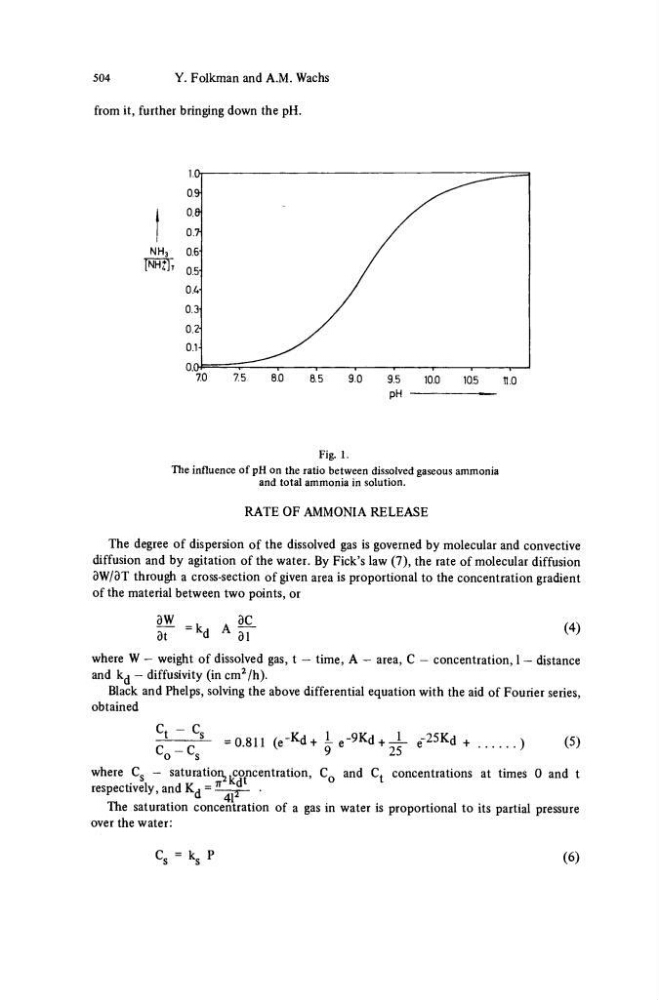
NH 3
Fig. 1.
The influence of pH on the ratio between dissolved gaseous ammonia
and total ammonia in solution.
RATE OF AMMONIA RELEASE
The degree of dispersion of the dissolved gas is governed by molecular and convective
diffusion and by agitation of the water. By Fick's law (7), the rate of molecular diffusion
3W/3T through a cross-section of given area is proportional to the concentration gradient
of the material between two points, or
3W
3C_
dt
K d
A 31
(4)
where W - weight of dissolved gas, t - time, A - area, C - concentration, 1 - distance
and k^ - diffusivity (in cm
2 /h).
Black and Phelps, solving the above differential equation with the aid of Fourier series,
obtained
c t ~ c s
C o "
C s
= 0.811 ( e
- K d + 5-e"
9 K d + ^
e"
25K d +
)
25
(5)
where C s - saturation .concentration, C Q and C t concentrations at times 0 and t
respectively, and L· = - — £ - .
The saturation concentration of a gas in water is proportional to its partial pressure
over the water:
C s =
k s
P
(6)
Y. Folkman and A.M. Wachs
from it, further bringing down the pH.
NH 3
Fig. 1.
The influence of pH on the ratio between dissolved gaseous ammonia
and total ammonia in solution.
RATE OF AMMONIA RELEASE
The degree of dispersion of the dissolved gas is governed by molecular and convective
diffusion and by agitation of the water. By Fick's law (7), the rate of molecular diffusion
3W/3T through a cross-section of given area is proportional to the concentration gradient
of the material between two points, or
3W
3C_
dt
K d
A 31
(4)
where W - weight of dissolved gas, t - time, A - area, C - concentration, 1 - distance
and k^ - diffusivity (in cm
2 /h).
Black and Phelps, solving the above differential equation with the aid of Fourier series,
obtained
c t ~ c s
C o "
C s
= 0.811 ( e
- K d + 5-e"
9 K d + ^
e"
25K d +
)
25
(5)
where C s - saturation .concentration, C Q and C t concentrations at times 0 and t
respectively, and L· = - — £ - .
The saturation concentration of a gas in water is proportional to its partial pressure
over the water:
C s =
k s
P
(6)