

506
Y. Folkman and A.M. Wachs
a. Removal of the gas accumulated in the atmosphere over the water.
b. Breakdown of the gas film at the interface.
c. Formation of waves, thereby increasing the surface area.
d. Agitation of the water body and acceleration of the upward migration of the gas
molecules.
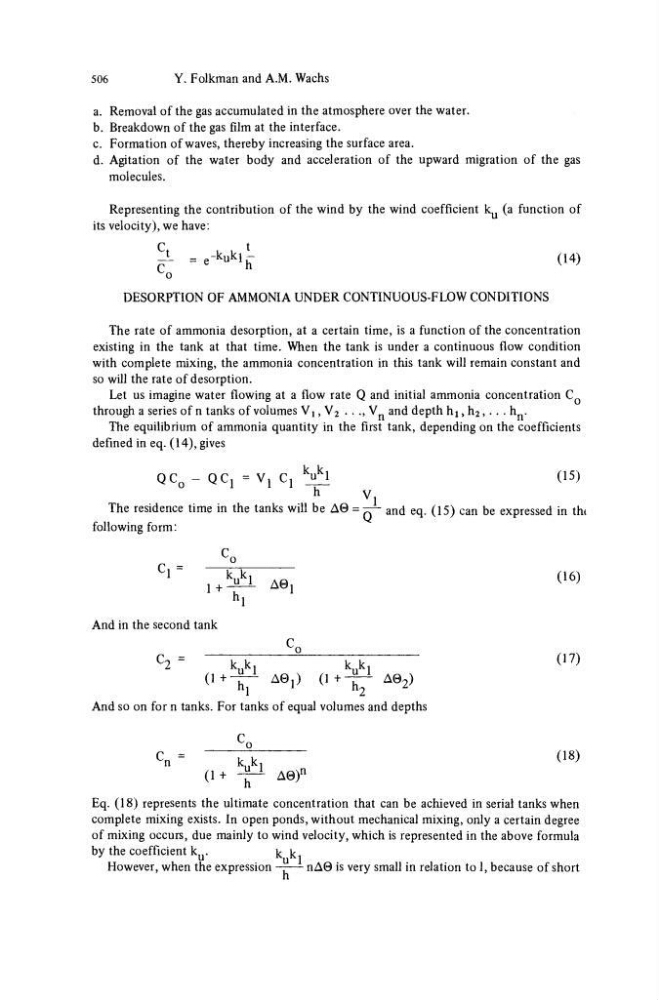
Representing the contribution of the wind by the wind coefficient l·^ (a function of
its velocity), we have:
^
= e -
k u M S ;
(14)
^o
DESORPTION OF AMMONIA UNDER CONTINUOUS-FLOW CONDITIONS
The rate of ammonia desorption, at a certain time, is a function of the concentration
existing in the tank at that time. When the tank is under a continuous flow condition
with complete mixing, the ammonia concentration in this tank will remain constant and
so will the rate of desorption.
Let us imagine water flowing at a flow rate Q and initial ammonia concentration C Q
through a series of n tanks of volumes V\, V2 . . ., V and depth h i , ri2, ·. · h .
The equilibrium of ammonia quantity in the first tank, depending on the coefficients
defined in eq. (14), gives
QC Q - QC } = V { C x
k
_}t±
(15)
The residence time in the tanks will be ΔΘ = — and eq. (15) can be expressed in th(
following form:
c
C
°
1
.
k u
k l
ΛΩ
(16)
1 + -y-L Δ Θ ι
h i
And in the second tank
C o
C 2
=
k u kj
k u k!
( 1 7 )
(H-Jj- Δ Θι ) ( 1 + - ^ ΔΘ 2 )
And so on for n tanks. For tanks of equal volumes and depths
C o
c
"
=
*Λ
(18)
(1+ - ^ - i ΔΘ)
η
Eq. (18) represents the ultimate concentration that can be achieved in serial tanks when
complete mixing exists. In open ponds, without mechanical mixing, only a certain degree
of mixing occurs, due mainly to wind velocity, which is represented in the above formula
by the coefficient k u .
^ u
However, when the expression —— ηΔΘ is very small in relation to 1, because of short
Y. Folkman and A.M. Wachs
a. Removal of the gas accumulated in the atmosphere over the water.
b. Breakdown of the gas film at the interface.
c. Formation of waves, thereby increasing the surface area.
d. Agitation of the water body and acceleration of the upward migration of the gas
molecules.
Representing the contribution of the wind by the wind coefficient l·^ (a function of
its velocity), we have:
^
= e -
k u M S ;
(14)
^o
DESORPTION OF AMMONIA UNDER CONTINUOUS-FLOW CONDITIONS
The rate of ammonia desorption, at a certain time, is a function of the concentration
existing in the tank at that time. When the tank is under a continuous flow condition
with complete mixing, the ammonia concentration in this tank will remain constant and
so will the rate of desorption.
Let us imagine water flowing at a flow rate Q and initial ammonia concentration C Q
through a series of n tanks of volumes V\, V2 . . ., V and depth h i , ri2, ·. · h .
The equilibrium of ammonia quantity in the first tank, depending on the coefficients
defined in eq. (14), gives
QC Q - QC } = V { C x
k
_}t±
(15)
The residence time in the tanks will be ΔΘ = — and eq. (15) can be expressed in th(
following form:
c
C
°
1
.
k u
k l
ΛΩ
(16)
1 + -y-L Δ Θ ι
h i
And in the second tank
C o
C 2
=
k u kj
k u k!
( 1 7 )
(H-Jj- Δ Θι ) ( 1 + - ^ ΔΘ 2 )
And so on for n tanks. For tanks of equal volumes and depths
C o
c
"
=
*Λ
(18)
(1+ - ^ - i ΔΘ)
η
Eq. (18) represents the ultimate concentration that can be achieved in serial tanks when
complete mixing exists. In open ponds, without mechanical mixing, only a certain degree
of mixing occurs, due mainly to wind velocity, which is represented in the above formula
by the coefficient k u .
^ u
However, when the expression —— ηΔΘ is very small in relation to 1, because of short