

492
W.W. Eckenfelder, Jr., CD. Magee and C.E. Adams, Jr.
When large land areas are available, it is possible to attain high removal efficiencies by
substituting detention time for nutrient addition. This practice has been common with
several pulp and paper mills in the United States.
TEMPERATURE EFFECTS
The performance of aerated lagoons is significantly influenced by changes in basin
temperature. The basin temperature in turn is influenced by the temperature of the
influent wastewater and the ambient air temperature. A thermal balance of aeration
basins resulted in the relationship reported by Eckenfelder (1)
t/D
7 . 4 8 (
T i -
T w )
f ( T w - T a )
(14)
The coefficient, f, incorporates numerous factors affecting the heat loss throughout the
lagoon. These factors include such variables as wind velocity, relative humidity, solar
radiation, surface area, mixing, etc. Data reported by a number of investigators are
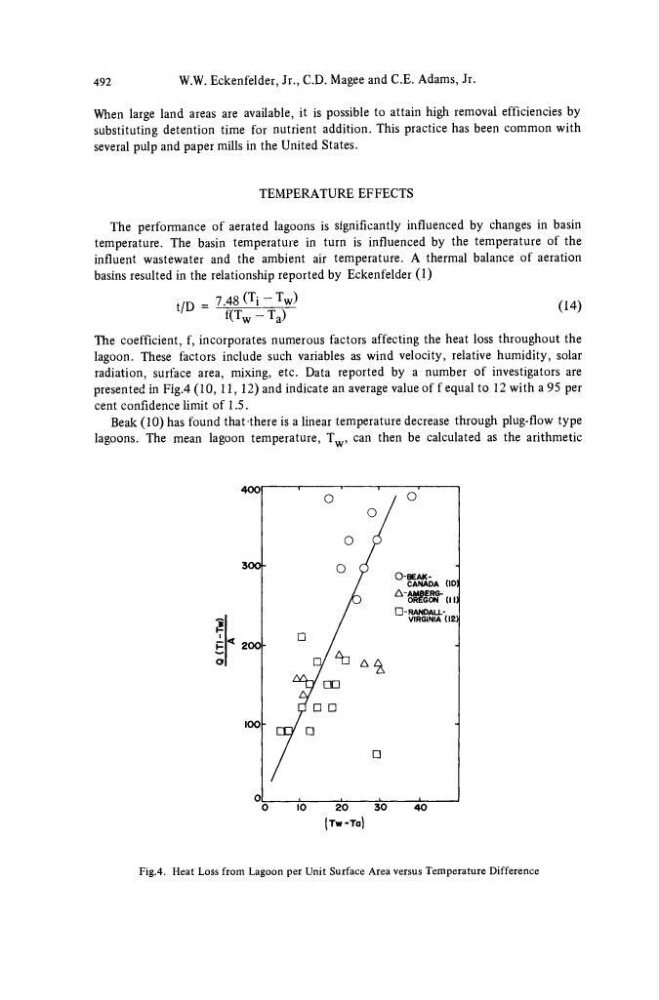
presented in Fig.4 (10, 11, 12) and indicate an average value of f equal to 12 with a 95 per
cent confidence limit of 1.5.
Beak (10) has found that there is a linear temperature decrease through plug-flow type
lagoons. The mean lagoon temperature, T w , can then be calculated as the arithmetic
4001
300l·
200
100
o
O-BEAK, .
CANADA (IOJ
Δ -βΒΗ-(.ΐί
D-RANDALL.
VIRGINIA (12)1
10
20
(Tw -To]
30
40
Fig.4. Heat Loss from Lagoon per Unit Surface Area versus Temperature Difference
W.W. Eckenfelder, Jr., CD. Magee and C.E. Adams, Jr.
When large land areas are available, it is possible to attain high removal efficiencies by
substituting detention time for nutrient addition. This practice has been common with
several pulp and paper mills in the United States.
TEMPERATURE EFFECTS
The performance of aerated lagoons is significantly influenced by changes in basin
temperature. The basin temperature in turn is influenced by the temperature of the
influent wastewater and the ambient air temperature. A thermal balance of aeration
basins resulted in the relationship reported by Eckenfelder (1)
t/D
7 . 4 8 (
T i -
T w )
f ( T w - T a )
(14)
The coefficient, f, incorporates numerous factors affecting the heat loss throughout the
lagoon. These factors include such variables as wind velocity, relative humidity, solar
radiation, surface area, mixing, etc. Data reported by a number of investigators are
presented in Fig.4 (10, 11, 12) and indicate an average value of f equal to 12 with a 95 per
cent confidence limit of 1.5.
Beak (10) has found that there is a linear temperature decrease through plug-flow type
lagoons. The mean lagoon temperature, T w , can then be calculated as the arithmetic
4001
300l·
200
100
o
O-BEAK, .
CANADA (IOJ
Δ -βΒΗ-(.ΐί
D-RANDALL.
VIRGINIA (12)1
10
20
(Tw -To]
30
40
Fig.4. Heat Loss from Lagoon per Unit Surface Area versus Temperature Difference